


Position of seats and headrests
The design of the car seats guarantees maximum comfort for the person sitting in them, while simultaneously providing conditions for the most effective performance of their functions by the seat belts and airbags. Soft padding of the cushions and backrests provides additional protection for the driver and passengers in emergency situations.
Attention: The use of any additional pillows or other objects placed on the seat cushion or backrest is not permitted!
The driver's seat must be adjusted to a position that provides the driver with maximum comfort when operating the pedals, gearshift lever/AT selector, steering wheel and instrument panel switches. In addition, adequate visibility through the windshield and side windows and reliable fastening of the driver's body with the seat belt must be ensured. The choice of seat position has a significant impact on the safety of the occupant. For example, if the front seat is moved too far forward, the risk of injury to the occupant when the airbag is deployed increases, as well as the risk of being thrown through the windshield in a frontal collision. Moving the driver's seat rearward affects the ease of use of the controls while driving.
Lock the front seat in the most remote position (convenient for driving) from the steering wheel/dashboard position. The authors of this Guide recommend choosing the position of the driver's seat so that the driver can hold the steering wheel by the rim slightly above the central spokes, while the arms at the elbows should be slightly bent.
Adjust the seat back to the most comfortable position. It should be remembered that increasing the tilt of the seat back will worsen the body fixation with the seat belt - the more the back is tilted back, the higher the probability of the body sliding under the lap section of the belt in a strong frontal impact, and the more severe the injuries may be. It is recommended to set the angle of the backrest at 25-30° from the vertical position.
(Original source is on the website: opelbook)
Important safety system elements are head restraints. They prevent injury to the cervical spine and head in the event of a rear impact. It is necessary to check the adjustment of the head restraints before each trip (see below).
Seat adjustments should be made before driving. After adjustments are complete, make sure that the backrest and the entire seat assembly are securely fixed.
Headrests
Warning: Headrests are an additional means of ensuring safety in the event of an accident, never remove them when driving! They are designed to work together with seat belts - do not forget to fasten the belts!
Adjustment
Attention: Adjustment of head restraints is mandatory! Only correctly installed head restraints provide adequate protection against possible damage to the cervical vertebrae in a rear impact!
The headrest should be adjusted in height so that its central part is at the same level as the eyes/upper edge of the ear of the occupant (see illustration 12.1), - if it is not possible to achieve this condition, the headrest should be set to the uppermost position (for tall people) or to the extreme bottom (for short people) position.
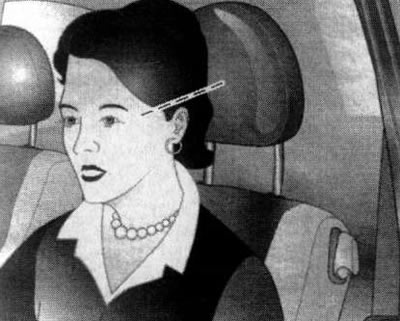
12.1 Position of a correctly adjusted head restraint
To adjust the height of the front seat head restraints, grasp the top of the head restraint with both hands and tilt it forward (see illustration 12.2). Keeping the headrest tilted, set it to the desired position and release. Do not attempt to adjust the headrest with one hand, especially while the vehicle is moving!
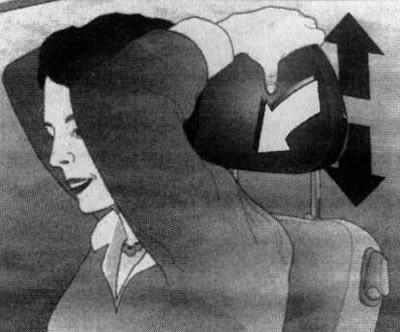
12.2. Adjusting the height of the front seat headrest
On the rear bench seat, to move the head restraint downwards, it is necessary to press the locks on the edge of the guide bushings of the corresponding head restraint (see illustration 12.3) and lower it. To move it up, simply pull out the headrest. The center seat of the rear seat on Combo models is equipped with a built-in (non-removable) headrest that can be set to 3 fixed positions: fully lowered, middle and fully raised.
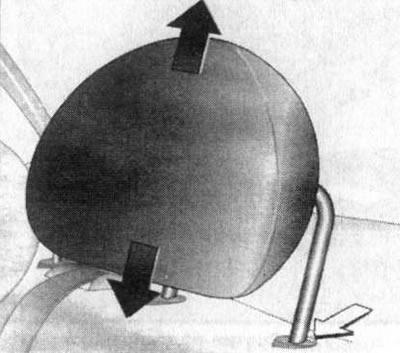
12.3. Adjusting the rear bench seat headrest (corsa C models)
Removal
To remove, hold the headrest locks in the pressed position, pull the headrest up and release it from the guide bushings (see illustration 12.4).
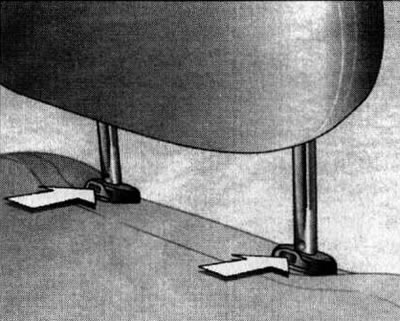
12.4. Removing the headrest
Note: The rear bench seat head restraint retainers are located on the rear side of the guide bushings (see illustration 12.3).
On Combo models the central (built-in) the rear bench seat head restraints cannot be removed. When not in use, the head restraints must be moved to the lowest position.
Installation
To install, insert the headrest rods into the guide bushings on the seat back and, pressing them with a little force, lower the headrest down.
Active head restraints
Caution: Correct adjustment significantly increases the effectiveness of the head restraints - be sure to adjust the active head restraints as described above! Never tie or hang anything on the head restraint rods!
Active head restraints (with appropriate equipment) reduce the likelihood and severity of neck injuries in a rear-end collision. The installation of active head restraints on seats is indicated by the inscription "ACTIVE" (see illustration 12.5) on the seat guide bushings. At the moment of impact, the active headrest moves forward under the influence of the inertial force of the passenger's body on the seat back and helps to reduce the dynamic backward tilt of the head, reducing the load on the cervical vertebrae. Then the headrest returns to its original position.
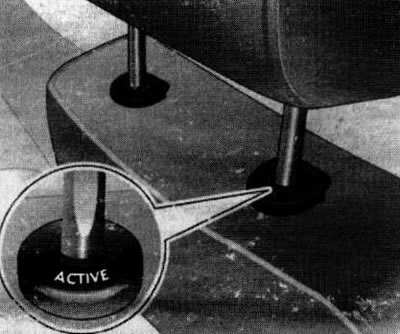
12.5. Designation of active head restraints
Active head restraints are particularly effective in low- and medium-speed collisions, where (as statistics show) accounts for the majority of cases of neck injuries to drivers and passengers.
Front seats
Attention: Adjustment of the seat position should only be carried out when the vehicle is stationary!
Adjustment
To move the front seat longitudinally, pull up on the release lever located under the outer front edge of the cushion, then slide the seat assembly to the desired position and release the lever (see illustration 12.6). Check the reliability of the seat fixation in the new position by trying to move it forward and backward - when the seat is fixed, a characteristic click is heard.
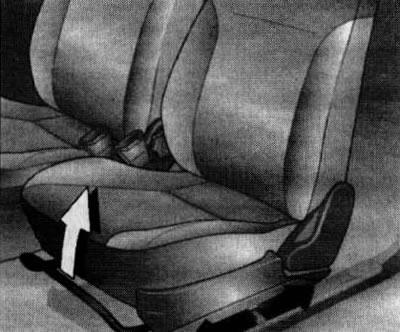
12.6. Adjusting the front seat assembly position in the longitudinal direction
The seat back angle is adjusted using a rotary handle located on the inner side surface of the back (see illustration 12.7).
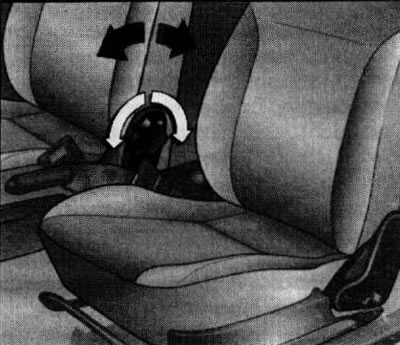
12.7. Adjusting the front seat backrest angle
Note: When making adjustments, remove your body weight from the seat back.
If equipped, the position of the front seat cushion can be adjusted - the locking handle is located under the seat cushion on the right (see illustration 12.8). To adjust, pull the lever up and, changing the load on the seat cushion with your body weight, set it to the most comfortable position. Release the lever and make sure the seat is securely fixed.
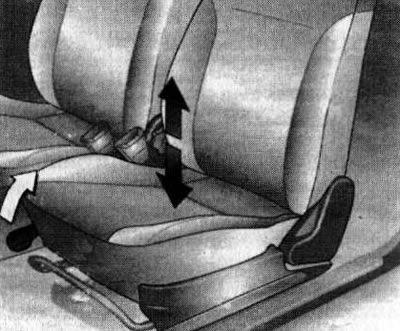
12.8. Adjusting the height of the front seat cushion
Folding
To allow passengers to board and disembark on models with the appropriate configuration, the backrests of the front seats can be tilted forward by pulling up the locking lever located on the outer side surface of the backrest (see illustration 12.9). When returning to its original position, the backrest is automatically locked - a characteristic click should be heard.
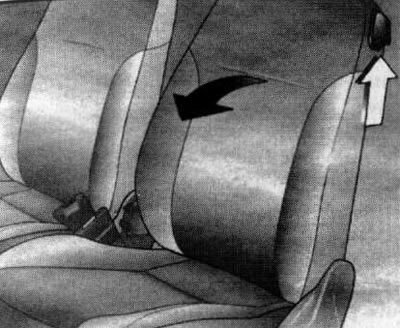
12.9. Folding the front seat back
In addition, if equipped accordingly, the back of the front passenger seat can be folded to the cushion, which requires first removing the headrest from the back. Then pull up the lever (see above) and fold the seat forward. Unfolding is done in the reverse order, it is imperative to check the reliability of the backrest fixation in the upper position.
Rear bench seat
The vehicles covered in this Manual may be equipped with a two-piece rear seat (with asymmetric division) bench type seat or structure (without division into sections)On models equipped with rear bench-type seats, the seat back may have two sections (with asymmetric division).
Backrest/Backrest Sections Adjustment
On Corsa C models, the backrest/backrest sections can be set to one of two fixed positions by pressing the corresponding lock located on the left/right at the top of the backrest (see illustration 12.10), and move the backrest/section to the required position until the lock clicks.
Folding
If it is necessary to expand the luggage compartment volume for transporting large-sized cargo, the rear seat or its backrest can be folded down (see illustration 12.10). When equipped accordingly, the split rear bench seat design allows each section to be folded independently of the other.
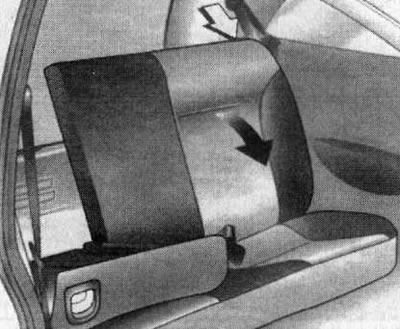
12.10. Folding the backrest/backrest sections of the rear bench seat
Folding the rear seat back
Before folding the seat backs, remove the head restraints, and on Combo models, lower the middle head restraint down as far as it will go (see above). Insert the seat belt clips of the outer rear seats into the special holders in the upholstery (see illustration 12.11). If equipped, remove the ISOFIX child seat mountings from the rear seat - strictly follow the recommendations given in the separate operating instructions for this system.
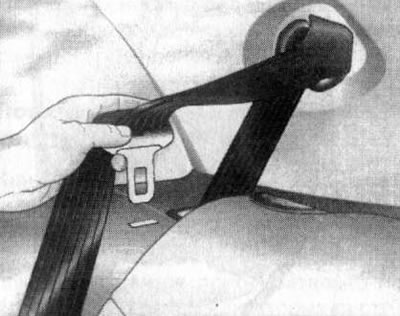
12.11. Insert the seat belt brackets of the outer rear seats into the special holders
The release buttons for the backrest locks are located on the outer sides of their upper edges (see illustration 12.10). To fold the backrests, press the button of the corresponding lock and fold the backrest sections one by one towards the seat cushions.
The backrest/sections of the backrest are unfolded in the reverse order. The backrest must be raised until the lock clicks - check that the backrests are securely fixed in the vertical position. Note: On Corsa C models, the backrest can be fixed in two positions. Make sure that the rear seat belts occupy their standard positions when the backrests are raised.
Note: The three-seat safety belt of the central rear seat can only be pulled out of the inertia return device if the backrest of the multi-seat seat is locked in an upright position.
Folding the rear seat
In order to maximally expand the luggage compartment of the car when transporting large-sized or multi-seat cargo, it is possible to fold the rear multi-seat seat.
To fold the seat, you must perform the same preparatory operations as when folding the backrest (see above).
On models equipped with rear bench seats, grasp the front edge of the rear bench seat cushion and firmly pull it up out of the holders in the floor. Then pull the seat cushion forward, upright, and fold it toward the front seatbacks (see illustration 12.12). Then press the release buttons and fold the rear seatback/sections forward to the lowest position (see above). On models equipped with two-section rear seats, when preparing the seat for folding, in addition to performing the above operations, it is necessary to remove the seat belt buckles into the special slots (see illustration 12.13). To fold the seat, pull the special loops attached to the back of the cushions and move the cushions to a vertical position, pressing them against the backs of the front seats. Press the locking buttons and fold the back sections forward to the lowest position (see illustration 12.14).
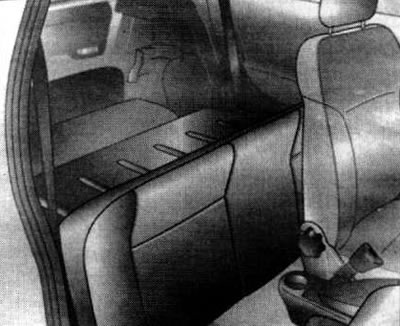
12.12. Rear bench seat in folded position
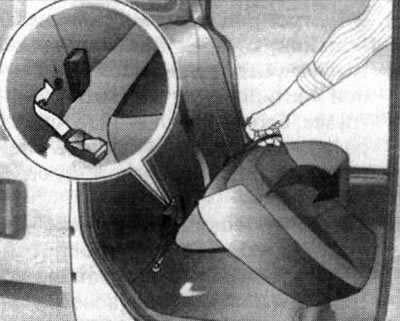
12.13. Folding the cushions of the two-section rear bench seat
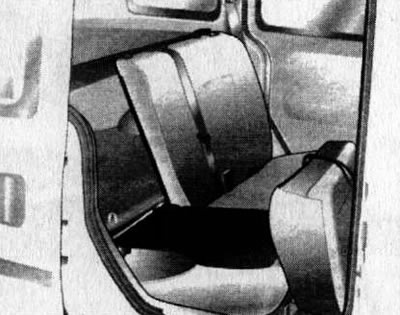
12.14. Right section of the rear multi-seat seat in the folded position
The seats are unfolded in the reverse order. The backrest must be raised until the lock clicks - check the reliability of the backrests in the vertical position. Make sure that the rear seat belts are in their standard positions.
Visitor comments