


Turn the crankshaft so that the piston of the 1st cylinder, counting from the side of the valve timing drive, occupies the TDC position of the end of the compression stroke; in this case, the mark on the crankshaft pulley should be opposite the mark on the camshaft drive cover, and the ends of the tappets should be at the backs of both cams of the 4th cylinder.
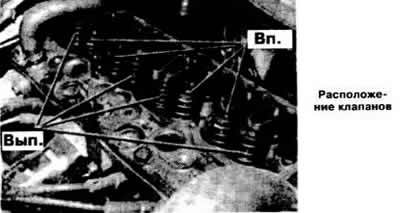
In this position, use a set of feeler gauges to measure the clearance between the rocker arm and the end of the stem of the intake valves of the 1st and 2nd cylinders and the exhaust valves of the 1st and 3rd cylinders, proceeding as follows:
- by rotating the self-locking nut of the rocker arm, achieve the required clearance, while the feeler gauge should enter with a slight clamping
- turn the crankshaft a full revolution and adjust the clearance of the intake valves of the 3rd and 4th cylinders and the exhaust valves of the 2nd and 4th cylinders as indicated above.
Clearances in the valve drive mechanism The normal clearance between the rocker arm and the end of the valve stem, measured with a feeler gauge on a hot engine, is 0.15 mm for intake valves and 0.25 mm for exhaust valves.
Note: The engine crankshaft is turned by moving the vehicle with the fourth gear engaged.
The clearances in the valve drive mechanism can be adjusted on a running, warm engine, using a cardboard pad to protect against oil splashes.
Article published on the website opelbook.ru
Visitor comments