
OpelBook.ru
Cars AvtoVAZ Cars Mitsubishi Cars BMW Cars Mercedes Cars Nissan Cars Toyota Cars Chevrolet
English Русский
Български
Беларускі
Український
Српски
Hrvatski
Română
Polski
Slovenský
Magyar
 |  Sitemap  |  Contacts  |    


Main Astra Corsa Insignia Kadett Omega Vectra Zafira Others Articles
Kadett D (1979-1984) Kadett E (1984-1995)
  • Main
  • Kadett
  • Kadett E
  • OHV power unit
  • Check and repair
  • Main metering system of the Weber 32 TL carburetor

Main metering system of the Weber 32 TL carburetor (Opel Kadett E)

            0

Contents: Power mode economizer ⬇ Econostat ⬇ Accelerator pump ⬇
Fuel is fed through the filter and the needle valve into the float chamber. From the float chamber, fuel enters through the main fuel jet into the emulsion well and mixes with air coming out of the holes of the emulsion tube and the main air jet.

Through the horizontal channel, the fuel-air emulsion enters the small and large diffusers of the carburetor.

Power mode economizer


In transient modes, when the vacuum behind the throttle valve increases, fuel is taken from the float chamber through ball valve 3 (see picture), which is closed while the diaphragm is held by the vacuum in the throttle space. Then, through the enrichment channel, an additional amount of fuel is supplied to the idle system through the enrichment jet, enriching the combustible mixture.
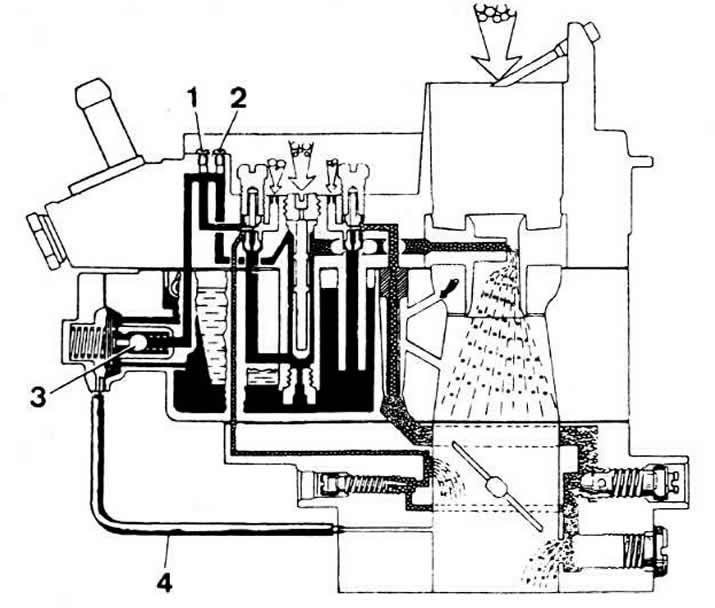
Power mode economizer:

Power mode economizer:
1 - idle enrichment jet;
2 - enrichment jet of the main dosing system;
3 - economizer ball valve;
4 — vacuum supply hose.


As the throttle valve opens, the vacuum drops somewhat and the diaphragm spring opens valve 3 even more. An additional amount of fuel passes through the economizer jet, through the enrichment jet 1 of the idle and the enrichment jet 2 of the main metering system and is supplied to the idle systems and the main metering system, enriching the combustible mixture.


Econostat


The economizer is switched on at full engine load at speeds close to maximum, with the throttle valve fully open. Fuel from the float chamber is supplied through the economizer nozzle to the injection tube, which sprays fuel into the mixing chamber, enriching the combustible mixture.
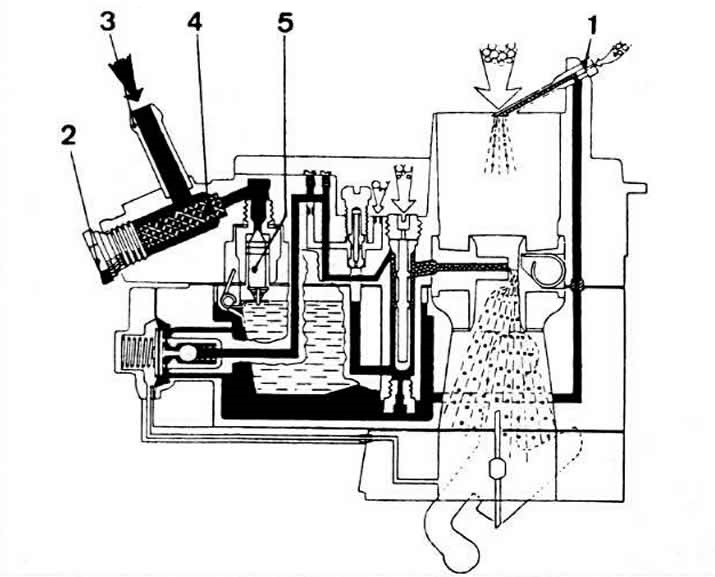
Econostat:

Econostat:
1 - economizer injection tube;
2 - screw-plug;
3 — fuel supply pipe;
4 - fuel filter;
5 - needle valve.


Accelerator pump


The accelerator pump has a mechanical drive. When the throttle valve is closed, spring 3 (see picture) moves diaphragm 2 back, which leads to filling of the pump cavity through check ball valve 7. When the throttle valve is opened, the cam acts on the pump drive lever, and the diaphragm forces fuel through ball valve 4 and sprayer 5 into the carburetor mixing chamber, enriching the combustible mixture. Excess fuel is drained into the float chamber through the drain channel.
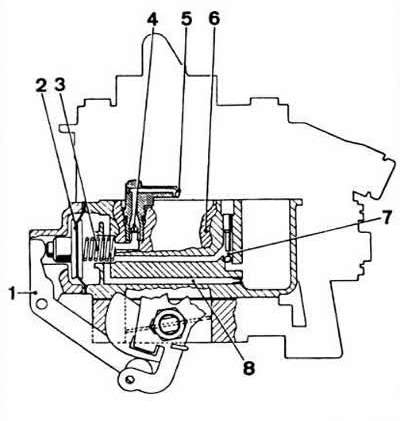
Accelerator pump:

Accelerator pump:
1 — drive lever;
2 - diaphragm;
3 - spring;
4 - fuel supply ball valve;
5 - sprayer;
6 - mixing chamber;
7 - check ball valve;
8 — vacuum supply channel.


This article is available at russian, bulgarian, belarusian, ukrainian, serbian, croatian, romanian, polish, slovak, hungarian
Checking the article: Shapovalov Yaroslav

Share information:

Previous articles
Opel Kadett E: Check and repair
Next articles

Operating principle of the Weber 32 TL carburetor
Fuel pump
Setting the ignition timing
Adjusting the gap between the contacts of the ignition system interrupter
Removal and installation the ignition system distributor
Adjusting clearances in the valve drive mechanism
Adjusting the starting clearance of the carburetor throttle valve
Oil filter


See similar ones from other Opel car manuals:
▶ Ignition system of carburetor engines — check Opel Astra F (1991-1998, petrol)
▶ Ignition system — carburetor models 1.8 liters Opel Omega A (1986-1993)
▶ Carburetor fuel system specifications Opel Vectra A (1988-1995, petrol)
▶ Main electric fan (installed behind the cooling system… Opel Zafira A (1999-2005, petrol)
▶ Checking the exhaust system Opel Corsa B (1993-2000)
Link to this page in different formats

Visitor comments


No comments yet


How much will 21 + 20 =


Kadett E (1984-1995) 
  • General information
  • Vehicle description
  • Operation and maintenance
  • OHV power unit
  • Engine design
  • Check and repair
  • Engine work
  • OHC power unit
  • Engine design
  • Engine repair
  • Ignition system
  • Cooling and lubrication
  • Supply system
  • Fuel injection «LE-Jetronic»
  • Fuel injection «LE3-Jetronic»
  • Motronic ML4.1 system
  • Motronic M1.5 system
  • Motronic M2.5 system
  • Transmission
  • Clutch
  • Gearbox F10 and F13
  • Gearbox F16 and F20
  • Automatic gearbox
  • Drive shafts
  • Chassis
  • Front suspension
  • Rear suspension
  • Steering
  • Brake system
  • Electrical equipment
  • Equipment and devices
  • Electrical circuits
Kadett D (1979-1984) 
  • General information
  • Car care
  • Maintenance
  • Power unit
  • Gasoline engines
  • Lubrication system
  • Cooling system
  • Power system (gasoline)
  • Carburetor Solex 35 PDSI
  • Carburetor Varajet II
  • Carburetor 1B1
  • Fuel injection (gasoline)
  • Diesel engines
  • Fuel system (diesel)
  • Transmission
  • Clutch
  • Manual gearbox
  • Chassis
  • Front suspension
  • Rear suspension
  • Steering
  • Brake system
  • Wheels and tires
  • Body
  • Body elements
  • Doors and windows
  • Electrical equipment
  • Equipment and devices
  • Lighting system
  • Power devices
  • Ignition system
  • Electrical circuits
OpelBook.ru © 2017–2026 · Mobile version · · Sitemap: EN BG BY UA RS HR RO PL SK HU · Feedback · Site search
Astra F, petrol · Astra G, petrol · Astra G · Astra H · Astra J, petrol · Corsa B · Corsa C, petrol · Corsa C · Insignia A · Kadett D · Kadett E · Omega A · Omega B · Omega B2 · Vectra A, petrol · Vectra A · Vectra B, petrol · Vectra B · Vectra C · Zafira A, petrol · Frontera A, petrol · Frontera B · Ascona C · Vivaro A ·
We want your visit to be comfortable 🤝! We use cookies 🍪 to make that happen.