


Contents: Position of seats and headrests ⬇ Headrests ⬇ Front seats ⬇ Transformation ⬇ Adjustment ⬇ Transformation ⬇
Position of seats and headrests
The driver's seat must be adjusted to a position that provides the driver with maximum comfort when operating the pedals, gearshift lever/selector lever, steering wheel and instrument panel switches. In addition, adequate visibility through the windshield and side windows and reliable fastening of the driver's body with the seat belt must be ensured.
The design of the car seats guarantees maximum comfort for the person sitting in them, while simultaneously providing conditions for the most effective performance of their functions by the seat belts and airbags. Soft padding of the cushions and backrests provides additional protection for the driver and passengers in emergency situations.
Attention: The use of any additional pillows or other objects placed on the seat cushion or backrest is not permitted!
The choice of seat position also affects the safety of the occupant. For example, if the front seat is moved too far forward, the risk of injury to the occupant increases when the airbag is deployed, as well as the risk of being thrown through the windshield in a frontal collision. Moving the driver's seat back affects the ease of use of controls while driving.
Increasing the angle of the seat back will worsen the fixation of the body by the seat belt - the more the back is tilted back, the higher the probability of the body sliding under the lap section of the belt in a strong frontal impact, and the more severe the injuries may be. It is recommended to set the angle of the backrest at 25-30° from the vertical position. Fix the front seat in the most remote position (convenient for driving) from the steering wheel/dashboard position, bring the backrest to a vertical position.
Important safety system elements are head restraints. They prevent injury to the cervical spine and head in the event of a rear impact. It is necessary to check the adjustment of the head restraints before each trip (see below)
Seat adjustments should be made before driving. After adjustments are complete, make sure that the backrest and the entire seat assembly are securely fixed.
Headrests
Warning: Headrests are an additional means of ensuring safety in the event of an accident, never remove them when driving! They are designed to work together with seat belts - do not forget to fasten the belts!
Adjustment
Attention: Adjustment of head restraints is mandatory! Only correctly installed head restraints provide adequate protection against possible damage to the cervical vertebrae in a rear impact!
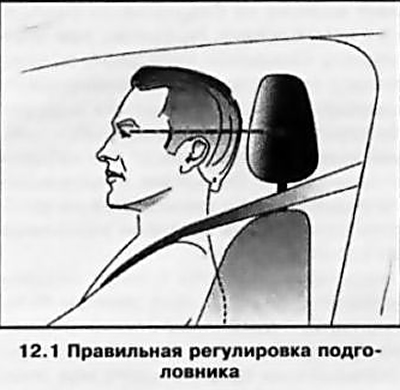
The headrest should be adjusted in height so that its central part is at the same level as the eyes/upper edge of the ear of the occupant (see illustration 12.1) - if it is not possible to achieve this condition, the headrest should be set to the uppermost position (for tall people) or to the extreme bottom (for short people) position.
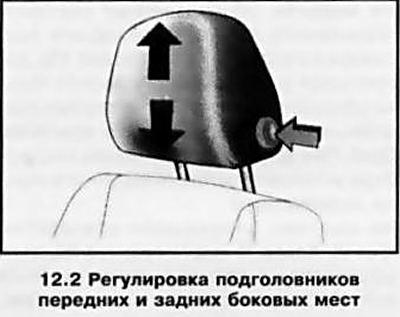
To adjust the headrests of the front and rear side seats, press the button (see illustration 12.2) on the side of the headrest and manually move it up or down to the desired amount.
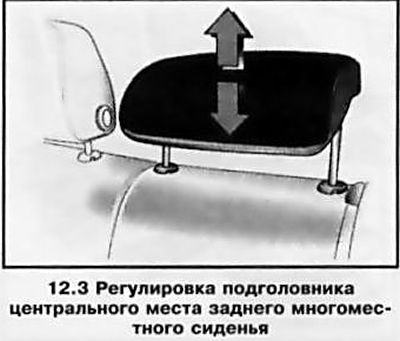
In some versions, the center seat of the rear bench seat is also equipped with a head restraint. To adjust the head restraint of the center seat of the rear bench seat, simply pull it up or hold the head restraint locks in the pressed position and lower it down (see illustration 12.3).
Removal
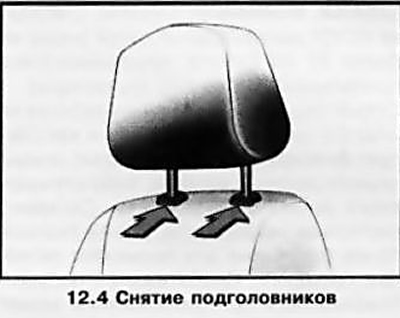
To remove, hold down the headrest locks, pull the headrest up and release it from the guides (see illustration 12.4). Note: The rear bench seat head restraint latches are located on the rear side.
The center head restraint of the rear bench seat is integrated into the seat assembly and cannot be removed. When not in use, the head restraint must be moved to its lowest position.
Installation
To install, insert the headrest rods into the receptacles on the seat back and, pressing them with a little force, lower the headrest down.
Active front head restraints
Caution: Correct adjustment significantly increases the effectiveness of the head restraints - be sure to adjust the active head restraints as described above! Never tie or hang anything on the head restraint rods!
Active head restraints (with appropriate equipment) reduce the likelihood and severity of neck injuries in a rear-end collision. The installation of active head restraints on the front seats is indicated by the inscription "ACTIVE" (see illustration 12.5) on the seat guide bushings. At the moment of impact, the active headrest moves forward under the influence of the inertial force of the passenger's body on the seat back and helps reduce the dynamic backward tilt of the head, reducing the load on the cervical vertebrae. Then the headrest returns to its original position.
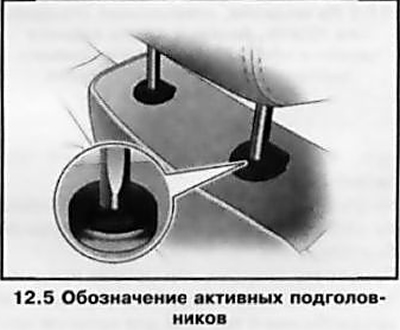
Active head restraints are particularly effective in low- and medium-speed collisions, where (as statistics show) accounts for the majority of cases of neck injuries to drivers and passengers.
Front seats
Attention: Adjustment of the seat position should only be carried out when the vehicle is stationary!
Adjustment
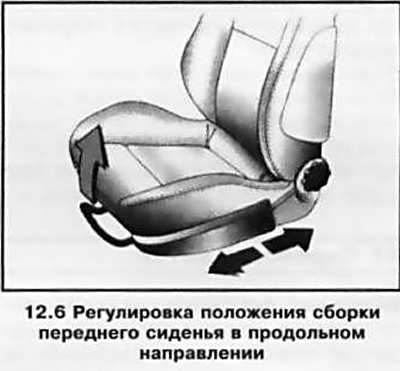
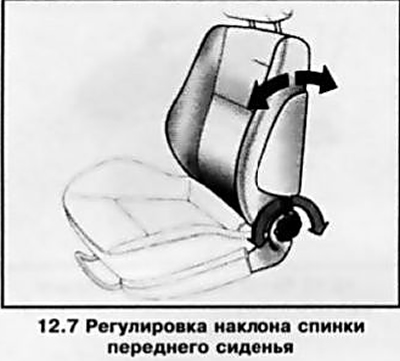
To move the front seat longitudinally, pull up on the release lever located under the front edge of the cushion, then slide the seat assembly to the desired position and release the lever (see illustration 12.6). To check the reliability of the seat fixation in the new position, try to move it. The seat back angle is adjusted using the rotary handle located on the outer side surface of the back (see illustration 12.7).
Note: When making adjustments, remove your body weight from the seat back.
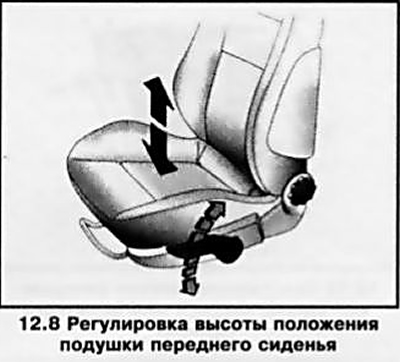
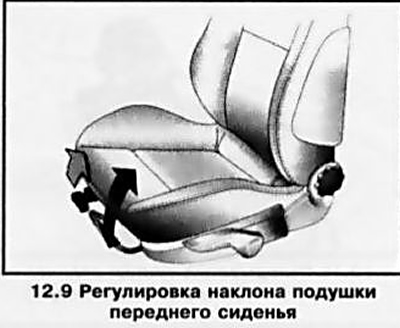
If equipped, the front seat cushion can be adjusted. The height of the cushion is adjusted by rocking the lever (see illustration 12.8), located on the outer side of the cushion (up to increase, down to decrease the height). To adjust the angle of the cushion, pull the lever up (see illustration 12.9), located under the seat on the inside, and by transferring body weight, give the cushion the required angle of inclination.
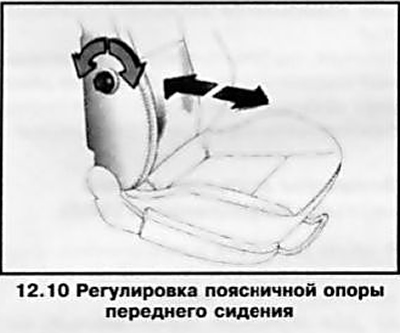
On some models, the design of the driver's seat back also allows for adjustment of the lumbar portion. Adjustment is made using a rotating handle located on the side surface of the seat back, on the inside of the latter (see illustration 12.10).
Material was taken from a resource [OPELBOOK.ru]
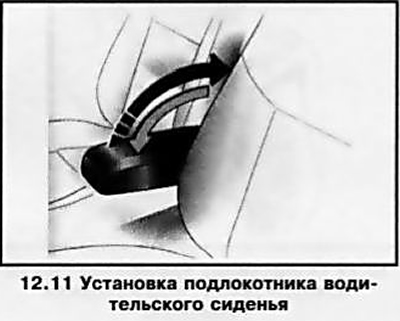
On models with the appropriate equipment, the driver's seat can be equipped with a folding internal armrest (see illustration 12.11). To lower the armrest, you need to press it and, overcoming resistance, lower it to a horizontal position. When raising, the armrest can be set in several fixed positions.
Transformation
On models with the corresponding configuration, the front seat backrests can be folded down towards the cushions by pulling the lever up (see illustration 12.12), located on the outer side of the seat back and fold the seat forward until the lock clicks, then slide the seat forward until it stops.
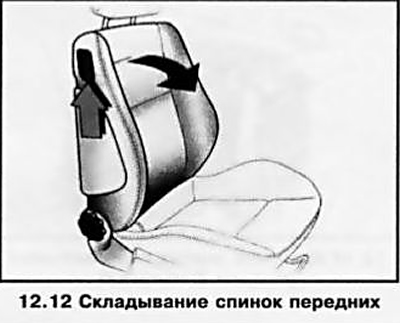
Unfolding is done in the reverse order; it is imperative to check the reliability of the backrest fixation in the upper position.
Rear bench seat
The vehicles covered in this Manual may be equipped with a two-piece rear seat (with asymmetric division), or a three-section design.
Adjustment
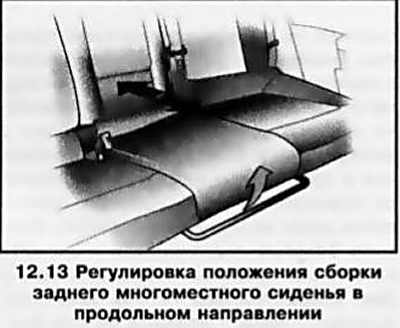
In some versions, it is possible to adjust the position of the rear bench seat assembly in the longitudinal direction. The adjustment principle is the same as for the front seats, the lock release bracket is located under the center seat of the rear seat (see illustration 12.13).
Transformation
Armrest
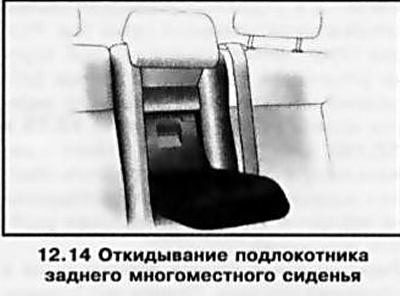
The rear seat can be equipped with a folding armrest (see illustration 12.14), intended for use when placing fewer than three passengers on the rear seat. To move the armrest into the working position, pull it by the upper edge/loop and lower it horizontally. If necessary, fold forward the cover of the hatch located in the wall of the pocket under the armrest in the back of the rear seat - skis or other long objects can be pushed through the resulting window. If equipped accordingly, the ability to transport long loads is also ensured by folding the back of the central section of the rear seat (see below).
Folding the rear seat backs
Caution: When folding and unfolding the rear seat, make sure that the seat belts are inserted into the special brackets (see illustration 10.4) to prevent the seat belts from getting caught in the seat back!
If you need to expand the luggage space to transport large items, the back of the rear seat can be folded down. The split design of the rear bench seat allows you to fold any section independently of the others.
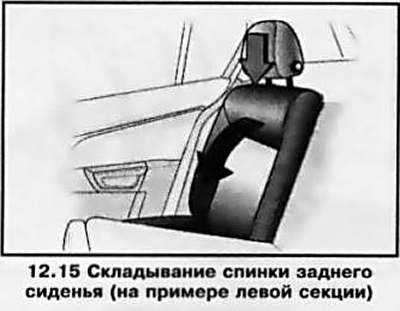
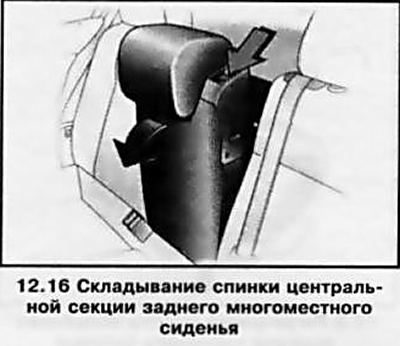
Before folding the seat backs, it is necessary to remove the head restraints of the side seats, and lower the middle head restraint down to the stop (see above), move the front seats forward a little, if the rear seat armrest was used before - it must be folded. If equipped, disconnect the fasteners of the decorative shelf of the luggage compartment / horizontal curtain / fencing net (see Section 17) from the back of the rear seat. The release buttons for the seatbacks are located on the outer sides of their upper edges (see illustrations 12.15 and 12.16). To fold the seat backs, press the locking buttons and fold the seat backs to the seat cushions, then move the front seats to the most comfortable position.
The backrests are unfolded in the reverse order. The backrest must be raised until the lock clicks – check the reliability of the backrests' fixation in the vertical position. Make sure that the rear seat belts take their standard positions when the backrests are raised.
Note: The three-seat safety belt of the central rear seat can only be pulled out of the inertia return device if the backrest of the multi-seat seat is locked in an upright position.
Folding the rear seat
In the Station Wagon models, in order to maximally expand the luggage compartment of the vehicle when transporting large or multi-seat cargo, there is an additional option of folding the rear multi-seat seat.
To fold the seat, you need to remove the armrest, lower the central headrest to the lowest position, disconnect the fasteners of the decorative luggage compartment shelf/horizontal curtain/barrier net (see Section 17) from the back of the rear seat by pulling on special loops (see illustration 12.17), move the rear seat cushions to a vertical position.
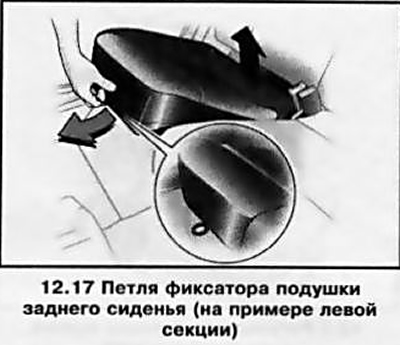
Note: When installing a rear seat with longitudinal adjustment on a vehicle, the cushions are raised by simply pulling up on their rear edge/loop.
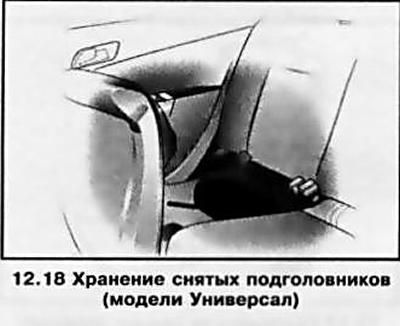
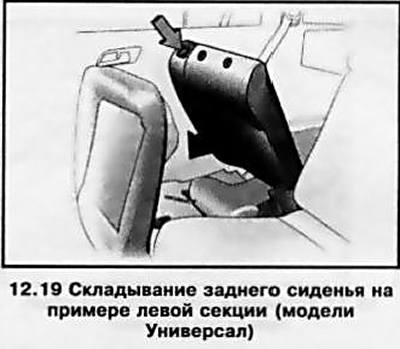
Remove the side head restraints and fold them into the recesses of the raised seat cushions (see illustration 12.18). To fold the backrests, press the locking buttons (see illustration 12.19) and fold the backrests forward to the lowest position.
The seats are unfolded in the reverse order. The backrest must be raised until the lock clicks - check the reliability of the backrests in the vertical position. Make sure that the rear seat belts are in their standard positions.
Note: The three-seat safety belt of the central rear seat can only be pulled out of the inertia return device if the backrest of the multi-seat seat is locked in an upright position.
Visitor comments