


Contents: General information ⬇ Rules for using seat belts ⬇ Recommendations for pregnant women ⬇ Recommendations for disabled people ⬇
Warning: A serious attitude to the use of seat belts is the key to minimizing the risk of serious injury and death in an accident! Remember that airbags should in no way be considered as an alternative to seat belts, neglecting the use of the latter!
General information
All seats of the car are equipped with seat belts - two front and three rear. All belts have a diagonal-lap (three-anchor) design.
One of the anchor points is equipped with an inertial return device with automatic locking in case of jerks. Belts of this type do not require length adjustment. Inertial belts practically do not restrict the movements of the person fastened with them, allowing him to freely change his position. In the event of a traffic accident or sudden braking of the car, the return device automatically locks the belt, ensuring the fixation of the body from dangerous movements. To check the proper functioning of the locking mechanism, you should sharply pull the belt by the shoulder section - if the belt locks, then the mechanism is functioning properly. The front seat belts can be equipped with automatic emergency tensioners. The procedure for using such belts is similar to the procedure for using belts of a conventional design. The operating principle of emergency tensioners is discussed in more detail in Section 13.
Attention: It is prohibited to make changes to the design of the belt assemblies, or in any way interfere with the automatic selection of belt slack by winding it onto the drum of the return mechanism!
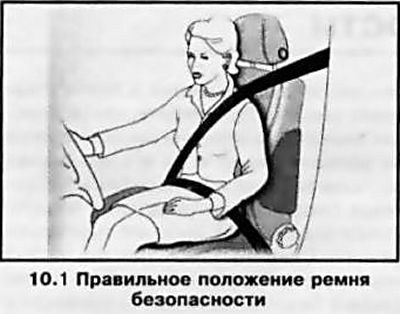
The design and layout of the seat belts were calculated taking into account the features of the human skeletal structure. The belt should fit tightly to the body of the person sitting in the pelvic area (waist section) and chest and shoulder (shoulder section). Make sure that the lap belt is lowered as low as possible to the hips and under no circumstances is it located on the occupant's stomach. The shoulder section of the belt should not be passed under the arm or placed on the neck. Make sure that the belt is not twisted. Incorrect use of seat belts can lead to serious injuries in an accident. The maximum effectiveness of the seat belt is achieved when the seat back is in an upright position. Excessive tilt of the seat back increases the likelihood of the occupant slipping under the belt during an impact.
The seat belt should fit the driver or passenger as tightly as possible without causing significant discomfort or limiting freedom of movement. Even a slight loosening of the belt dramatically reduces the effectiveness of its protective action in an accident.
All people in the vehicle must wear seat belts at all times while the vehicle is in motion. Under no circumstances is one seat belt allowed to be used to fasten more than one person, including a child sitting on the lap!
In the instrument cluster (see Section 16) a special control lamp is installed, reminding the driver and passengers of the need to fasten their seat belts, which is switched off only when the belts are fastened.
Information on how to place special child seats and secure them using standard seat belts is provided in Section 11.
Rules for using seat belts
General rules
Warning: Neglecting to use seat belts can result in serious injuries in an accident or even death! An incorrectly used seat belt will not provide adequate protection for the driver/passenger! If you are not sure that the seat belts are adjusted correctly, contact a service station specialist.
Slowly pull the belt out of the return device, place it over your shoulder and snap the belt buckle clip into the lock, then pull the shoulder section strap up, checking that the clip is securely locked into the lock. Make sure that the belt strap is not twisted - a twisted belt is dangerous in itself.
Note: The three-seat safety belt of the central rear seat can only be pulled out of the inertia return device if the backrest of the multi-seat seat is locked in an upright position.
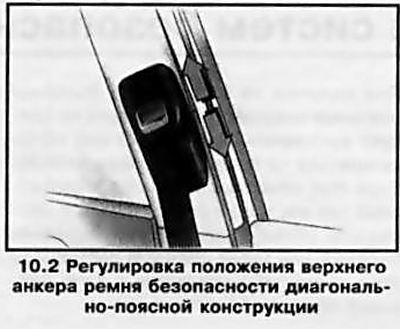
Lower the waist section of the belt as far as possible, placing it as low on your hips as possible. Pull the shoulder section to take up the slack in the strap and try to achieve a snug fit (see illustration 10.1). The strap should be positioned diagonally across the occupant's chest so that the impact load is primarily on the strongest part of the upper torso - if necessary, adjust the position of the upper belt anchor.
To adjust the height of the upper anchor, press the push-button lock (see illustration 10.2) on its body and move it to the required position, then release the button and fix the anchor - a characteristic click should be heard.
Note: After completing the adjustment, check that the anchor is securely fastened by tugging it up and down. After buckling up, the driver must check that all passengers are also properly buckled up.
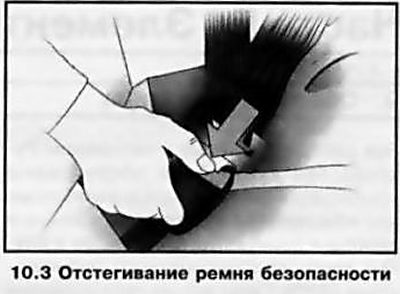
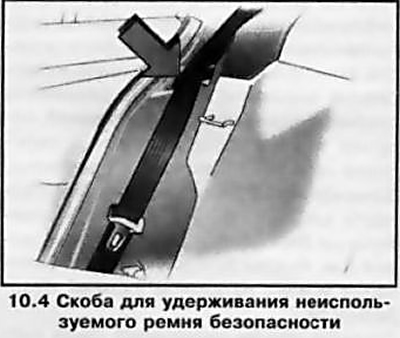
To unfasten the belt, press the red button located on the buckle body (see illustration 10.3). When winding the belt with the drum of the retractor, hold it by the lock bracket. When leaving the car, make sure that the belt does not get into the door opening and does not get caught when the latter is slammed. There are special brackets on the sides of the rear seat (see illustration 10.4), designed to hold unused rear seat belts and prevent them from getting caught in the door opening and getting pinched when the seat is folded.
Recommendations for pregnant women
Ensuring the safety of a pregnant woman is also the best way to preserve the fetus in the event of an accident, so when traveling by car (as a driver or passenger) a pregnant woman must wear a seat belt, paying particular attention to the correct placement of its sections relative to her body.
When using diagonal-waist belts, remember that the waist section of the belt should be positioned as low as possible on the hips and should never be placed on the stomach, while the diagonal section should pass over the middle of the shoulder and then across the chest to the hip.
A pregnant woman should also take an upright position in the seat, with the front seat moved as far away from the dashboard as possible, which will reduce the risk of injury and damage not only to the mother but also to the fetus in the event of an accident or if the front airbag is deployed.
For personalized recommendations, contact your doctor. At each visit to the antenatal clinic, ask whether it is advisable for you to drive a car.
Recommendations for disabled people
Opel strongly recommends that all disabled persons use seat belts when driving. Belts should be adjusted according to the nature of the injury or disability. For personalized recommendations, please contact your physician.
Additional information on seat belts
The authors of this Manual recommend replacing the entire belt assembly that has been overloaded in an accident, regardless of the severity of the consequences, even if its condition has not changed in any way. Those belts that were not used at the time of the collision must be checked for suitability for further use by specialists. To replace and check the condition of the seat belt assemblies, contact an Opel service station.
Do not forget to check the general condition of the seat belts from time to time. If signs of malfunction of the buckles, tension mechanisms, reliability of tightening of anchor fasteners and other defects that interfere with the normal functioning of the seat belts are detected, the failed components should be replaced without delay.
Attention: If any tears, abrasions or heavily soiled areas of the tape are detected, the seat belt must be replaced without fail!
During the entire service life of the seat belts, protect the surfaces of their webbing from contamination with polishes, oils, and other chemicals. Never allow the belts to come into contact with sulfuric acid, which is the basis of the electrolyte in batteries. The belts should be cleaned carefully, using a brush, soft soap and water, or other cleaning agents recommended for treating furniture upholstery and carpeting. After cleaning, the belts should be thoroughly dried in an extended state - under no circumstances allow damp belts to be wound onto the retractor drum.
Note: Avoid drying the belts by exposing them to direct sunlight.
Do not attach pads or other objects to the seat belt webbing. Installing additional devices, modifying the design of seat belt components, or changing the position of the shoulder section attachment may reduce the effectiveness of the seat belt and increase the risk of injury in a crash.
Do not place any objects between your body and the front airbag.
Carrying hard or sharp objects on your lap, or driving with a smoking pipe or other sharp objects in your mouth, can result in serious injury in the event of an accident.
To prevent the risk of unauthorized deployment of the front airbags, try not to press your hands against the locations of their modules on the instrument panel and in the steering wheel hub.
Visitor comments