


Contents: Sport driving mode ⬇ Winter driving mode ⬇ Anti-aircraft Protection…⬇ Anti-lock brake system (ABS) ⬇ Speed control system (Tempostat) ⬇ Parking assistance system ⬇
On models equipped with AT/Easytronic, additional vehicle control modes controlled by electronic equipment are available if appropriately equipped.
Warning: Electronic equipment is very sensitive to voltage drops in the vehicle's electrical system! If the battery voltage drops below 10 V, electronic systems may malfunction - constantly monitor the battery's condition and charge!
Sport driving mode

On models with the corresponding configuration, when activating the sports mode while driving, the steering parameters and the vehicle's throttle response are changed by delaying the AT gear shift moments. The engine responds more sensitively to the movements of the gas pedal.
To activate this mode, you need to press the "S" button located on the top of the selector lever handle (see illustration 25.1). The corresponding indicator will be displayed in the display field of the selected gearbox mode (see Section 16). To deactivate the mode, press the same button again - the indicator in the display field should go out.
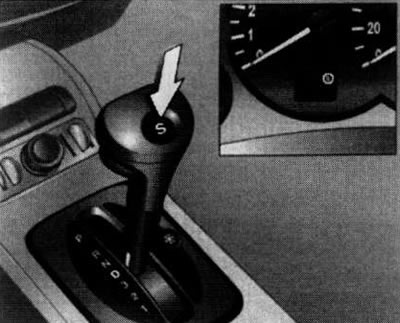
25.1. Sports mode activation/deactivation button
Winter driving mode

Winter driving mode prevents a sharp increase in engine speed during acceleration, starting from a standstill with wheel slippage, and also changes in the gear ratio in the transmission while driving, thereby protecting the car from sudden skidding. The activation/deactivation button for this mode is located on the selector/gear shift lever panel and is marked with the symbol
 (see illustration 25.2).
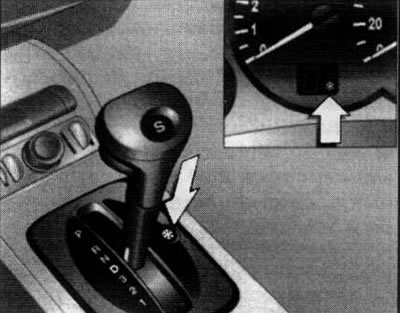
25.2. Winter driving mode activation button AT
Winter driving mode can be activated in selector lever positions AT "P", "R", "N", "D" and "3", and on models with Easytronic when starting off, the corresponding indicator should appear in the display field of the selected gearbox mode (see Section 16).
When winter mode is activated, the car will move in a constantly engaged gear: AT - 3rd, Easytronic - 2nd.
You can turn off the winter mode by pressing the same button again, switching the AT selector lever to position "2" or "1", or switching Easytronic to manual control mode.
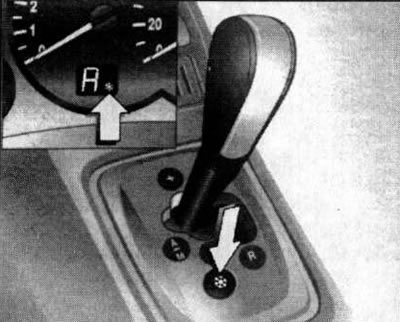
25.3. Easytronic winter driving mode activation button
When the ignition is turned off, this mode is disabled automatically.
Note: To prevent failure of transmission units, winter driving mode is also automatically switched off when the transmission oil temperature is too high.
Additionally, on AT-equipped models, the winter driving mode is automatically deactivated when the speed reaches 80 km/h or higher.
Anti-aircraft Protection (ESP)system/anti-slip (vehicle) system
If equipped accordingly, the vehicle's system monitors the rotation speed of the drive wheels and, if it detects that at least one of them is slipping, reduces engine power (engine noise changes) and brakes the slipping wheel. This ensures a stable ride and improves the vehicle's traction properties.
On models with the appropriate configuration, the ESP system increases the vehicle's stability while driving and simultaneously provides automatic control of the powertrain's traction force in all operating modes. If there is a risk of the vehicle skidding, a command from the ESP control module automatically reduces the engine power, while simultaneously releasing the brakes on wheels that are starting to skid or applying controlled braking to wheels that are rotating at too high a speed, thereby counteracting skidding and improving vehicle control.
Note: The ESP system fully incorporates the functions of the vehicle system.
The ESP/TC system is activated automatically when the ignition is turned on - the corresponding indicator on the instrument cluster should light up (see Section 16). After a few seconds, the indicator goes out, confirming the functional readiness of the system. When driving on a road with low traction properties or when making sharp maneuvers, ESP/TC is automatically activated - at the same time, the indicator of deterioration of the traction properties of the road surface on the instrument panel is activated in flashing mode. The operation of the system is accompanied by pulsation of the foot brake pedal and noise (vibration) in the engine compartment.
Attention: Remember that when ESP/TC is operating, the vehicle is moving at the limit of its traction properties, which borders on loss of control - be especially careful when driving further!
If the indicator lights up continuously while driving, this indicates that the system has failed and is switched off. In this case, you can continue driving, but remember that the vehicle's directional stability will deteriorate, and if the road surface properties change, the vehicle should be driven with greater caution. In the event of a system failure, contact a service station specialist as soon as possible.
When the battery is disconnected/the power supply is interrupted, the system settings are reset - after the battery is connected, the indicator lights up continuously. To restore the system's functionality, it is necessary to synchronize the steering wheel angle sensor. Automatic synchronization occurs during straight-line driving for some time on a dry and level road at a speed of 20-40 km/h. To synchronize the sensor, manually turn the steering wheel 1-2 times from the extreme left to the extreme right position.
If the indicator continues to light after the synchronization procedure, contact the service station specialists.
Anti-lock brake system (ABS)
Warning: ABS improves the braking properties of the car, but will not prevent collisions due to careless and dangerous driving, especially on slippery roads! Do not allow carelessness in driving, relying on the auxiliary systems of the car - responsibility for traffic safety lies entirely with the driver!
ABS prevents premature wheel locking by continuously controlling the speed of their rotation during braking by modulating the hydraulic fluid pressure in each of the brake mechanisms.
The system consists of electronic sensors, electric pumps and electromagnetic valves of the brake system hydraulic drive and is controlled by an electronic device. Checking, adjusting and servicing the ABS system should be performed by specialists only in a service station.
Every time the ignition is turned on, a special control module diagnoses all devices included in the ABS system - a characteristic dull noise can be heard and a noticeable pulsation of the foot brake pedal occurs, and the corresponding indicator should light up on the instrument cluster (see Section 16). After a few seconds, the indicator goes out, confirming the functional readiness of the system. If, when braking while driving, the electronic sensors detect that one or more wheels are close to complete blocking, the control module activates the actuator, which, by modulating the brake fluid pressure, will hold the wheels on the verge of their complete blocking. Quite noticeable pulsations of the foot brake pedal, characteristic noise and slight vibration in the engine compartment are associated with the activation of ABS and should not cause concern - continue to press the pedal. The car remains controllable when the brake pedal is fully depressed, and even in the case of emergency braking, it is possible to go around the obstacle. The operation of ABS will be accompanied by the activation in flashing mode of the corresponding indicator on the instrument cluster (see Section 16).
If a fault is detected in the system, the control module switches off the ABS - the indicator on the instrument cluster will be activated in permanent mode. The service brake system will continue to function in normal mode - when the pedal is fully depressed, the wheels are blocked from turning - be careful! To eliminate the fault, contact a service station as soon as possible.
ABS operation automatically stops when the driving speed drops to 5 + 10 km/h.
Speed control system (Tempostat)
When equipped accordingly, the cruise control buttons are built into the end section of the left steering column switch (see Section 17).
Parking assistance system
The parking assistance system allows you to automatically measure the distance from the car to an obstacle behind you when reversing. Four sensors are built into the rear bumper to determine the distance (see illustration 25.4).
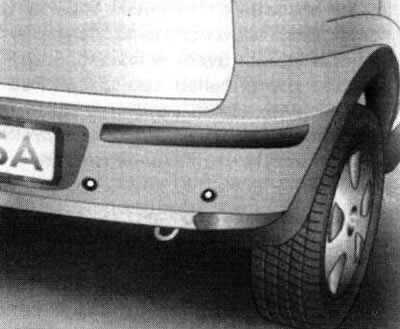
25.4. Parking assistance system sensors
Please note: The presence of the parking assistance system does not relieve you of the obligation to exercise caution when reversing - under certain conditions, various reflective surfaces of objects or clothing, as well as external sound sources, can create interference in which the system will not react to the obstacle!
The parking assistance system is activated automatically when the ignition is switched on - a short sound signal confirms its functional readiness. When reverse gear is engaged, when approaching an obstacle at a distance of approximately 1 m, an intermittent sound signal is activated in the vehicle interior - when approaching an obstacle at a distance of less than 30 cm, the signal buzzer becomes continuous. After disengaging reverse gear, the sound signal is switched off.
In case of a malfunction or failure in the parking assistance system, the sound signal will be activated continuously already at a distance of approximately 1 m from the obstacle. First of all, check the cleanliness of the sensors, wipe them with a clean cloth. If you were unable to detect the malfunction, contact the car service specialists.
Caution: Rear racks, such as those for transporting bicycles, mounted close to the sensors may interfere with the functioning of the system!
Note: On models equipped with a factory-fitted parking assistance system, retrofitting a towing hitch is not possible.
Visitor comments