
OpelBook.ru
Cars AvtoVAZ Cars Mitsubishi Cars BMW Cars Mercedes Cars Nissan Cars Toyota Cars Chevrolet
English Русский
Български
Беларускі
Український
Српски
Hrvatski
Română
Polski
Slovenský
Magyar
 |  Sitemap  |  Contacts  |    


Main Astra Corsa Insignia Kadett Omega Vectra Zafira Others Articles
Astra F (1991-1998, petrol) Astra G (1998-2004, petrol) Astra G (1998-2004) Astra H (2004-2009) Astra J (2009-2015, petrol)
  • Main
  • Astra
  • Astra F
  • Power unit
  • Engine in car
  • Camshaft — Removal, Inspection and Installation

Camshaft — Removal, Inspection and Installation (Opel Astra F)

            0

Contents: Single camshaft engines ⬇ Twin Cam Engines ⬇

Single camshaft engines


Removal


The camshaft can be removed without removing the casing only if you have a special tool (Vauxhall/Opel N 603850 or equivalent), allowing you to press the valve lifters.

If there is no such tool, the casing is also removed. Since this removes the cylinder head bolts, we recommend installing a new gasket on it. If the gasket is not new and breaks during installation, the cylinder head will have to be removed again to install a new gasket, and another set of bolts will be required.

The removal and installation of the cover is discussed in the next section along with the cylinder head. It is recommended that the head be secured to the cylinder block with four bolts and gaskets to reduce the possibility of damaging the seal between the head and the cylinder block.

After removing the camshaft, perform the following operations.

On carbureted engines, remove the fuel pump (chapter 4).

Remove the ignition distributor or ignition coil.

On 1.6L engines with multi-point fuel injection, remove the three bolts and ignition coil panel.

On 1.8L and 2.0L engines, remove the rear camshaft oil seal.

At the tail end of the camshaft, use a socket wrench to loosen the two bolts on the support plate (it is shown in the picture), then remove it, marking the position.
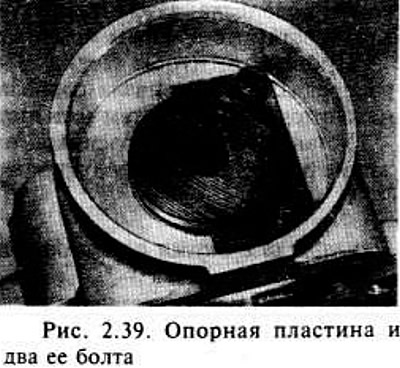
At the tail end of the camshaft, use a socket wrench to loosen the two bolts on the support plate…


Remove the camshaft carefully to avoid damaging the journals.


Examination


After removing the camshaft, inspect the bearings for signs of wear or chipping. Check that the oil feed holes in the camshaft housing are not clogged.
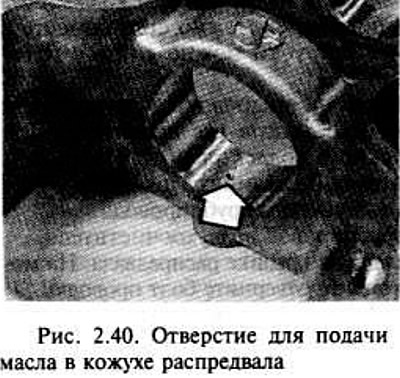
After removing the camshaft, inspect the bearings for signs of wear or chipping. Check that the oil…


There should be no scratches or burrs on the journal and cam surfaces. If there are any, replace the camshaft (after replacing it, the rocker arms should also be replaced).

Check the shaft support plate and replace it if necessary.
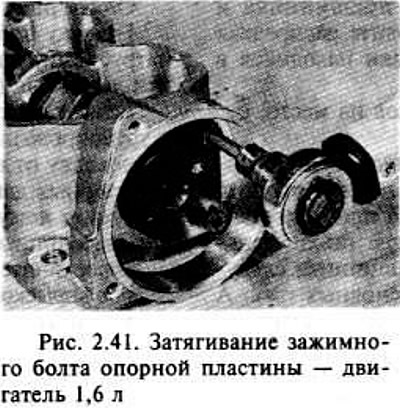
Check the shaft support plate and replace it if necessary.


Installation


It is highly recommended to replace the front camshaft oil seal if it is removed. Pry the seal with a screwdriver and remove it, gently tap it, put on a new one so that it lies flush with the surface.

Begin installation by liberally greasing the bearings as well as the seal lips.

Carefully insert the camshaft into the housing from the distributor/ignition coil side, being careful not to damage the bearings.


Install the support plate and tighten the mounting bolts. Check the camshaft offset along the axis with a feeler gauge. If it exceeds the permissible limit, replace the support plate.
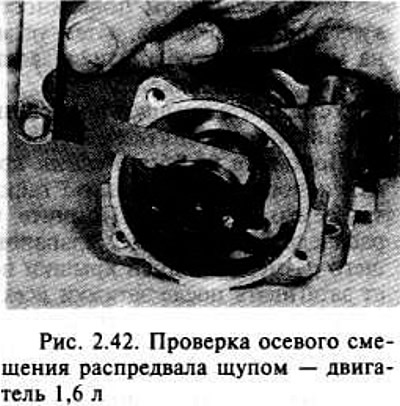
Install the support plate and tighten the mounting bolts. Check the camshaft offset along the axis…


On 1.8L and 2.0L engines, install a new rear camshaft seal flush with the housing.

On 1.6L engines with multi-point fuel injection, check the condition of the seals at the rear of the mounting panel and replace if necessary.

Install the ignition distributor or ignition coil if required (chapter 5).

On carburetor engines, install a fuel pump.

Where required, remove the cylinder head bolts and gaskets.

Install the camshaft housing.

If a new camshaft is installed, the following running-in schedule must be followed immediately after starting the engine:
  • a) for 1 min at 2000 rpm;
  • b) for 1 min at 1500 rpm;
  • c) for 1 min at 3000 rpm;
  • d) for 1 min at 2000 rpm.

Change your engine oil (there is no need to change the filter if the time has not come), approximately 1000 km after installing a new shaft.

Twin Cam Engines


Removal


Remove the camshaft sprocket.

If it is necessary to remove the exhaust camshaft, remove the ignition distributor.


Check the markings on the camshaft bearing caps, and if there are none, make marks on the caps and on the top surface of the cylinder head. Before removing the bearing caps, note their location, they must then be installed exactly in place.
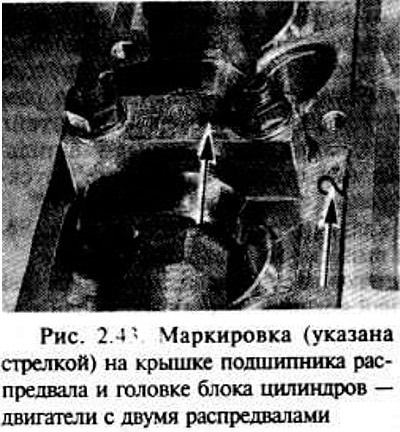
Check the markings on the camshaft bearing caps, and if there are none, make marks on the caps and…


Before removing the camshaft, check its axial offset. If it exceeds the permissible value, the camshaft must be replaced.

Loosen the bearing cap nuts in half-turn increments.

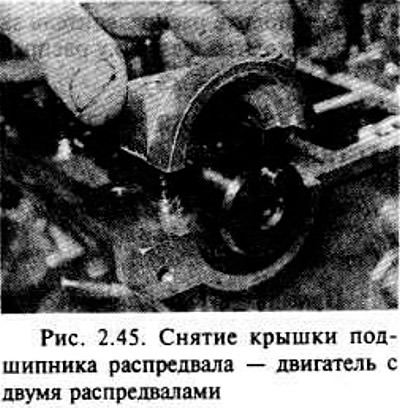
Remove the bearing cap nuts with washers and the caps themselves, then carefully remove the shaft.
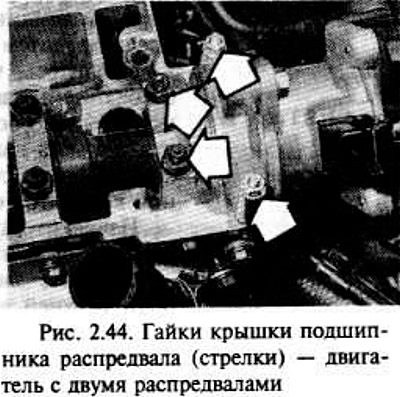
Remove the bearing cap nuts with washers and the caps themselves, then carefully remove the shaft.


Examination


After removing the camshaft, check the bearing surfaces for wear or chipping. If any, the cylinder head and bearing caps must be replaced as a set, since only the bearings cannot be replaced.


After removing the camshaft, check the bearing surfaces for wear or chipping. If any, the cylinder…


The camshaft should not have any scratches or burrs on the journal or cam surfaces. If any, replace the camshaft.

We strongly recommend replacing the front camshaft oil seal.

Installation


Begin installation by liberally lubricating the cam contact surfaces with molybdenum disulfide paste.

Lubricate the mating surfaces of the bearing cap, which contains the seal, and, if it is an exhaust camshaft, the bearing cap at the distributor drive with a suitable sealant (Vauxhall/Opel N 15 04 201 or equivalent).

Lubricate the bearing and camshaft lobes with oil, then install the camshaft in place so that the sprocket pin is at the highest point.

Install the bearing caps in the location marked before removal.

Install the bearing cap washers and nuts and tighten the nuts gradually in half-turn increments to the specified torque. Remember that when installing the exhaust camshaft, the two smaller nuts at the rear bearing cap should be tightened after all the main nuts have been tightened. Also, the two smaller nuts should be tightened with a torque wrench with a lower setting value than the main nuts.

Lightly coat the lips of the new front oil seal with grease and install it in place.


Install the ignition distributor (chapter 5).

Install the camshaft sprocket.


This article is available at russian, bulgarian, belarusian, ukrainian, serbian, croatian, romanian, polish, slovak, hungarian
Checking the article: Trifonova Emilia

Share information:

Previous articles
Opel Astra F: Engine in car
Next articles

Camshaft Seals — Replacement
Belt tension indicator (1.4 and 1.6 L engines) — removal and installation
Timing Belt Sprockets — Removal and Installation
Distributor belt — removal, installation and adjustment
Timing Belt Covers — Removal and Installation
Crankshaft pulley — removal and installation
Cylinder head — removal and installation
Oil pump — removal and installation
Oil pump — disassembly, inspection, assembly
Crankshaft Seals — Removal
Flywheel/Drive Disc — Removal, Inspection, and Installation
Oil Cooler (TWC Engine) — Removal and Installation


See similar ones from other Opel car manuals:
▶ Replacing the camshaft seal Opel Corsa B (1993-2000)
▶ Replacing the primary drive chain (camshaft drive chain) Opel Insignia A (2008-2017)
▶ Installing the camshaft Opel Kadett E (1984-1995)
▶ Camshaft Cover — Removal and Installation Opel Omega B2 (1999-2003)
▶ Front camshaft oil seal — removal and installation Opel Vectra A (1988-1995, petrol)
Link to this page in different formats

Visitor comments


No comments yet


How much will 29 + 33 =


Astra J (2009-2015, petrol) 
  • General information
  • Vehicle device
  • User manual
  • Faults en route
  • Maintenance
  • Power unit
  • Engine repair
  • Cooling and lubrication system
  • Engine power system
  • Exhaust system
  • Transmission
  • Clutch
  • Car gearbox
  • Drive shafts
  • Chassis
  • Front suspension
  • Rear suspension
  • Steering
  • Brake system
  • Wheels and tires
  • Body
  • Exterior
  • Interior
  • Doors and windows
  • Body Care
  • Heating and air conditioning
  • Security systems
  • Electrical equipment
  • Equipment and devices
  • Lighting and signaling
  • Power devices
  • Electrical circuits
Astra H (2004-2009) 
  • General information
  • Introduction to the guide
  • Troubleshooting
  • User manual
  • Maintenance
  • Power unit
  • Engine repair
  • Cooling and heating
  • Power and exhaust system
  • Ignition system
  • Launch and charge system
  • Transmission
  • Mechanical gearbox
  • Automatic gearbox
  • Drive shafts
  • Chassis
  • Brake system
  • Car suspension
  • Steering
  • Body
  • Interior
  • Exterior
  • Electrical equipment
  • Equipment and devices
  • Electrical circuits
Astra G (1998-2004) 
  • General information
  • Introduction to manual
  • User manual
  • Maintenance
  • Power unit
  • SOHC gasoline engines
  • DOHC gasoline engines
  • Diesel engines 1.7 and 2.0
  • Engine repair
  • Cooling system
  • Supply system
  • Injection system (gasoline)
  • Injection system (diesel)
  • Exhaust system
  • Charge and launch system
  • Ignition system (gasoline)
  • Preheat system (diesel)
  • Transmission
  • Manual gearbox
  • Automatic gearbox
  • Clutch
  • Drive shafts
  • Chassis
  • Brake system
  • Wheel suspension
  • Steering
  • Body
  • Exterior
  • Interior
  • Doors and windows
  • Ventilation and heating
  • Electrical equipment
  • Equipment and devices
  • Electrical circuits
Astra G (1998-2004, petrol) 
  • General information
  • User manual
  • Car care
  • Maintenance
  • Power unit
  • Single shaft engines
  • Twin shaft engines
  • Engine repair
  • Cooling and heating
  • Fuel and exhaust systems
  • Starting and charging system
  • Ignition system
  • Transmission
  • Clutch
  • Mechanical gearbox
  • Automatic gearbox
  • Drive shafts
  • Chassis
  • Brake system
  • Car suspension
  • Steering
  • Body
  • Interior
  • Exterior
  • Electrical equipment
  • Equipment and devices
  • Wiring diagrams Opel Astra
  • Wiring diagrams Opel Zafira
Astra F (1991-1998, petrol) 
  • General information
  • Maintenance
  • Power unit
  • Engine in car
  • Engine removed
  • Cooling system
  • Heating and ventilation
  • Fuel supply (carburetor)
  • Fuel supply (injector)
  • Emission control
  • Ignition system
  • Transmission
  • Clutch
  • Mechanical gearbox
  • Automatic gearbox
  • Drive shafts
  • Chassis
  • Brake system
  • Car suspension
  • Steering
  • Body
  • Exterior
  • Interior
  • Electrical equipment
  • Equipment and devices
  • Electrical circuits
OpelBook.ru © 2017–2026 · Mobile version · · Sitemap: EN BG BY UA RS HR RO PL SK HU · Feedback · Site search
Astra F, petrol · Astra G, petrol · Astra G · Astra H · Astra J, petrol · Corsa B · Corsa C, petrol · Corsa C · Insignia A · Kadett D · Kadett E · Omega A · Omega B · Omega B2 · Vectra A, petrol · Vectra A · Vectra B, petrol · Vectra B · Vectra C · Zafira A, petrol · Frontera A, petrol · Frontera B · Ascona C · Vivaro A ·
We want your visit to be comfortable 🤝! We use cookies 🍪 to make that happen.