


Contents: Removal ⬇ Installation ⬇
Note: Before you begin, see. Chapter 2.
Removal
Single overhead camshaft models
1. The procedure is the same as described for models with carburettors. See Section 4A, however note the following:
- a) Depressurize the fuel system (Chapter 8).
- b) On models with C16 NZ and XI6 SZ engines, disconnect the exhaust system from the manifold
- c) When working with the sensors in the fuel tank, please note that only one hose needs to be disconnected.
- d) Disconnect the fuel lift pump hose and electrical wiring as described in Chapter 12.
- e) When releasing the tank fastening straps, please note that the fuel filter must be moved to the side or completely removed, as you find more convenient
- j) One of the fuel supply hoses is connected to a pipe on the side of the tank.
Models with two overhead camshafts
2. Disconnect the negative cable from the battery.
3. Pump out all remaining fuel from the tank.
4. Block the front wheels, then jack up the rear of the vehicle and support it on axle stands placed under the sides of the body frame.
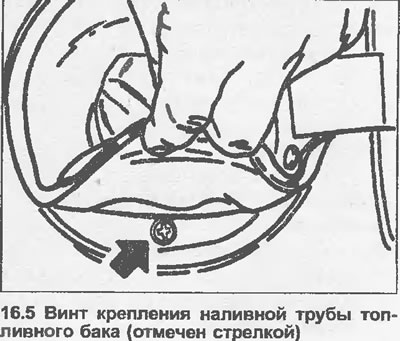
5. Open the lid of the native fuel tank neck, then move the rubber seal away and unscrew the screw underneath that secures the fuel tank filler pipe (see illustration).
6. Release the drain hoses from the brackets on the bottom.
7. Support the fuel tank with a jack.
8. Remove the mounting bolts from the tank mounting straps. Then remove the straps, lower the tank enough to allow disconnection of the fuel supply hoses, ventilation hoses and fuel level sensor wiring in the tank (see illustration).
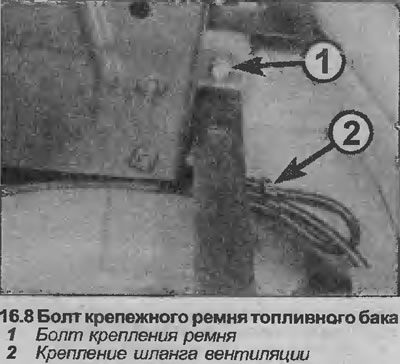
9. Disconnect the ventilation hoses and sensor wiring. Note the positions of the hoses to facilitate installation.
10. Disconnect the fuel supply hoses from the tank and sensor, marking their positions to avoid confusion during installation. Plug the open ends of the hoses to prevent dirt from entering and further fuel loss.
11. Lower the fuel tank and remove it from under the vehicle.
12. If there is sediment or water in the tank, flush it two or three times with clean fuel. But before that, remove the sensor from the fuel tank as described in Chapter 17. This procedure should be carried out in a well-ventilated area or outdoors, while observing fire safety measures.
Installation
13. Fuel tank repairs must be performed by a professional.
14. Install in reverse order, making sure all hoses are connected correctly as marked before removal.
15. Finally, fill the fuel tank, then start the engine and check the system for leaks. If there are leaks, turn off the engine immediately and fix the problem without delay.
The source is on the online website [OpelBook]
Visitor comments