


Note: For safety, the fuel tank should be removed in a well-ventilated area, never over a pit.
1. Disconnect the negative battery cable.
2. Remove the filler cap and, if possible, pump out all the fuel (there is no drain plug).
3. Block the front wheels, then jack up the rear of the car and secure it on axle stands.
4. Disconnect the electrical wiring from the fuel level sensor and the fuel pump, if it is located in the fuel tank.
5. Place a suitable container under the fuel tank to catch any spilled fuel.
6. Mark the fuel supply and return hoses and install clamps on them. Loosen the clamps, disconnect the hoses and plug the open ends.
7. On fuel injected models, disconnect the valve pipe.
8. On models equipped with air leveling rear suspension, disconnect the pressure line from the fuel tank.
9. Support the fuel tank using a block and jack.
Original posted on the website [Opelbook.ru]
10. Unscrew the two fastening straps from the bottom (photo).
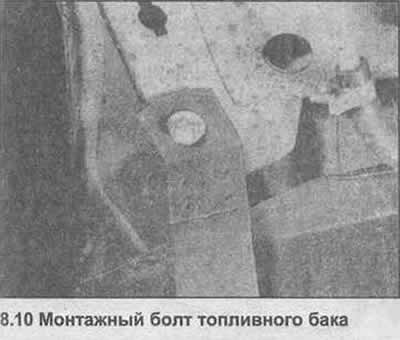
11. Slowly lower the fuel tank.
12. Remove the rubber hose from the wing.
13. Note the location of the ventilation tubes and disconnect them.
14. Remove the fuel level sensor and, where applicable, the fuel pump (Chapters 9 and 6).
15. Loosen the hose clamps, remove the filler neck, valve container and hose.
16. Drain the remaining fuel from the tank.
17. If the tank is contaminated with sediment or water, flush it with clean fuel. If there are leaks or the tank is damaged, contact a specialist for repair or replace it. Do not solder or weld the fuel tank under any circumstances.
18. Check the ventilation tubes, hose and clamps, replace if necessary.
19. Installation is carried out in reverse order, but please note the following additional points:
- (a) Make sure that the ventilation tubes and hoses are not kinked or pinched.
- (b) Install the rubber hose with the "U" mark on the end.
- (c) Do not tighten the lower filler hose clamp until the filler neck is installed correctly.
Visitor comments