


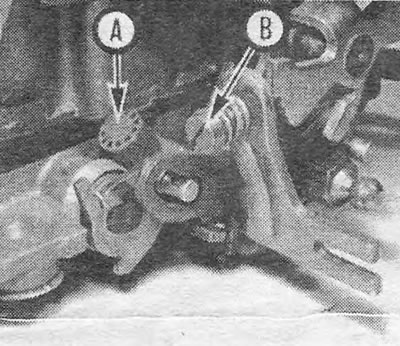
Photo 10.1A. GM Varajet carburetor - showing quantity screw (A) and fast idle adjustment screw (B).
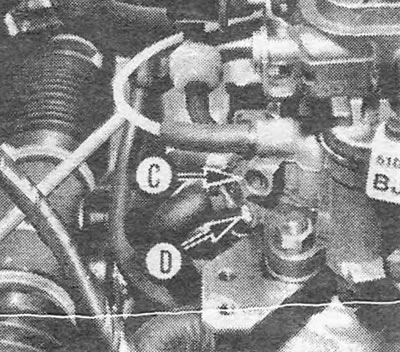
Photo 10.1B. GM Varajet carburetor - additional valve visible (bypass) quality screw (C) and the location of the main quality screw (D), as well as the coolant hoses and vacuum hoses that go to the rear of the carburetor.
2. Additional provision (bypass) mixture composition adjustment screw. It is not closed with a plug, because it is with its help that the engine idle speed is regulated.
3. Before adjusting the carburetor, check that the engine is at normal operating temperature, the ignition is properly adjusted, the spark plugs have the correct spark gap, the choke is fully open, and the throttle cable is properly adjusted.
4. Connect the tachometer to the engine in accordance with the manufacturer's instructions.
(Material provided by this website: www.opelbook.ru)
5. If the idle speed is outside the specified limits (see Specifications), adjust them by turning the additional (bypass) quality screws. This will not affect the CO content in the exhaust in any way.
6. After overhauling the carburetor or replacing any of its important parts, the idle speed and mixture composition should be adjusted.
7. Connect the tachometer and exhaust gas analyzer in accordance with the manufacturer's instructions. Connect the vacuum gauge to the distributor at the vacuum sampling point.
8. Remove the plugs.
9. With the engine at normal operating temperature, check the CO content in the exhaust gases. If it is out of the permissible range, adjust it with the main quality screw. Turning the screw clockwise decreases the CO content, counterclockwise increases it.
10. Reduce idle speed to 600 rpm to check vacuum. If it goes beyond 0-20 mbar, remove the plug from the quantity screw and use it to achieve a vacuum of 10 mbar. Return the speed to the desired value using an additional (bypass) quality screws.
10. After completing the adjustment, install new plugs on the screws.
Visitor comments