
OpelBook.ru
Cars AvtoVAZ Cars Mitsubishi Cars BMW Cars Mercedes Cars Nissan Cars Toyota Cars Chevrolet
English Русский
Български
Беларускі
Український
Српски
Hrvatski
Română
Polski
Slovenský
Magyar
 |  Sitemap  |  Contacts  |    


Main Astra Corsa Insignia Kadett Omega Vectra Zafira Others Articles
Frontera A (1991-1998, petrol) Frontera B (1998-2004) Ascona C (1981-1988) Vivaro A (2001-2014)
  • Main
  • Opel
  • Ascona C
  • Power unit
  • Fuel and exhaust system
  • Carburetor Pierburg 2EZ — adjustment on the engine

Carburetor Pierburg 2EZ — adjustment on the engine (Opel Ascona C)

            0

Contents: Fast idle ⬇ Air damper lowering (opening)…⬇ Vacuum Blocks - Checking for Leaks ⬇
The following checks and adjustment procedures are not required under normal conditions and should only be performed if the adjustments described in Section 15 do not allow the carburetor to operate properly. They may also be required after removing and overhauling the carburetor.

Fast idle


1. The engine must be at normal operating temperature and the idle speed and mixture composition must be properly adjusted. To make work easier, remove the air cleaner.

2. Set the fast idle screw to the second highest step on the fast idle cam. Connect a tachometer to the engine. Check that the air damper is fully open.

3. Start the engine without pressing the gas pedal and compare the engine speed with the value specified in the Specifications. If adjustment is necessary, break off the plug covering the fast idle speed adjustment screw and adjust the speed with it (see photo).
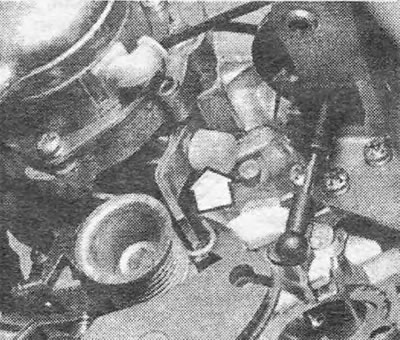
Photo 16.3. Fast idle speed adjusting screw (shown by arrow) — the carburetor has been removed for…

Photo 16.3. Fast idle speed adjusting screw (shown by arrow) — the carburetor has been removed for clarity purposes.


(Material copied from this portal OPELBOOK.ru)

4. Once the desired speed has been achieved, turn off the engine and disconnect the tachometer.

Air damper lowering (opening) mechanism


5. Remove the air cleaner.

6. Unscrew 3 screws, remove the retaining ring and then the choke cover. There is no need to disconnect the cooling system hoses, just move the cover to the side. Note how the end of the bimetallic spring is attached to the air damper actuator lever (see photo).
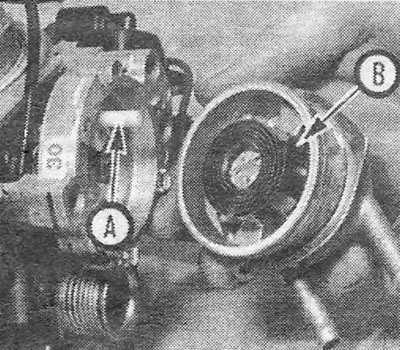
Photo 16.6. The loop (B) at the end of the bimetallic spring must be hooked onto the air damper…

Photo 16.6. The loop (B) at the end of the bimetallic spring must be hooked onto the air damper drive lever (A).


7. Move the air damper drive lever until it is completely closed. Set the fast idle screw to the highest cam ledge.

8. Apply vacuum to the air damper lowering (opening) unit (on the hose closest to the carburetor body). Press the air damper actuator lever slightly in a clockwise direction (as for closing the damper) and measure the gap between the edge of the valve and the wall of the neck, inserting a drill of the appropriate size between them (see photo).
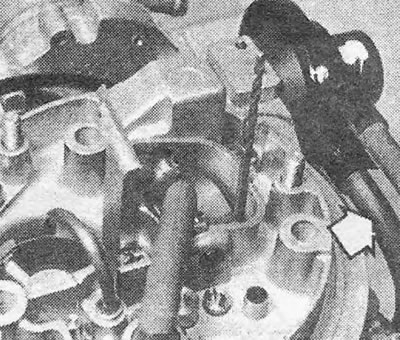
Photo 16.8. Checking the clearance when lowering the air damper using a drill. Apply vacuum to the…

Photo 16.8. Checking the clearance when lowering the air damper using a drill. Apply vacuum to the hose shown by the arrow.


9. If adjustment is necessary, turn the adjusting screw located on the side of the choke housing (see photo).
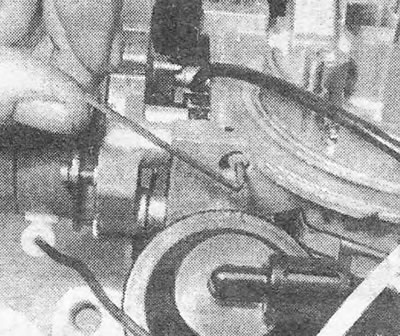
Photo 16.9. Screw for adjusting the clearance of the lowered air damper.

Photo 16.9. Screw for adjusting the clearance of the lowered air damper.


10. Replace the choke cover, making sure that the end of the spring is hooked onto the choke drive lever. When tightening the screws, align the marks on the choke cover with the marks on its body (see photo).
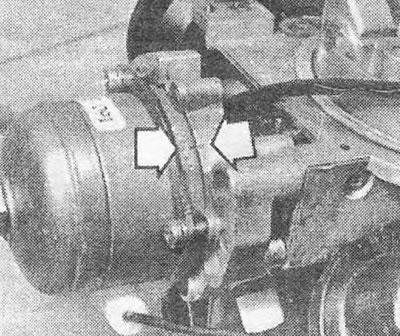
Photo 16.10. Installation marks on the cover and the choke housing (shown by arrows).

Photo 16.10. Installation marks on the cover and the choke housing (shown by arrows).


Vacuum Blocks - Checking for Leaks


11. If you have a vacuum source with a vacuum gauge, apply a vacuum of approximately 300 mbar to the air damper lowering (opening) block (on the hose closest to the carburetor body). Shut off the vacuum source and check if the unit holds the vacuum. If the block is leaking, find and repair or replace the leaking part.


12. Check the secondary throttle valve vacuum block in the same manner.

13. If you do not have a vacuum source, the tightness of the vacuum blocks can be checked by trial replacement.


This article is available at russian, bulgarian, belarusian, ukrainian, serbian, croatian, romanian, polish, slovak, hungarian
Checking the article: Kornev Georgy

Share information:

Previous articles
Opel Ascona C: Fuel and exhaust system
Next articles

Carburetor Pierburg 2EZ — regulation of idle speed and mixture composition
Carburetor Pierburg 2EZ — description
GM Varajet Carburetor — Overhaul
GM Varajet Carburetor — Removal and Installation
GM Varajet Carburetor — Engine Adjustment
GM Varajet Carburetor — Idle Speed and Mixture Control
Carburetor Pierburg 2EZ — removal and installation
Carburetor Pierburg 2EZ — overhaul
Carburetor Pierburg 2EZ — adjustment on the removed carburetor
Injector system — description
Injector system — precautions
Injector system — regulation of idle speed and mixture composition


See similar ones from other Opel car manuals:
▶ Carburetor — diagnostics of faults, repair and adjustment Opel Astra F (1991-1998, petrol)
▶ Checking and basic adjustment of ignition timing (C14NZ… Opel Corsa B (1993-2000)
▶ Starting a carburetor engine Opel Kadett E (1984-1995)
▶ Carburetor Throttle Damper (Automatic Transmission Models)… Opel Omega A (1986-1993)
▶ Engine compartment fuse box Opel Insignia A (2008-2017)
Link to this page in different formats

Visitor comments


No comments yet


How much will 34 + 42 =


Vivaro A (2001-2014) 
  • General information
  • User manual
  • Power unit
  • Petrol engine F4R
  • Diesel engine F9Q
  • Diesel engine G9U
  • Transmission
  • Clutch and drive shafts
  • Manual gearbox
  • Chassis
  • Front suspension
  • Rear suspension
  • Brake system
  • Body
  • Exterior
  • Interior
  • Electrical equipment
  • Heating and ventilation
  • Air conditioner
  • Equipment and devices
  • Electrical diagrams
Ascona C (1981-1988) 
  • General information
  • Maintenance
  • Power unit
  • Gasoline engines
  • Diesel engines
  • Cooling system
  • Fuel and exhaust system
  • Contact ignition system
  • Contactless ignition system
  • Transmission
  • Clutch
  • Mechanical gearbox
  • Automatic gearbox
  • Drive shafts
  • Chassis
  • Steering
  • Brake system
  • Car suspension
  • Body
  • Exterior
  • Interior
  • Doors and windows
  • Electrical equipment
  • Equipment and devices
  • Power devices
  • Electrical circuits
Frontera B (1998-2004) 
  • General information
  • User manual
  • Maintenance
  • Power unit
  • Petrol engines 2.2 l
  • Petrol engines 3.2 l
  • Diesel engines 2.2 l
  • Cooling system
  • Fuel system (petrol)
  • Fuel system (diesel)
  • Ignition system
  • Transmission
  • Clutch
  • Manual gearbox MUA5C
  • Automatic gearbox 4L30E
  • Chassis
  • Suspension and axles
  • Steering
  • Brake system
  • Body
  • Exterior
  • Interior
  • Doors, locks and windows
  • Heating and air conditioning
  • Electrical equipment
  • Power devices
  • Equipment and devices
  • Lighting and signaling
  • Electrical diagrams
Frontera A (1991-1998, petrol) 
  • General information
  • Introduction to guide
  • User manual
  • Maintenance
  • Power unit
  • Engine repair
  • Lubrication system
  • Cooling system
  • Power and exhaust system
  • Engine electrics
  • Transmission
  • Clutch
  • Mechanical gearbox
  • Cardan shafts
  • Chassis
  • Brake system
  • Front suspension
  • Rear suspension
  • Steering
  • Body
  • Repair and care
  • Electrical equipment
  • Equipment and devices
  • Electrical circuits
OpelBook.ru © 2017–2026 · Mobile version · · Sitemap: EN BG BY UA RS HR RO PL SK HU · Feedback · Site search
Astra F, petrol · Astra G, petrol · Astra G · Astra H · Astra J, petrol · Corsa B · Corsa C, petrol · Corsa C · Insignia A · Kadett D · Kadett E · Omega A · Omega B · Omega B2 · Vectra A, petrol · Vectra A · Vectra B, petrol · Vectra B · Vectra C · Zafira A, petrol · Frontera A, petrol · Frontera B · Ascona C · Vivaro A ·
We want your visit to be comfortable 🤝! We use cookies 🍪 to make that happen.