
OpelBook.ru
Cars AvtoVAZ Cars Mitsubishi Cars BMW Cars Mercedes Cars Nissan Cars Toyota Cars Chevrolet
English Русский
Български
Беларускі
Український
Српски
Hrvatski
Română
Polski
Slovenský
Magyar
 |  Sitemap  |  Contacts  |    


Main Astra Corsa Insignia Kadett Omega Vectra Zafira Others Articles
Frontera A (1991-1998, petrol) Frontera B (1998-2004) Ascona C (1981-1988) Vivaro A (2001-2014)
  • Main
  • Opel
  • Ascona C
  • Chassis
  • Car suspension
  • Level Control System — Description

Level Control System — Description (Opel Ascona C)

            0

Contents: Automatic control system. ⬇ Manual control system. ⬇
1. This system is only installed on some models and its function is to compensate for the effect on the rear suspension due to the vehicle being loaded with heavy loads or being used as a tow vehicle.

2. This system operates by changing the air pressure in the rear shock absorbers. On some models, the pressure in the system is regulated automatically, while on others (which is more common) the pressure can be adjusted manually.

Automatic control system.


3. When a fully automatic system is installed, the compressed air source is an electrically driven compressor and the driver does not need to do anything. The level change response occurs after 20 seconds to prevent the system from activating during bumpy driving.

4. The diagram of the automatic level control system and the location of the various components are shown in Figure 10.33.

(Material taken from an internet portal www.OPELBOOK.ru)
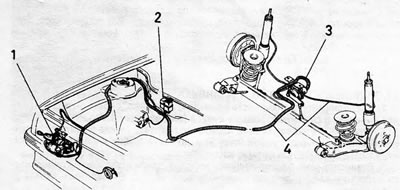
Figure 10.33. Components of an automatic level control system 1. Electric compressor. 2. Relay and…

Figure 10.33. Components of an automatic level control system 1. Electric compressor. 2. Relay and fuse assembly. 3. Load sensor. 4. Overhead and electric lines.


Manual control system.


5. On this more common system, the compressed air line is connected to a coupling inside each shock absorber at the rear. The two hoses are combined into one, which passes through the side panels of the housing to the control valve (similar to a tire pressure valve) in the back of the case. The location of this valve varies depending on the model, but it should be either in the trunk or in the rain channel on the right rear corner (access with trunk lid open).


This article is available at russian, bulgarian, belarusian, ukrainian, serbian, croatian, romanian, polish, slovak, hungarian
Checking the article: Kornev Georgy

Share information:

Previous articles
Opel Ascona C: Car suspension
Next articles

Flexible bushings of the closing lever — replacement
Rear Axle — Removal and Installation
Short axle rear suspension — removal and installation
Rear Coil Spring — Removal and Installation
Rear anti-roll bar — removal and installation
Rear shock absorber — removal, inspection and installation
Level control system (manual) — setup
Level Control System Components — Removal and Installation (General Description)
Rear wheel arrangement
Wheels and Tyres — General Care and Maintenance
Fault Diagnosis — Suspension


See similar ones from other Opel car manuals:
▶ Rear Suspension Level Control System — General Information Opel Astra F (1991-1998, petrol)
▶ Checking the rear suspension level control system Opel Vectra A (1988-1995, petrol)
▶ Using an Oscilloscope to Monitor the Operating Parameters… Opel Corsa B (1993-2000)
▶ Replacing the control unit of the system for changing the… Opel Insignia A (2008-2017)
▶ On-board control system Opel Kadett E (1984-1995)
Link to this page in different formats

Visitor comments


No comments yet


How much will 33 + 48 =


Vivaro A (2001-2014) 
  • General information
  • User manual
  • Power unit
  • Petrol engine F4R
  • Diesel engine F9Q
  • Diesel engine G9U
  • Transmission
  • Clutch and drive shafts
  • Manual gearbox
  • Chassis
  • Front suspension
  • Rear suspension
  • Brake system
  • Body
  • Exterior
  • Interior
  • Electrical equipment
  • Heating and ventilation
  • Air conditioner
  • Equipment and devices
  • Electrical diagrams
Ascona C (1981-1988) 
  • General information
  • Maintenance
  • Power unit
  • Gasoline engines
  • Diesel engines
  • Cooling system
  • Fuel and exhaust system
  • Contact ignition system
  • Contactless ignition system
  • Transmission
  • Clutch
  • Mechanical gearbox
  • Automatic gearbox
  • Drive shafts
  • Chassis
  • Steering
  • Brake system
  • Car suspension
  • Body
  • Exterior
  • Interior
  • Doors and windows
  • Electrical equipment
  • Equipment and devices
  • Power devices
  • Electrical circuits
Frontera B (1998-2004) 
  • General information
  • User manual
  • Maintenance
  • Power unit
  • Petrol engines 2.2 l
  • Petrol engines 3.2 l
  • Diesel engines 2.2 l
  • Cooling system
  • Fuel system (petrol)
  • Fuel system (diesel)
  • Ignition system
  • Transmission
  • Clutch
  • Manual gearbox MUA5C
  • Automatic gearbox 4L30E
  • Chassis
  • Suspension and axles
  • Steering
  • Brake system
  • Body
  • Exterior
  • Interior
  • Doors, locks and windows
  • Heating and air conditioning
  • Electrical equipment
  • Power devices
  • Equipment and devices
  • Lighting and signaling
  • Electrical diagrams
Frontera A (1991-1998, petrol) 
  • General information
  • Introduction to guide
  • User manual
  • Maintenance
  • Power unit
  • Engine repair
  • Lubrication system
  • Cooling system
  • Power and exhaust system
  • Engine electrics
  • Transmission
  • Clutch
  • Mechanical gearbox
  • Cardan shafts
  • Chassis
  • Brake system
  • Front suspension
  • Rear suspension
  • Steering
  • Body
  • Repair and care
  • Electrical equipment
  • Equipment and devices
  • Electrical circuits
OpelBook.ru © 2017–2026 · Mobile version · · Sitemap: EN BG BY UA RS HR RO PL SK HU · Feedback · Site search
Astra F, petrol · Astra G, petrol · Astra G · Astra H · Astra J, petrol · Corsa B · Corsa C, petrol · Corsa C · Insignia A · Kadett D · Kadett E · Omega A · Omega B · Omega B2 · Vectra A, petrol · Vectra A · Vectra B, petrol · Vectra B · Vectra C · Zafira A, petrol · Frontera A, petrol · Frontera B · Ascona C · Vivaro A ·
We want your visit to be comfortable 🤝! We use cookies 🍪 to make that happen.