


Contents: Maintenance work ⬇ Removal the brake booster ⬇ Replacing brake pipes ⬇ Removal brake hoses ⬇
Maintenance work
The engine must be turned off.
Press the brake pedal 10 times.
Now keep the pedal fully depressed and start the engine.
If the brake booster is working properly, the pedal should move slightly. If the pedal does not move, the brake booster is faulty.
The defect most likely lies in the low-pressure system: the vacuum hose from the intake manifold to the brake booster is leaky, the check valve in the vacuum hose is leaky, the rubber ring between the master brake cylinder and the servo drive or the brake booster membrane is defective.
To check the check valve, remove the vacuum hose to the servo on the distributor part at the intake manifold - it cannot be blown through, but suction is possible.
When installing a new valve, the arrow on its body should point towards the intake manifold.
To replace a defective rubber ring between the master brake cylinder and the booster, you need to remove the cylinder.
Finally, there is still a defect in the brake booster itself. In this case, repair is impossible - replace it.
Removal the brake booster
At the driver's feet, remove the trim under the dashboard.
Remove the safety clip from the piston rod pin and remove the pin.
In the engine compartment, remove the rubber gasket from the front wall.
Remove the vacuum hose from the brake booster.
Unscrew the master cylinder from the brake booster.
Unscrew the wiring harness channel on the front wall.
Remove the relay box from the brake booster.
Where necessary, unscrew the brake pipes from the ABS hydraulic unit.
Loosen the brake booster bracket mounting bolts.
At the rear of the brake booster, unscrew the four mounting nuts.
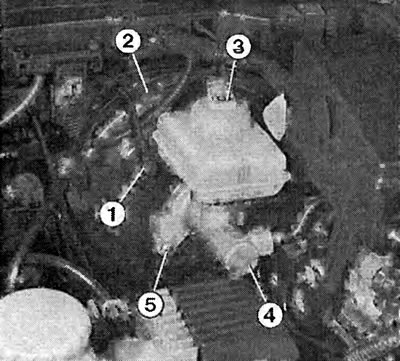
The brake booster is located on the left in the engine compartment. The numbers indicate:
1 - vacuum hose to intake manifold;
2 - brake booster;
3 - expansion tank with brake fluid;
4 - master brake cylinder;
5 - fastening nut of the main brake cylinder.
Slightly tilt the brake booster in the engine compartment and remove it upwards.
If you are installing a new brake booster, remove the bracket, lock nut and fork from the old one.
Loosely thread the hex nut and fork onto the piston rod of the new brake booster.
Adjust the piston rod length: the distance from the fork to the adjacent surface with four spacer pins should be 149.5 + 0.5 mm. Lock the hex nut (18 Nm).
Screw on the bracket with a new gasket (20 Nm).
Insert the brake booster into the front wall from the engine compartment side. Tighten the mounting nuts to 20 Nm.
Brake pipes on the hydraulic unit - 20 Nm.
Lightly lubricate the pivot pin before installation.
Insert a new O-ring between the brake booster and the master cylinder.
After installation, check the operation of the brake booster.
Replacing brake pipes
Unscrew the union nut of the brake pipe. To do this, hold the mutual screw connection, for example, with the brake hose.
If the nut is rusted to the tube, which rotates with it, then the tube must be replaced in any case. Thin-walled tubes break off quickly.
To loosen the tube connections, you can use the following technique if the section of tube already needs to be replaced:
Cut off the brake pipe near the screw connection, unscrew the nut with a hex key.
If the new tube needs to be bent a little more, then this can only be done with a large radius. Otherwise, the thin tube will break.
Use your thumb to hold the inside of the tube as you bend it. This way you can work slowly along the radius.
Don't forget any protective hoses for the tubes that may be present.
Place the brake pipes into the spacer brackets.
Tightening torque 16 Nm.
Removal brake hoses
Front brake hose: Remove the corresponding front wheel.
If necessary, remove the brake pad wear indicator wire retaining clip from the brake hose.
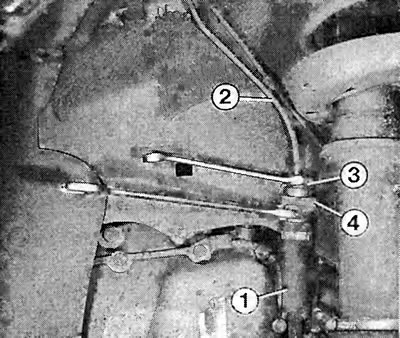
The brake pipe (2) is secured to the brake hose (1) with a union nut (3). The brake hose in turn is secured to the bracket with a safety clip (4).
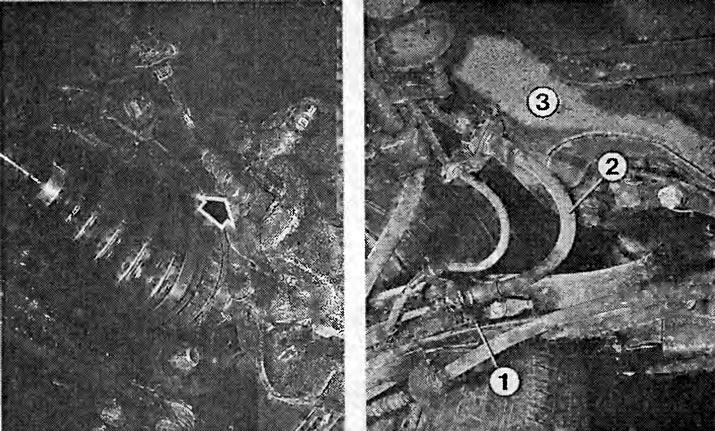
Left: at the front, the brake hose is attached to the brake caliper with a hollow bolt. The hollow bolt can only be tightened to 40 Nm.
Right: the photograph shows the brake hose (2) routed between two brackets on the rear axle support (3) and, accordingly, on the trailing arm (1). The brake hose is secured in the brackets with metal clamps.
Unscrew the union nut of the corresponding brake pipe, while pressing the connecting element in the opposite direction.
Remove the safety shields from the brackets using pliers.
Unscrew the hollow bolt from the brake caliper. Remove the brake hose. Use new gaskets when installing.
Rear brake hose: Unscrew both union nuts of the brake pipes, press the connecting element in the opposite direction.
Remove the safety shields from the brackets using pliers.
Remove the brake hose from the brackets.
Installation: Do not install the brake hoses in a twisted form. The longitudinal strips along the hoses serve as a control.
Tightening torques: brake hose on the brake caliper - 40 Nm, brake hose on the brake pipe - 16 Nm.
Bleed the brake system.
Immediately after the repair, check to see if the hoses are rubbing anywhere.
Repeat the check after a long trip.
Visitor comments