
OpelBook.ru
Cars AvtoVAZ Cars Mitsubishi Cars BMW Cars Mercedes Cars Nissan Cars Toyota Cars Chevrolet
English Русский
Български
Беларускі
Український
Српски
Hrvatski
Română
Polski
Slovenský
Magyar
 |  Sitemap  |  Contacts  |    


Main Astra Corsa Insignia Kadett Omega Vectra Zafira Others Articles
Vectra A (1988-1995, petrol) Vectra A (1988-1995) Vectra B (1995-2002, petrol) Vectra B (1995-2002) Vectra C (2002-2008)
  • Main
  • Vectra
  • Vectra B
  • Chassis
  • Brake system
  • Malfunction of the anti-lock system

Malfunction of the anti-lock system (Opel Vectra B)

            0

When the ignition is turned on, the ABS indicator light on the instrument panel flashes. It should go out when the engine starts or no later than when the vehicle reaches a speed of 5 km/h.

If the indicator light is constantly on, the ABS is not ready for operation. An Opel workshop with the appropriate equipment should find the cause of this phenomenon. Not every workshop can do this, as it requires additional tools and constant professional training of employees, so find out first. As an amateur, you can at least check the plug connectors of the control unit or the speed sensors. Below are some more tips based on our experience with ABS failures:
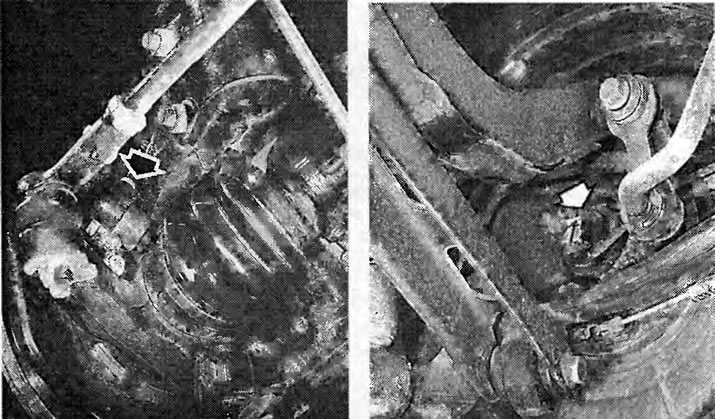
Left: the speed sensors (arrow) on the left and right are bolted to the steering knuckles with an…

Left: the speed sensors (arrow) on the left and right are bolted to the steering knuckles with an Allen bolt and read the toothed disk on both drive shafts. The resulting voltage is a measurement value for the speed.

Right: at the rear, the ABS speed sensor (arrow) is integrated into the so-called wheel bearing module.
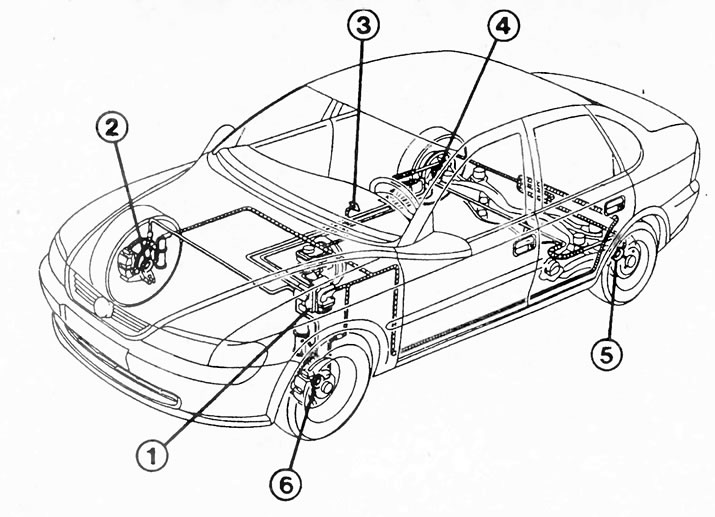

The figure shows the location of the ABS components, as well as the wiring kits and brake pipe…

The figure shows the location of the ABS components, as well as the wiring kits and brake pipe routing:
1 - hydraulic module and control unit;
2 - RPM sensor front right;
3 - ABS indicator light;
4 - speed sensor rear right;
5 - RPM sensor rear left;
6 - speed sensor, front left.


At high speed (from approximately 160 km/h) the ABS indicator light may come on. This is due to the different rotation speeds of the rear and front axle wheels, caused by an unfavourable combination of tyres. This effect does not occur with standard tyres.


If, for example, on ice the front wheels rotate for more than 20 seconds, the control lamp lights up due to the difference in wheel rotation speed.

If the on-board voltage drops below 10 V, the control lamp also lights up. It may also light up if one of the wheels makes a rotation for more than 20 seconds. Then turn off the ignition again and restart the engine.

When ABS is working, it can be felt by the pulsating brake pedal. If it pulsates even during light braking in favorable traffic conditions (aBS warning light does not come on), then this indicates a malfunction.

Tip: Even if the ABS indicator light is constantly on, i.e. the ABS is either disabled or faulty, the car can be driven without restrictions. In this case, the brakes function the same as in a car without ABS.


This article is available at russian, bulgarian, belarusian, ukrainian, serbian, croatian, romanian, polish, slovak, hungarian
Checking the article: Shapovalov Yaroslav

Share information:

Previous articles
Opel Vectra B: Brake system
Next articles

Functions of individual nodes
What does ABS do?
ABS can't do everything!
Help with brake problems
Bleeding the brake system
Checking the brake booster
Traction Control System


See similar ones from other Opel car manuals:
▶ Anti-lock braking system (ABS) Opel Astra F (1991-1998, petrol)
▶ General information about the anti-lock braking system Opel Corsa C (2000-2006, petrol)
▶ Anti-lock braking system and traction control system Opel Insignia A (2008-2017)
▶ Technical characteristics of the anti-lock braking system Opel Kadett E (1984-1995)
▶ Anti-lock Braking System (ABS) — Precautions Opel Omega A (1986-1993)
Link to this page in different formats

Visitor comments


No comments yet


How much will 23 + 50 =


Vectra C (2002-2008) 
  • General information
  • User manual
  • Vehicle device
  • Maintenance
  • Troubleshooting
  • Power unit
  • Engine repair
  • Cooling system
  • Power and control system
  • Engine electrics
  • Transmission
  • Clutch
  • Car gearbox
  • Drive shafts
  • Chassis
  • Car suspension
  • Steering
  • Brake system
  • Body
  • Exterior
  • Interior
  • Doors, locks and windows
  • Heating and ventilation
  • Electrical equipment
  • Equipment and devices
  • Headlights and lighting
  • Electrical circuits
Vectra B (1995-2002) 
  • General information
  • User manual
  • Weekly checks
  • Maintenance (gasoline)
  • Maintenance (diesel)
  • Troubleshooting
  • Power unit
  • SOHC gasoline engine
  • DOHC petrol engine
  • Diesel engine 1.7 liter
  • Diesel engine 2.0 liters
  • Engine repair
  • Cooling system
  • Fuel system (gasoline)
  • Fuel system (diesel)
  • Charging system
  • Launch system
  • Ignition and preheat
  • Transmission
  • Clutch
  • Mechanical gearbox
  • Automatic gearbox
  • Drive shafts
  • Chassis
  • Brake system
  • Wheel suspension
  • Steering
  • Body
  • Exterior
  • Interior
  • Doors and windows
  • Heating and ventilation
  • Electrical equipment
  • Equipment and devices
  • Electrical circuits
Vectra B (1995-2002, petrol) 
  • General information
  • Maintenance
  • Help with malfunctions
  • Power unit
  • Engine repair
  • Exhaust system
  • Cooling system
  • Fuel system
  • Multec injection system
  • Four point injection
  • Transmission
  • Clutch
  • Gearbox and drive
  • Chassis
  • Wheel suspension
  • Steering
  • Brake system
  • Wheels and tires
  • Body
  • Exterior
  • Interior
  • Electrical equipment
  • Fuses and electronics
  • Power devices
  • Ignition system
  • Lighting and signaling
  • Equipment and devices
  • Heating and ventilation
  • Electrical circuits
Vectra A (1988-1995) 
  • Power unit
  • Engine repair
  • Ignition system
  • Lubrication system
  • Cooling system
  • Injection system
  • Fuel system (carburetor)
  • Fuel system (diesel)
  • Exhaust system
  • Transmission
  • Clutch
  • Car gearbox
  • Chassis
  • Front suspension
  • Rear suspension
  • Steering
  • Brake system
  • Wheels and tires
  • Body
  • Exterior
  • Interior
  • Electrical equipment
  • Electrical circuits
Vectra A (1988-1995, petrol) 
  • General information
  • User manual
  • Maintenance
  • Power unit
  • SOHC engine
  • DOHC engine
  • Cooling and ventilation
  • Fuel system (carburetor)
  • Fuel system (injector)
  • Exhaust converter
  • Transmission
  • Clutch
  • Mechanical gearbox
  • Automatic gearbox
  • Drive shafts
  • Chassis
  • Brake system
  • Car suspension
  • Steering
  • Body
  • Body elements
  • Electrical equipment
  • Power devices
  • Equipment and devices
  • Electrical circuits
OpelBook.ru © 2017–2026 · Mobile version · · Sitemap: EN BG BY UA RS HR RO PL SK HU · Feedback · Site search
Astra F, petrol · Astra G, petrol · Astra G · Astra H · Astra J, petrol · Corsa B · Corsa C, petrol · Corsa C · Insignia A · Kadett D · Kadett E · Omega A · Omega B · Omega B2 · Vectra A, petrol · Vectra A · Vectra B, petrol · Vectra B · Vectra C · Zafira A, petrol · Frontera A, petrol · Frontera B · Ascona C · Vivaro A ·
We want your visit to be comfortable 🤝! We use cookies 🍪 to make that happen.