


Contents: Hydraulic module ⬇ Speed sensor ⬇ Electronic control unit ⬇ Electronic brake force distribution ⬇
Hydraulic module
It is located on the left in the engine compartment: the module is installed between the brake pipes from the master brake cylinder and the brake pipes to the wheel brakes. In accordance with the signals from the electronic control unit, the pressure on the wheel brakes is either maintained constant, or reduced, or increased again. But the pressure in the master brake cylinder cannot become higher than that which you create by pressing the brake pedal. The pressure is regulated by eight rapidly switching electromagnetic valves, i.e. two for each wheel. If the electromagnetic valves are de-energized, the pressure increases. If maximum current is supplied, the pressure decreases, and at medium current the pressure is maintained. Of particular interest is the pressure reduction phase: since the brake fluid that is squeezed out of the master brake cylinder cannot simply flow out somewhere (as a result, the brake pedal would be pressed completely), then the brake fluid is pumped back to the main brake cylinder by a powerful return pump. You notice this by the brake pedal, which begins to pulsate slightly when the return pump is operating - ABS begins to function.
If you listen carefully, you can also hear the noise from the pump. The noise is slightly suppressed by the silencer in the hydraulic module.
Speed sensor
A total of four sensors record the rotation speed of each individual wheel and transmit this information to the electronic control unit. Based on this, the control unit can, in turn, regulate the operation of the hydraulic module.
The speed sensors themselves consist of a magnetic core and a coil and are mounted a short distance from the toothed disk, the rotor. The rotor - its name speaks for itself - rotates together with the wheel and makes the teeth along its perimeter rotate past the sensor faster or slower depending on the speed. Each tooth passing under the sensor induces a short voltage rise in the sensor. In this way, an alternating voltage is created in the sensor, which changes its frequency in accordance with the speed of the wheel. The resulting signal is processed by the electronic control unit as information about the number of wheel revolutions.
In the Vectra, the rotors are located at the front on the steering knuckle. At the rear, the speed sensors are mounted in the wheel bearing modules.
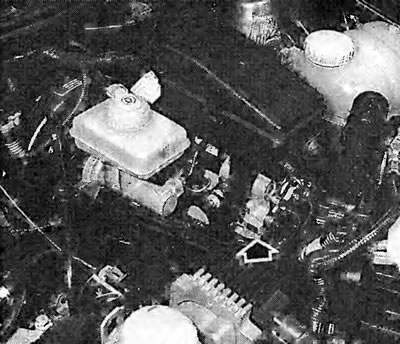
The hydraulic module of the anti-lock system is located in the engine compartment on the left.
Electronic control unit
The control unit for the anti-lock system is mounted directly on the hydraulic module. It processes the information coming from the speed sensors. At the same time, it controls the hydraulic module so that the wheels do not lock. In addition to complex signal processing and the subsequent logical part, the control unit also has a locking circuit. With its help, the device can check itself, recognize external defects and monitor the operating voltage. If an error is detected, the ABS is switched off and a control lamp lights up on the instrument panel. Furthermore, the control unit has a program memory and is capable of self-diagnosis. The error is saved in the memory for subsequent troubleshooting. For this purpose, the workshop has a reading device that is connected to the connector under the center console, as a result of which the diagnostic excitation and ground wires are short-circuited. In this way, faults are displayed on the display of the reading device and then malfunctions can be eliminated.
Electronic brake force distribution
The Vectra does without a traditional brake force regulator at the rear wheels. Instead of mechanical or hydraulic pressure control, a hydraulic ABS module is used to distribute the brake force electronically.
The control unit monitors the deceleration of the wheels via a speed sensor on each rear wheel and compares the values of the front and rear axles. If the braking forces on the rear axle are too great, the pressure is quickly reduced by means of electromagnetic valves in the hydraulic module (adapts to the optimal wheel deceleration). This prevents excessive braking of the rear axle wheels.
[Text copied from a web portal: OpelBook.ru]
Visitor comments