


Contents: Removal ⬇ Installation ⬇
Note: If the transmission is removed for repair, first make sure that it is the transmission that is damaged and not the control system (see "Troubleshooting"). The following procedure is the same as the manual transmission removal/installation given in Section 7A. Before you start working, please read the relevant Chapter Section 7A as well as the text below and prepare everything you need.
Removal
1. Disconnect the negative cable from the battery.
2. Drain the transmission fluid (see above).
3. Disconnect the transmission wiring by unplugging the five connectors from the switches, solenoids and sensors, then release the wiring from all brackets.
4. Disconnect the shift cable from the transmission control lever, then either remove the cable bracket bolts or release the cable from the bracket. Move the cable away from the transmission and tie it to the body.
5. Remove the transmission breather hose from under the battery bracket, releasing it from all mounting brackets and ties.
6. Disconnect the oxygen sensor wiring (where is it used).
7. Disconnect the speedometer drive cable.
8. Proceed as described above to disconnect the auxiliary transmission fluid cooler hoses (either from the transmission or from the radiator).
9. Support the engine/transmission, remove the front suspension subframe and disconnect the drive shafts as described in steps 7-10 Chapter 9 Section 7A (where necessary, see Sections 8 and 10).
10. Remove the three transmission case cover bolts, then mark the relative positions of the torque converter and drive plate. Place a wrench on the crankshaft pulley/sprocket bolt and rotate the crankshaft until one of the torque converter bolts becomes accessible. Lock the drive plate by inserting a screwdriver or similar tool into the recess between its teeth and remove the bolt. Remove the remaining two bolts in the same manner.
11. Remove the transmission as described in points 17-21 (except point 19) Chapter 9. Section 7A.
12. If the torque converter comes out of the transmission (even partially), a significant amount of fluid contained in the block will spill out. To prevent this, support the torque converter or secure it by bolting a metal strip across the crankcase when removing the transmission from its mounting pins and from the engine bay.
Installation
13. Installation is carried out in the reverse order of removal, paying attention to the following.
- a) If any fluid has been spilled from the torque converter, carefully refill the unit. Wipe the converter bushing to avoid damaging the transmission input shaft seal when installing it, and make sure the converter is correctly positioned on the pump shaft.
- b) If the transmission is to be replaced, carefully flush the passages of the auxiliary transmission fluid cooler. Opel recommends using low-pressure air for this, but be careful not to deform the radiator.
- c) Carefully inspect all components for cleanliness to avoid the risk of dirt entering the system.
- d) Use a special plug M10x1.25 to clean the threads of the torque converter holes and use new bolts during installation
- e) Inspect the threads of the left engine/transmission bracket hole (Section 7A, Chapter 9, point 22) and use new bolts for assembly.
Tighten all nuts and bolts to the specified tightening torque Specifications.
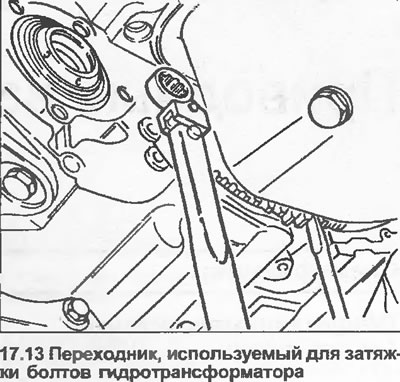
To tighten the bolts that secure the torque converter to the drive disk, you will need a special adapter, which can be purchased at auto parts stores (see illustration).
Material copied from this resource: www.opelbook.ru
Finally, adjust the shift cable length and fill the transmission with fluid (see above).
Visitor comments