


Contents: Towing hitch ⬇ Towing hitch with removable ball…⬇ Installing the bar ⬇ Removal the barbell ⬇ Trailer unladen weight ⬇ Support load ⬇ Driving performance of a car with a…⬇ Driving on hills ⬇
Towing hitch
It is advisable to install it at a service station.
Towing hitch with removable ball head bar
The removable rod with a ball head fits into a cover and is transported in the trunk.
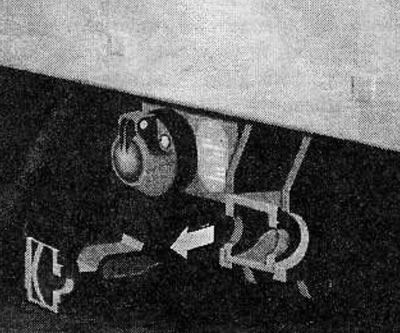
Installing the bar
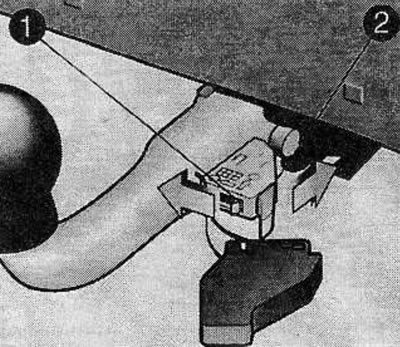
The socket for attaching the removable rod is closed with a plug. Pull it out and place it in the luggage compartment.
Unlock lever 1 by turning it to the left, press lever 2 forward.
Place the rod into the socket and press lightly to secure it in place. If it does not lock, remove it and repeat from the beginning, cleaning the socket if necessary.
For safety reasons, the removable towing hitch bar is mounted only with the protective cover fitted and secured to levers 1 and 2.
Removal the barbell
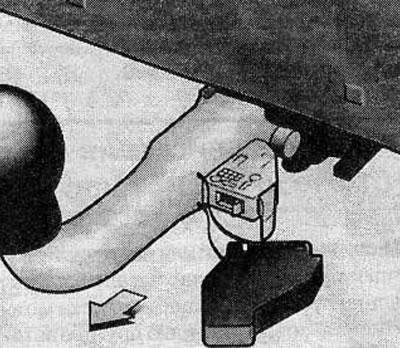
In order to avoid partially covering the rear number plate of the vehicle, the towing hitch bar with the ball head must always be removed when the vehicle is not being used with a trailer. To do this, disconnect the protective cover of levers 1 and 2 from the safety hoses and remove it.
Turn lever 1 to the left and unlock.
Press lever 2 forward and remove the bar. Cover it with a cover and put it in the trunk. Insert a plug into the freed socket for attaching the rod.
Trailer unladen weight
The trailer's permissible loads are the characteristics that affect the vehicle's driving performance and on which the normal operation of the engine depends. For this reason, their excess is not permitted. The actual load of the Caravan trailer is the difference between the gross weight of the trailer itself and the weight of the cargo carried on it.
You can find out the permissible trailer loading standards by subtracting the total mass of the unladen vehicle indicated on the identification plate from the indicated total mass of the vehicle with a trailer. These calculations are based on the vehicle moving uphill with a 12% incline.
When driving in the mountains, at high altitudes, these standards, as well as engine power, may be somewhat lower, therefore the permissible trailer load should be reduced.
Support load
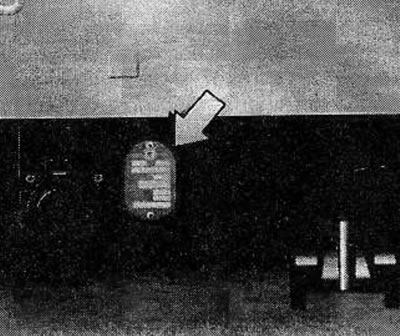
The support load with which the Caravan towing device or trailer presses on the head of the towing hitch must not be higher or lower than the prescribed norm.
It may vary depending on the placement of cargo in the trailer. The maximum permissible support load of 96 kg for the three-door model and 112 kg for the five-door model is indicated on the sticker next to the towing hitch of the car and on the trailer type plate. When measuring the support load, set the drawbar of the loaded trailer to the height of the coupling head of the loaded vehicle with a trailer. Particularly important for the Caravan towing device with a stable axle and low-positioned drawbar.
After connecting the Caravan towing device or another trailer, the permissible load on the rear axle of the towing, fully loaded vehicle (including passengers) should not be exceeded.
Driving performance of a car with a trailer, driving recommendations
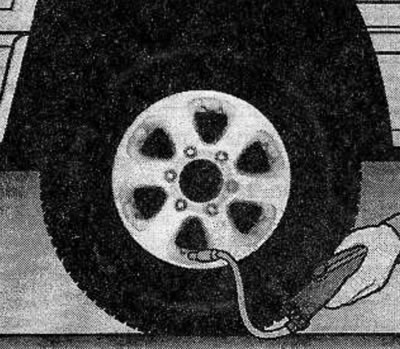
Increase the tire pressure of the towing vehicle to the required level when fully loaded.
Before coupling a trailer, lubricate the ball head of the towing hitch.
Driving performance depends largely on the trailer load. The load must be secured and, if possible, placed in the middle of the Caravan or trailer, i.e. above the axle.
Trailers equipped with brakes have an additional device to prevent rollback when stopping or parking.
Driving with a Caravan towing hitch or with a trailer is made much easier by special branded additional equipment, such as protruding rear-view mirrors for wide Caravan-type trailers.
For trailers of the Caravan type with insufficient stability against lateral deviations during movement, it is recommended to use a locking device to dampen lateral vibrations. The permissible speed with a trailer is no more than 80 km/h.
When turning corners, make sure there is a sufficient radius. Avoid sharp turns of the steering wheel.
If the trailer starts to skid, slow down and do not try to correct the direction by turning the steering wheel in the opposite direction. In extreme cases, brake sharply.
Keep in mind that on descents, greater braking force will be required when braking. It is advisable, as when moving uphill, to set one suitable gear and move at approximately the same speed.
If you have to brake, press the brake pedal all the way down; it is necessary that the braking distance, especially for a trailer, is as short as possible.
Do not forget that the braking distance of a car with a Caravan towing hitch or a trailer, regardless of whether they have brakes, is significantly longer than that of a car without a trailer.
Driving on hills
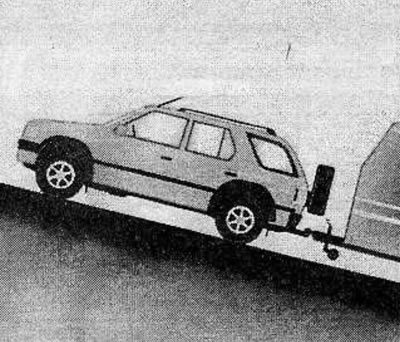
Before starting to move uphill, turn off all electrical energy consumers that are not needed at this time (air conditioning, heated rear window, etc.).
The most optimal engine crankshaft speed when driving uphill ranges between 2,500 and 3,000 min⁻¹ for gasoline engines and between 2,000 and 2,500 min⁻¹ for diesel engines.
The clutch engages smoothly and easily, without jerking, and the parking brake is released and the gas is added at the same time.
Incorrect clutch engagement increases clutch wear and makes lifting difficult.
In case of difficult and steep descents - briefly engage all-wheel drive (4L). When overcoming the descent, stop the car as quickly as possible and switch back to 2-wheel drive (2H), having unlocked the front freewheel bushings for this.
Visitor comments