


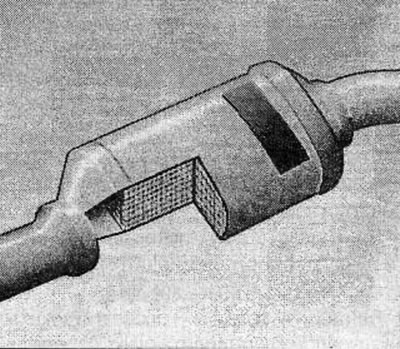
A three-way catalytic converter is a device for reducing the toxicity of exhaust gases installed in the exhaust system. To reduce toxicity, exhaust gases in a three-way catalytic converter are burned at high temperatures.
Using gasoline containing lead will damage the catalytic converter because lead will settle in the catalytic converter, reducing its efficiency. Therefore, to prevent accidental filling of the vehicle with leaded gasoline, the filler neck of the fuel tank has a smaller diameter, and it is impossible to insert the filling nozzle of a pump with leaded gasoline into it.
Failure to follow these guidelines may result in damage to the catalytic converter and vehicle:
- Keep your engine in good condition. Problems with the ignition, fuel injection, and electrical systems can allow fuel to enter the catalytic converter and burn, damaging it. If misfiring or deterioration in engine performance or performance occurs, do not continue driving but take the vehicle immediately to an Opel dealer for inspection and repair. In case of emergency, it is permissible to continue driving under its own power to the nearest service station at low speed with a low crankshaft rotation frequency.
- If unburned fuel gets into the catalytic converter, it can ignite, causing the catalytic converter to overheat and destroy itself. Therefore, avoid:
- frequent cold engine restarts;
- long-term operation of the starter, since fuel injection occurs during this time;
- complete depletion of fuel from the fuel tank, since uneven fuel supply can lead to interruptions in engine operation and damage to the catalytic converter;
- starting the engine by towing, as unburned fuel may enter the catalytic converter. To start the engine, it is better to use the battery of another car.
On vehicles equipped with a catalytic converter, the converter housing becomes so hot that it can ignite grass or dry leaves. Therefore, do not stop or park your vehicle over flammable material such as dry grass, paper or rags.
Visitor comments