
OpelBook.ru
Cars AvtoVAZ Cars Mitsubishi Cars BMW Cars Mercedes Cars Nissan Cars Toyota Cars Chevrolet
English Русский
Български
Беларускі
Український
Српски
Hrvatski
Română
Polski
Slovenský
Magyar
 |  Sitemap  |  Contacts  |    


Main Astra Corsa Insignia Kadett Omega Vectra Zafira Others Articles
Frontera A (1991-1998, petrol) Frontera B (1998-2004) Ascona C (1981-1988) Vivaro A (2001-2014)
  • Main
  • Opel
  • Frontera B
  • General information
  • User manual
  • Constant speed control system (cruise control)

Constant speed control system (cruise control) (Opel Frontera B)

            0

Contents: Start and speed control ⬇ Increasing the speed of the vehicle ⬇ Reducing the speed of the vehicle ⬇ Disabling the cruise control system ⬇ Return to previously set speed ⬇ Cancelling the set speed ⬇
With this system, any set speed from 40 km/h can be maintained within the limits of engine power/engine braking efficiency. This eliminates the need to keep your foot on the accelerator pedal, which is particularly convenient on long motorway journeys.

The speed control system must not be used in heavy traffic conditions, on winding roads or in poor road conditions (for example, ice, danger of aquaplaning, gravel throw), because there is a risk of accident.

Warning! Do not leave the main switch in the running position if the cruise control system is not used.


Start and speed control
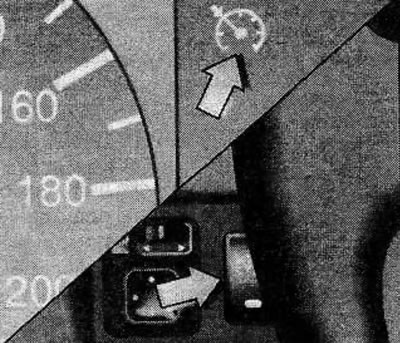


Start and speed control


1. Press the cruise control switch , and the control lamp in the switch will light up.

2. Press the accelerator pedal to accelerate the car to the desired speed above 40 km/h.
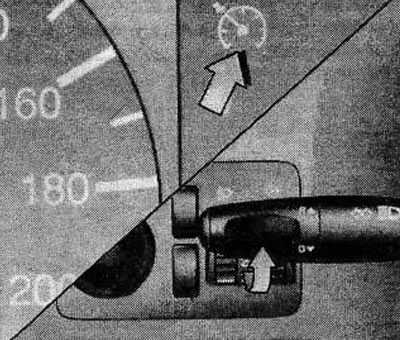


2. Press the accelerator pedal to accelerate the car to the desired speed above 40 km/h.


3. Press and release button I to set the desired speed, the indicator light will light up in the instrument cluster. Release the accelerator pedal.

To increase the vehicle's speed temporarily, press the accelerator pedal. After releasing the accelerator pedal, the vehicle will return to the same speed it was moving before pressing the accelerator pedal.

Increasing the speed of the vehicle
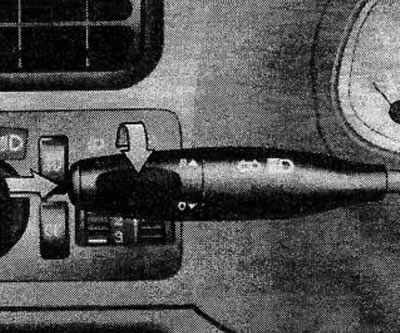


Increasing the speed of the vehicle


Increasing the speed of the vehicle is possible by using one of the following methods:


  • To increase the vehicle speed, press the accelerator pedal, then turn and hold the clutch in the R position for more than 1 second. After releasing the clutch, the cruise control system will maintain the new set speed.
  • To increase the vehicle speed, press the accelerator pedal, then press the I button, and the cruise control system will maintain the new set speed.
  • The vehicle speed can be increased in steps by turning the clutch to position R and quickly releasing it. Each time the clutch is turned, the vehicle's cruising speed increases by 1.6 km/h. This method can increase the vehicle's cruising speed by no more than 16 km/h.

Reducing the speed of the vehicle


Reducing the speed of the vehicle is possible using one of the following methods:
  • Press and hold button I. Once the desired lower vehicle speed has been reached, release the button. After releasing the clutch, the vehicle will move at the new set speed.
  • Reduce the vehicle speed by pressing the brake pedal, then press and release the I button, and the cruise control system will maintain the new set speed.
  • The vehicle speed can be reduced stepwise by briefly pressing the I button. Each time the button is pressed, the vehicle cruising speed is reduced by 1.6 km/h. This method can reduce the vehicle cruising speed to a minimum of 40 km/h.

Disabling the cruise control system


The cruise control system can be disabled in the following cases:
  • When you press the brake pedal.
  • When pressing the clutch pedal of a car with a manual transmission.
  • When moving the selector lever to the N position of a vehicle with an automatic transmission.
  • When turning the speed controller clutch to position 0.
  • When the vehicle speed is less than 26 km/h.
  • When the vehicle speed decreases by 19 km/h relative to the set cruising speed.


Return to previously set speed


When the vehicle speed is over 40 km/h and the cruise control system is switched off, the previously set speed can be recalled by turning the clutch to position R.

Cancelling the set speed


The set speed will be cancelled when:
  • The I button is pressed and at the same time the clutch is turned to the R position.
  • The cruise control main switch is off.
  • The ignition is off.


[Material copied from this portal opelbook.ru]


This article is available at russian, bulgarian, belarusian, ukrainian, serbian, croatian, romanian, polish, slovak, hungarian
Checking the article: Chernov Alexander

Share information:

Previous articles
Opel Frontera B: User manual
Next articles

Catalytic converter of a car with a gasoline engine
Towing a car
Heated front seats
Rear Window Defogger — On
Air conditioning system
Heating and ventilation system
Wheels and tires
Driving with a trailer
Starting the engine from an external source
Spare wheel
Jack and tools
Wheel replacement


See similar ones from other Opel car manuals:
▶ Speed control system (Tempostat) Opel Astra H (2004-2009)
▶ Fuel injection system — idle speed and mixture control Opel Omega A (1986-1993)
▶ Anti-lock braking system and Traction Control, vehicle… Opel Vectra B (1995-2002, petrol)
▶ Scheme 31. Cruise control system Opel Zafira A (1999-2005, petrol)
▶ Using an Oscilloscope to Monitor the Operating Parameters… Opel Corsa B (1993-2000)
Link to this page in different formats

Visitor comments


No comments yet


How much will 35 + 23 =


Vivaro A (2001-2014) 
  • General information
  • User manual
  • Power unit
  • Petrol engine F4R
  • Diesel engine F9Q
  • Diesel engine G9U
  • Transmission
  • Clutch and drive shafts
  • Manual gearbox
  • Chassis
  • Front suspension
  • Rear suspension
  • Brake system
  • Body
  • Exterior
  • Interior
  • Electrical equipment
  • Heating and ventilation
  • Air conditioner
  • Equipment and devices
  • Electrical diagrams
Ascona C (1981-1988) 
  • General information
  • Maintenance
  • Power unit
  • Gasoline engines
  • Diesel engines
  • Cooling system
  • Fuel and exhaust system
  • Contact ignition system
  • Contactless ignition system
  • Transmission
  • Clutch
  • Mechanical gearbox
  • Automatic gearbox
  • Drive shafts
  • Chassis
  • Steering
  • Brake system
  • Car suspension
  • Body
  • Exterior
  • Interior
  • Doors and windows
  • Electrical equipment
  • Equipment and devices
  • Power devices
  • Electrical circuits
Frontera B (1998-2004) 
  • General information
  • User manual
  • Maintenance
  • Power unit
  • Petrol engines 2.2 l
  • Petrol engines 3.2 l
  • Diesel engines 2.2 l
  • Cooling system
  • Fuel system (petrol)
  • Fuel system (diesel)
  • Ignition system
  • Transmission
  • Clutch
  • Manual gearbox MUA5C
  • Automatic gearbox 4L30E
  • Chassis
  • Suspension and axles
  • Steering
  • Brake system
  • Body
  • Exterior
  • Interior
  • Doors, locks and windows
  • Heating and air conditioning
  • Electrical equipment
  • Power devices
  • Equipment and devices
  • Lighting and signaling
  • Electrical diagrams
Frontera A (1991-1998, petrol) 
  • General information
  • Introduction to guide
  • User manual
  • Maintenance
  • Power unit
  • Engine repair
  • Lubrication system
  • Cooling system
  • Power and exhaust system
  • Engine electrics
  • Transmission
  • Clutch
  • Mechanical gearbox
  • Cardan shafts
  • Chassis
  • Brake system
  • Front suspension
  • Rear suspension
  • Steering
  • Body
  • Repair and care
  • Electrical equipment
  • Equipment and devices
  • Electrical circuits
OpelBook.ru © 2017–2026 · Mobile version · · Sitemap: EN BG BY UA RS HR RO PL SK HU · Feedback · Site search
Astra F, petrol · Astra G, petrol · Astra G · Astra H · Astra J, petrol · Corsa B · Corsa C, petrol · Corsa C · Insignia A · Kadett D · Kadett E · Omega A · Omega B · Omega B2 · Vectra A, petrol · Vectra A · Vectra B, petrol · Vectra B · Vectra C · Zafira A, petrol · Frontera A, petrol · Frontera B · Ascona C · Vivaro A ·
We want your visit to be comfortable 🤝! We use cookies 🍪 to make that happen.