
OpelBook.ru
Cars AvtoVAZ Cars Mitsubishi Cars BMW Cars Mercedes Cars Nissan Cars Toyota Cars Chevrolet
English Русский
Български
Беларускі
Український
Српски
Hrvatski
Română
Polski
Slovenský
Magyar
 |  Sitemap  |  Contacts  |    


Main Astra Corsa Insignia Kadett Omega Vectra Zafira Others Articles
Frontera A (1991-1998, petrol) Frontera B (1998-2004) Ascona C (1981-1988) Vivaro A (2001-2014)
  • Main
  • Opel
  • Frontera B
  • Chassis
  • Brake system
  • Anti-lock braking system (ABS)

Anti-lock braking system (ABS) (Opel Frontera B)

            0

The anti-lock braking system prevents the wheels from locking during sudden braking. Thanks to this, the car remains controllable under maximum braking. ABS is ready for operation after the ignition is turned on and the indicator lamp goes out.

Braking is most effective when the tyre has maximum grip on the road surface. When braking, the tire slides on the surface and the peripheral speed of the wheel becomes less than the speed of the car.

Minimal slip is when the wheel rolls freely and maximum slip is when the wheel is locked. The greatest braking efficiency is achieved when the peripheral speed of the wheel is almost equal to the speed of the vehicle.

The anti-lock braking system operates based on information from four sensors transmitted to the ABS unit. The system controls each wheel separately and reduces the fluid pressure in the wheel brake mechanism whose wheel begins to lock.

Under normal conditions, the standard brake system applies the brakes until the wheel locks up, which is detected by the ABS control unit. When the ABS control unit detects a wheel lock up, it controls each valve to increase or decrease the pressure.

The ABS control unit determines the rotation speed and deceleration rate of each wheel based on information from the wheel speed sensors. When braking, the wheel speed decreases and the ABS unit detects the difference between the vehicle speed and the wheel speed. If the deceleration of some wheels exceeds the expected value, the ABS unit detects the onset of locking and opens the corresponding solenoid valves to reduce the brake fluid pressure. At the same time, the wheel rotation speed increases and the electromagnetic pressure relief valve closes, increasing the brake fluid pressure in the working brake cylinder of the corresponding wheel.
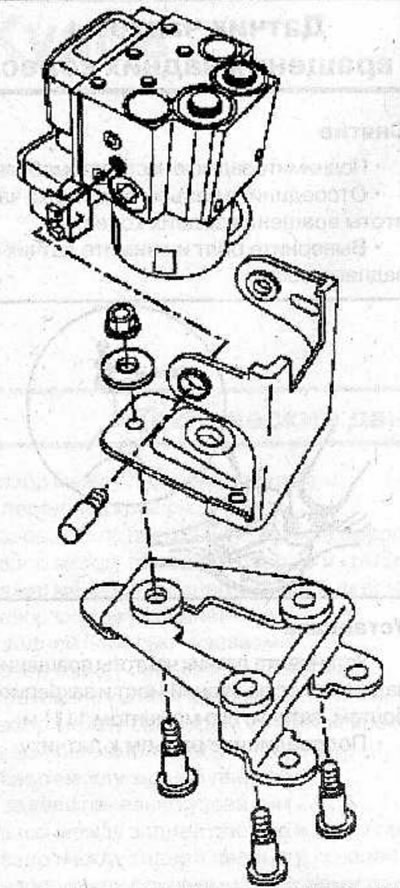


Electrohydraulic control unit for anti-lock braking system

Electrohydraulic control unit for anti-lock braking system


Control unit


The ABS control unit performs self-diagnostics and checks of the ABS electrical system every time the ignition is turned on. During the test, the ABS indicator light comes on.

The control unit also performs functional tests of the solenoid valves, pump, and modulator, and a slight pulsation in the brake pedal is felt.

If a fault occurs that affects the operation of the ABS, the control unit switches off the ABS, turns on the ABS indicator lamp and stores the fault code.

The absence of a signal from one front wheel speed sensor does not result in ABS being disabled, as the control unit will continue to control the system using the remaining signal from the second front wheel sensor.

If there is a fault in the ABS, the system switches to conditional braking mode.

Error codes can be read with the TECH 2 device.

The shift control unit sends a signal to the ABS control unit while driving whether the drive is on two or four wheels. Based on this signal, the ABS control logic changes the braking parameters.


This article is available at russian, bulgarian, belarusian, ukrainian, serbian, croatian, romanian, polish, slovak, hungarian
Checking the article: Chernov Alexander

Share information:

Previous articles
Opel Frontera B: Brake system
Next articles

Adjusting the position of the brake booster pushrod
Vacuum brake booster
Master brake cylinder
Brake pipes and hoses
Parking brake cable compensator
Parking brake cables
Electrohydraulic control unit for anti-lock braking system (ABS 325)
Front wheel speed sensor
Rear wheel speed sensor


See similar ones from other Opel car manuals:
▶ Anti-lock braking system (ABS) Opel Astra F (1991-1998, petrol)
▶ General information about the anti-lock braking system Opel Corsa C (2000-2006, petrol)
▶ Anti-lock braking system and traction control system Opel Insignia A (2008-2017)
▶ Technical characteristics of the anti-lock braking system Opel Kadett E (1984-1995)
▶ Anti-lock Braking System (ABS) — Precautions Opel Omega A (1986-1993)
Link to this page in different formats

Visitor comments


No comments yet


How much will 44 + 19 =


Vivaro A (2001-2014) 
  • General information
  • User manual
  • Power unit
  • Petrol engine F4R
  • Diesel engine F9Q
  • Diesel engine G9U
  • Transmission
  • Clutch and drive shafts
  • Manual gearbox
  • Chassis
  • Front suspension
  • Rear suspension
  • Brake system
  • Body
  • Exterior
  • Interior
  • Electrical equipment
  • Heating and ventilation
  • Air conditioner
  • Equipment and devices
  • Electrical diagrams
Ascona C (1981-1988) 
  • General information
  • Maintenance
  • Power unit
  • Gasoline engines
  • Diesel engines
  • Cooling system
  • Fuel and exhaust system
  • Contact ignition system
  • Contactless ignition system
  • Transmission
  • Clutch
  • Mechanical gearbox
  • Automatic gearbox
  • Drive shafts
  • Chassis
  • Steering
  • Brake system
  • Car suspension
  • Body
  • Exterior
  • Interior
  • Doors and windows
  • Electrical equipment
  • Equipment and devices
  • Power devices
  • Electrical circuits
Frontera B (1998-2004) 
  • General information
  • User manual
  • Maintenance
  • Power unit
  • Petrol engines 2.2 l
  • Petrol engines 3.2 l
  • Diesel engines 2.2 l
  • Cooling system
  • Fuel system (petrol)
  • Fuel system (diesel)
  • Ignition system
  • Transmission
  • Clutch
  • Manual gearbox MUA5C
  • Automatic gearbox 4L30E
  • Chassis
  • Suspension and axles
  • Steering
  • Brake system
  • Body
  • Exterior
  • Interior
  • Doors, locks and windows
  • Heating and air conditioning
  • Electrical equipment
  • Power devices
  • Equipment and devices
  • Lighting and signaling
  • Electrical diagrams
Frontera A (1991-1998, petrol) 
  • General information
  • Introduction to guide
  • User manual
  • Maintenance
  • Power unit
  • Engine repair
  • Lubrication system
  • Cooling system
  • Power and exhaust system
  • Engine electrics
  • Transmission
  • Clutch
  • Mechanical gearbox
  • Cardan shafts
  • Chassis
  • Brake system
  • Front suspension
  • Rear suspension
  • Steering
  • Body
  • Repair and care
  • Electrical equipment
  • Equipment and devices
  • Electrical circuits
OpelBook.ru © 2017–2026 · Mobile version · · Sitemap: EN BG BY UA RS HR RO PL SK HU · Feedback · Site search
Astra F, petrol · Astra G, petrol · Astra G · Astra H · Astra J, petrol · Corsa B · Corsa C, petrol · Corsa C · Insignia A · Kadett D · Kadett E · Omega A · Omega B · Omega B2 · Vectra A, petrol · Vectra A · Vectra B, petrol · Vectra B · Vectra C · Zafira A, petrol · Frontera A, petrol · Frontera B · Ascona C · Vivaro A ·
We want your visit to be comfortable 🤝! We use cookies 🍪 to make that happen.