


Contents: Gear shifting in manual transmission ⬇ Switching transfer case modes ⬇ Peculiarities of driving all-wheel…⬇ Overcoming water obstacles ⬇ Precautions when driving in…⬇
Gear shifting in manual transmission
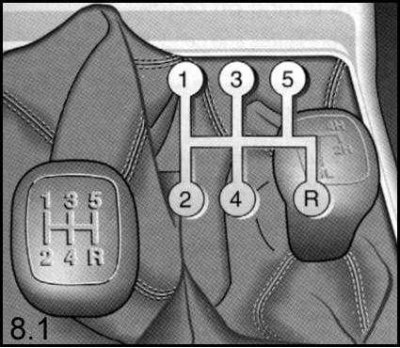
The diagram of the positions of the manual transmission control lever is shown on the top of its handle.
To engage 5th gear, you need to move the lever to the right, overcoming the resistance, then move it forward.
Reverse gear is engaged only when the vehicle is stationary and not earlier than three seconds after the clutch pedal is depressed.
1. Overcoming the resistance, move the lever to the right, then move it back.
2. If you are unable to engage the desired gear, return the lever to neutral, release the clutch pedal, then depress it again and try selecting the gear again.
Switching transfer case modes
Using the transfer case control lever, the driver has the option to choose between normal and all-wheel drive modes.
When selecting the all-wheel drive mode ("4H" or "4L"), the indicator lamp (16) lights up on the vehicle's instrument panel
 |
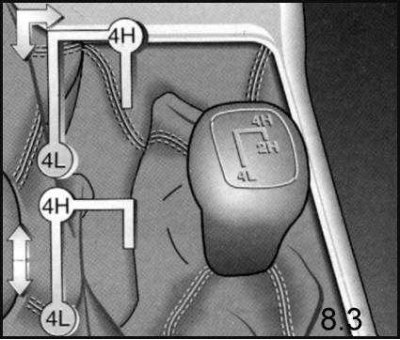 |
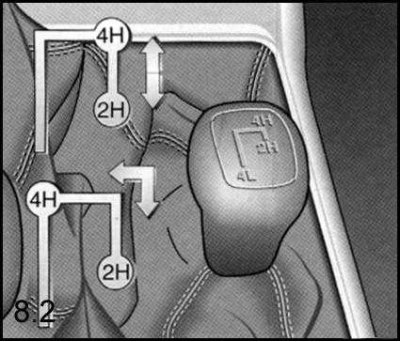
The possible positions of the control lever are indicated on the top of its handle.
The transfer case does not have a neutral position, so its control lever must always be securely set in one of three possible positions ("2H", "4H" or "4L").
Mode "2H" designed for driving a car on normal road surfaces, provides maximum fuel economy and minimal noise levels. When this mode is enabled, it is necessary to disable the manual locking of the front wheel hubs (models with manual hub lock - see below).
Mode "4H" provides optimal conditions for driving on wet or icy road surfaces. Don't forget to engage the manual locking of the front wheel hubs. The vehicle speed must not exceed 100 km/h (60 mph).
"4L" mode provides maximum engine power output and is designed for use when driving a vehicle in mountainous terrain, off-road, in sand, mud or deep snow. The manual front wheel hub lock must be engaged. The vehicle speed must not exceed 40 km/h (25 mph).
Shifting the transfer case control lever does not require depressing the clutch pedal.
Switching from "2H" mode to "4H" mode on the move is only possible if the manual locking of the front wheel hubs is already engaged (models with manual hub lock).
Attention! Never switch the transfer case from "2H" to "4H" mode while driving if the manual or automatic locking of the front wheel hubs is not engaged!
Switching the gearbox from the "4H" mode to the "2H" mode can be done at any vehicle speed, without the need to depress the clutch pedal.
Attention! Switching the transfer case from the "4H" mode to the "4L" mode and back should only be done when the vehicle is stationary!
Models with automatic locking of front wheel hubs
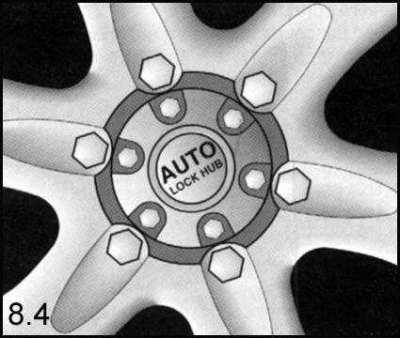
The front wheel hubs of these models are marked accordingly.
1. To engage the hub lock, stop the vehicle and move the transfer case control lever to the "4H" or "4L" position.
2. The lock will occur automatically when the car starts moving.
Note: Even if the lever is in the "2H" position, the hubs will remain locked until the direction of travel is changed.
3. To disengage the lock, stop the vehicle, shift the transmission to the "2H" position, then slowly move away in the direction opposite to the last one. It will be enough to move forward just one meter.
When the transfer case is engaged in the "4H" or "4L" mode, the hub lock disengages instantly and re-engages when the direction of travel changes.
Models with manual hub lock
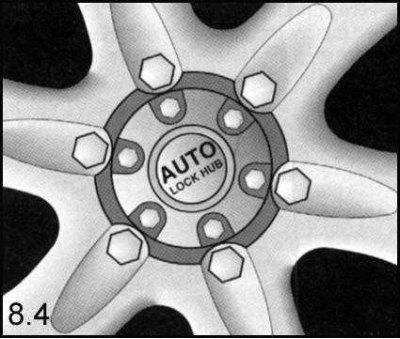
The front wheel hubs of these models are marked accordingly.
To release the clutch lock, turn it counterclockwise and set it to the "FREE" position (see ibid).
Peculiarities of driving all-wheel drive vehicles
Driving on the highway in the cold season
The increased traction of all-wheel drive models provides the vehicle with better control when driving in difficult road conditions, particularly in deep snow and heavy icing. However, all-wheel drive does not provide any anti-skid protection. Moreover, it is often easier to pull a rear-wheel drive or front-wheel drive vehicle out of a skid than in the case of "4WD" models. In view of the above, you should not abuse the inclusion of all-wheel drive modes when driving on shallow snow or ice crust.
- Depending on specific conditions, switch the transfer case to "4L" or "2H" mode;
- Start the engine, engage a low gear and start moving with the lowest possible revs, manipulating the gas and clutch pedals;
- Try to avoid excessive clutch slippage;
- Try to shift the transmission into a higher gear as quickly as possible and make sure that the engine speed does not rise excessively.
Off-road driving
When deterioration of the road surface provides grounds for engaging all-wheel drive mode, try to comply with the following basic requirements:
- Drive slowly enough, in lower gears, taking into account road and weather conditions;
- To control the car, try to use the gas pedal, minimizing the use of the brakes;
- Try not to let it happen clutch slippage and turning the wheels;
- Avoid sharp steering wheel turns.
Try to take into account all weather and road factors - use common sense and try to soberly assess the capabilities of the car. Before setting off on a long trip, plan your route in advance. Before departure, check the technical condition of the vehicle.
Overcoming water obstacles
Try not to drive into deep water.
Before you start crossing, study the bottom relief of the obstacle and choose the most gentle entrance to the water.
Shift the transfer case to the "4L" position and engage first gear.
Try to avoid engine revving to avoid water getting into the exhaust system if the exhaust pipe is below the surface. Drive at speeds no greater than 5 km/h (3 mph) and try not to create too much splash.
Try not to move against the current. If this is not possible, try to turn the car at such an angle to the flow vector so that the oncoming water does not flow into the engine compartment.
Avoid splashing into the engine compartment to avoid engine stalling due to wetting of ignition system components.
Be careful not to let water get into the engine air intake, as this can cause the engine to seize up and require expensive repairs.
After successfully crossing a water obstacle, check that the brakes are functioning properly.
To speed up the drying of the working surfaces of the brake mechanisms, brake the car several times while driving at low speed.
As soon as possible, check whether water has entered the air cleaner filter element, the engine, transmission, axle housings and the vehicle interior.
Replace any lubricating fluids that have acquired a milky consistency, which is evidence of water entering the oil.
Precautions when driving in all-wheel drive modes
When driving in 4WD modes, some special precautions must be taken.
To avoid damage to transmission components and the risk of loss of control, avoid using the vehicle in all-wheel drive modes with the front wheel hubs locked when driving on dry, hard road surfaces (asphalt).
On models with automatic front wheel hub locking, there is no signaling system to notify the driver that the lock is engaged, so if you are not sure about the condition of the locks, (for example, when changing drivers) just in case, you should perform the lock disabling procedure.
Remember that SUVs usually have a fairly high center of gravity, so you should take this into account when choosing your driving style - don't try to make turns as fast as you would in a regular car.
Strong crosswinds can also have a noticeable effect on the vehicle's handling. Try to reduce your speed during particularly strong squalls.
Visitor comments