


Contents: Selection of fuel grades ⬇ Features of the fuel system of…⬇ Additional information on the…⬇
Model variant | Parameters | Gasoline engine | Diesel |
| 3-door | Urban fuel consumption Consumption on the highway Average consumption CO₂ emission | 15.5 9.6 11.8 279 | 12.8 8.4 10.0 266 |
| 5-door | Urban fuel consumption Consumption on the highway Average consumption CO₂ emission | 15.0 9.4 11.4 270 | 13.0 8.6 10.2 270 |
Use of some additional or non-standard equipment (wide wheels, air conditioning, trailer, etc.) contributes to increased fuel consumption and a decrease in the maximum speed of the vehicle.
The first few thousand kilometers of a new car's mileage are characterized by slightly increased fuel consumption due to the running-in of the internal components of the engine and transmission.
Selection of fuel grades
Petrol engines
The quality of gasoline used in a vehicle has a significant impact on engine performance and service life. The use of various types of fuel additives also plays an important role. Try to fill your car only with the highest quality fuel, which includes all the necessary additives and supplements.
Using fuel with too low an octane rating causes detonation
To refuel Opel Frontera vehicles, use high octane gasoline.
Note: The design of the filler neck of models intended for filling exclusively with unleaded fuel is such that the filling nozzle of a pump with leaded gasoline does not fit through it.
The models in question are equipped with an automatic octane corrector for the ignition timing depending on the type of fuel being filled.
Try to fill your car with fuel with an octane rating of at least 95.
Diesel models
Refuel diesel models only with high-quality diesel fuel that meets the requirements of DIN EN 590. Never use fuel intended for use in marine diesel engines, fuel oil, etc. to refuel the vehicle. petroleum fuel.
The use of conventional diesel fuel in winter is unacceptable due to the crystallization of paraffin in it, leading to clogging of the injectors and fuel filter. When using branded winter diesel fuel, adding any temperature additives to it in cold weather is not required. To successfully use summer diesel fuel in winter, you should add a little kerosene to it or use special additives.
Note: Paraffin that has already crystallized cannot be dissolved.
To use summer diesel fuel in ambient temperatures from 0°C to -15°C, it should be diluted with kerosene in a ratio of 80/20. At air temperatures in the range from -15°C to -25°C, kerosene should be added to winter diesel fuel in the same proportions.
Features of the fuel system of diesel models
When emptying the fuel tank of diesel models, air must be removed from the fuel system before starting the engine after refueling. If you are unable to contact an Opel dealer or service centre for assistance, please follow these steps:
1. Fill your car with diesel fuel.
[Article posted on a web portal www.opelbook.ru]
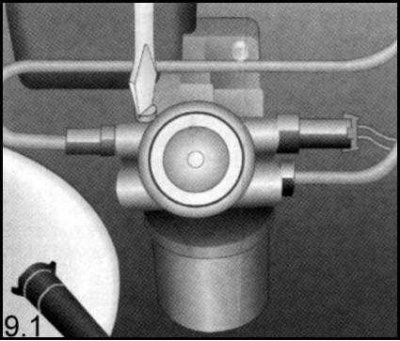
2. Using a screwdriver, loosen the fuel filter bleed valve by half a turn.
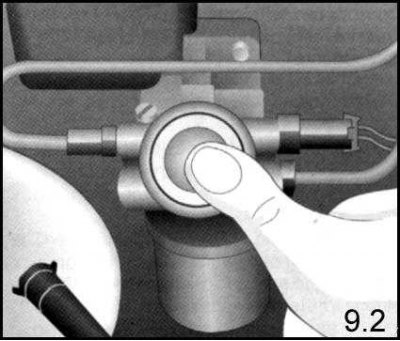
3. Slowly and evenly rotate the priming pump manually until air-free fuel comes out of the priming valve.
4. Tighten the valve.
5. Rotate the booster pump manually a few more times to ensure that fuel reaches the injection pump, while checking for any signs of external leaks.
It is necessary to periodically remove accumulated moisture from the fuel filter of the diesel engine fuel system. This procedure is usually performed at the same time as changing the oil filter. When operating the vehicle in conditions of high humidity, extreme temperatures or strong temperature differences between day and night values, the fuel filter should be checked as often as possible.
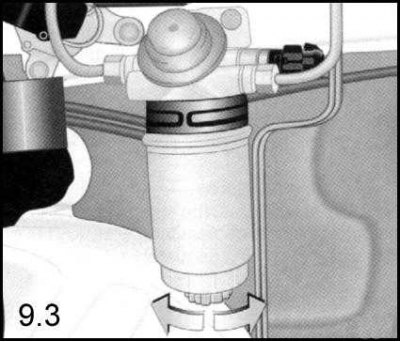
1. Loosen the plastic drain plug on the bottom of the filter assembly one turn and drain the water.
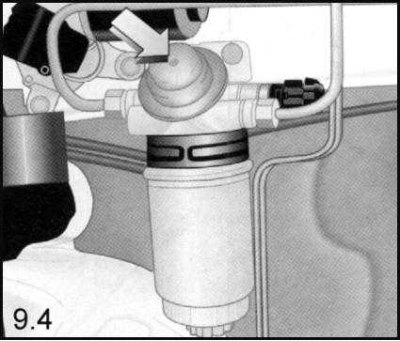
2. If water does not flow out of the filter by gravity, pump the booster pump manually (as when removing air from the system).
Additional information on the operation of turbocharged diesel models
To ensure the quality of lubrication of turbocharger bearings, the following operating rules for turbocharged diesel models should be followed:
- Try to avoid long periods of engine downtime;
- Do not operate the vehicle without warming up the engine sufficiently;
- When completing a long journey at high speeds or high engine loads, allow the engine to idle for a period of time before shutting it off:
- at route speed over 80 km/h (50 mph) = 30 sec
- at speeds over 100 km/h (60 mph) = 60 sec
- when driving in mountainous areas or long-term driving at a speed of over 100 km/h = 120 sec
Visitor comments