


Contents: Removal ⬇ Installation ⬇
Attention! Work is performed on a cold engine.
Removal
1. Set the piston of the 1st cylinder to TDC of the compression stroke.
2. Unscrew the oil filler cap and remove the engine casing by unscrewing the screws or removing the pins.
3. Remove the upper and lower belt covers.
4. Raise the engine on a jack dolly, placing a board on the jack's lifting foot.
[The article was published on the website: www.opelbook.ru]
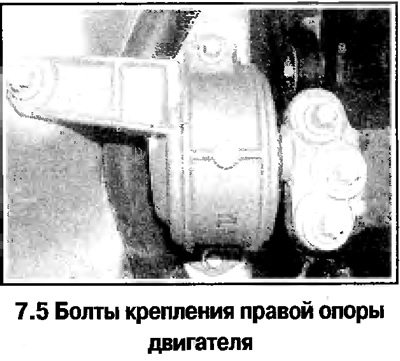
5. Unscrew the 3 bolts securing the right engine support bracket to the cylinder block, and the 3 bolts securing the support to the mudguard, remove the bracket with the support (see photo).
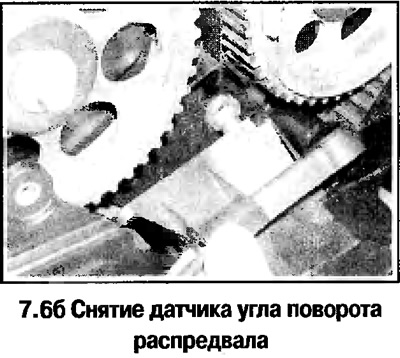
6. On 1.4, 1.6 and 1.8 L engines, check the alignment of the timing marks (see photo). Unscrew 2 bolts and remove the camshaft angle sensor (see photo). If you have the OPEL KM852 lock, lock the camshaft.
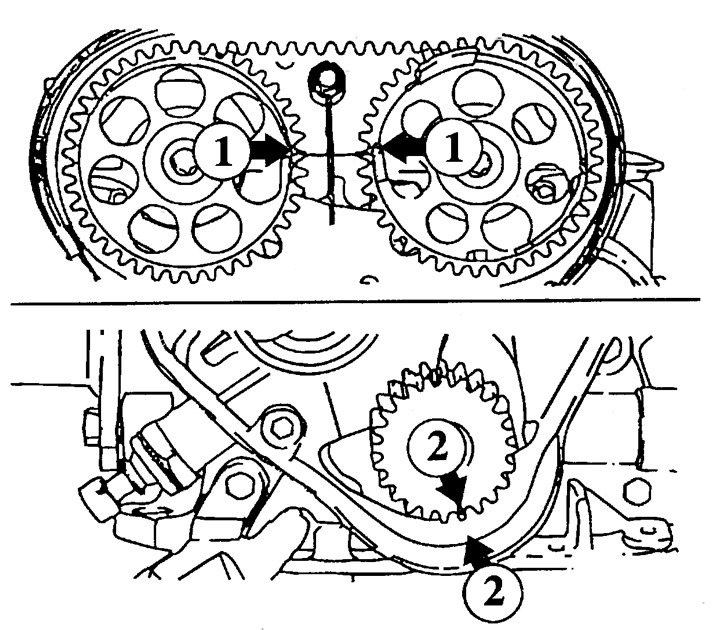
7.6a Timing marks on 1.4, 1.6 and 1.8 l engines
1. The marks on the camshaft sprockets must be strictly at the level of the upper edge of the cylinder head.
2. The mark on the crankshaft sprocket must be opposite the pointer on the oil pump housing.
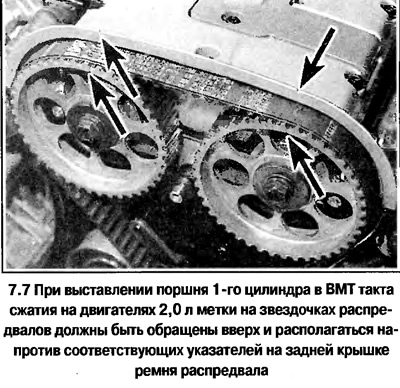
7. On 2.0L engines, ensure that the marks on the camshaft sprockets are facing up and are aligned with the corresponding pointers on the rear camshaft belt cover, with the notch in the crankshaft pulley ring aligned with the pointer at the base of the belt cover (see photo).
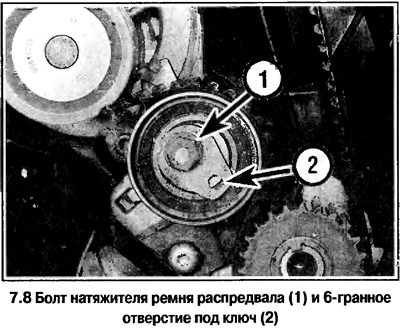
8. On all engines, loosen the tensioner bolt, turn the tensioner arm counterclockwise with a hex key and tighten the bolt (see photo).
9. Remove the timing belt (see photo). Mark the direction of normal movement on the belt.
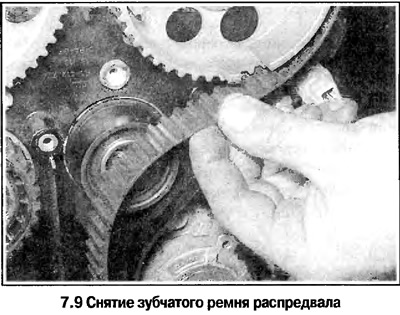
10. Check the condition of the belt. If the belt mileage is about 60,000 km, then it should be replaced. The belt is also changed if any, even minor, defects are detected (delamination, cracks, tears) or contamination.
Installation
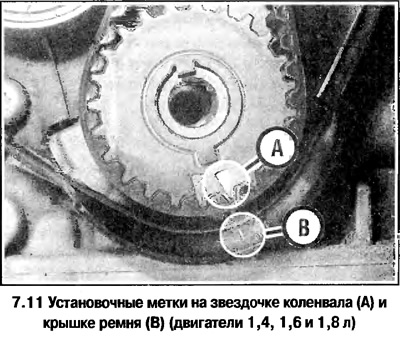
11. Before installing the belt, make sure the timing marks are aligned again (see photo)
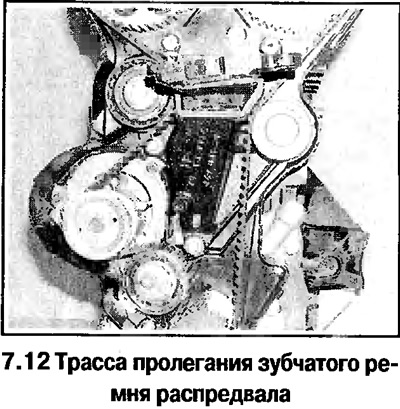
12. Put the belt on the crankshaft and camshaft sprockets, following the direction of the arrow. Tighten the belt from the tensioner side. First, put the belt on the crankshaft sprocket, then, slightly tightening it, on the camshaft sprocket. Lastly, put the belt on the tension rollers (see photo).
13. Loosen the tensioner bolt and move the tensioner towards the belt (the tensioner lever should be in the extreme right position), tighten the bolt (see photo).
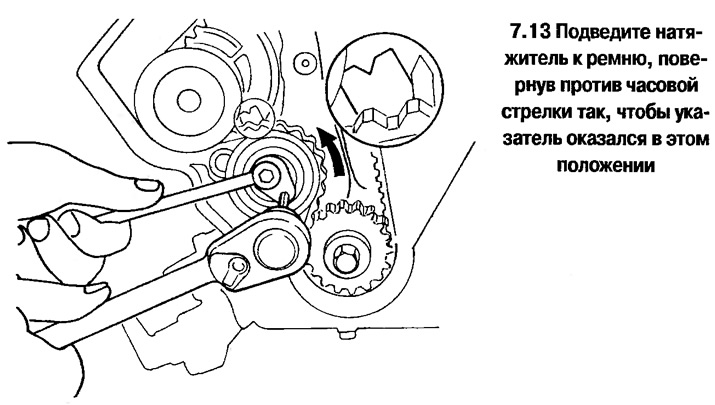
14. Remove the tool from the tensioner hole. Install the removed engine mount, tighten the mount mounting bolts to the specified torque.
15. Make sure that the timing marks on the sprockets are aligned with the marks on the oil pump housing on the rear cover.
16. Rotate the crankshaft 2 revolutions in the direction of normal rotation. Make sure all timing marks are aligned, then loosen the tensioner bolt.
17. If a new belt is being installed, position the tensioner lever so that the pointer on it is aligned with the notch on the rear tensioner plate. Holding the tensioner in this position, tighten the bolt to the specified torque. Turn the crankshaft 2 turns until the timing marks are aligned. Make sure that the pointer on the lever is also aligned with the notch on the plate.
18. If the removed belt is being installed, on all engines except the 1.8 L, adjust the tensioner so that the pointer on the lever is 4 mm to the left of the notch in the tensioner plate. On 1.8 L engines, adjust the tensioner so that the pointer on the lever is opposite the USED mark on the tensioner plate (see photo). Hold the tensioner in one of the above positions and tighten the bolt. Turn the crankshaft 2 turns until the timing marks are aligned. Make sure that the pointer on the lever is also aligned with the notch on the plate.
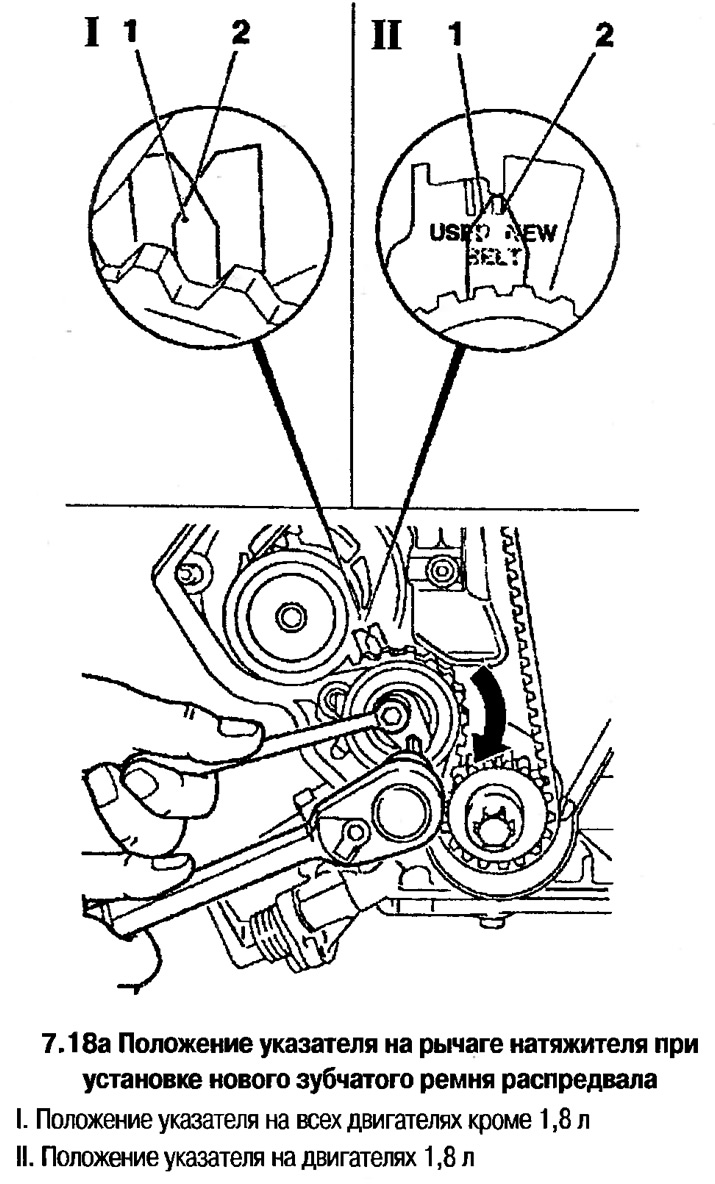
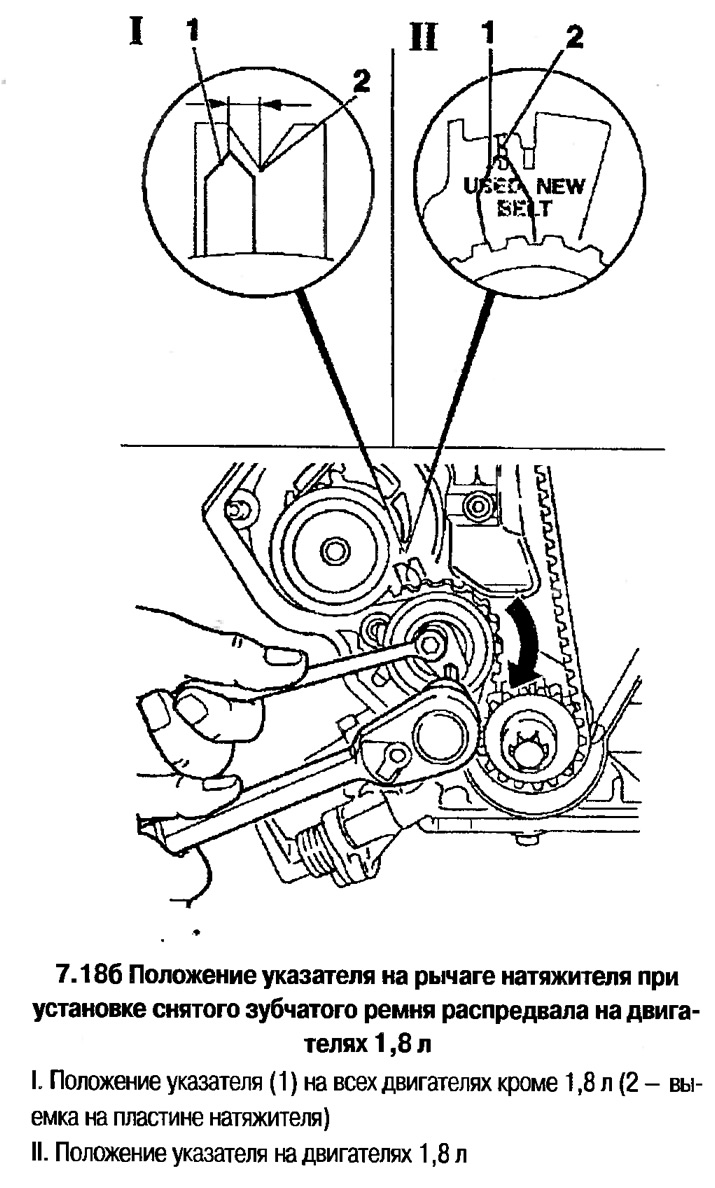
19. If it is not possible to precisely align the lever with the plate, then repeat the tensioning procedure again.
20. Install all removed parts in reverse order.
Visitor comments