
OpelBook.ru
Cars AvtoVAZ Cars Mitsubishi Cars BMW Cars Mercedes Cars Nissan Cars Toyota Cars Chevrolet
English Русский
Български
Беларускі
Український
Српски
Hrvatski
Română
Polski
Slovenský
Magyar
 |  Sitemap  |  Contacts  |    


Main Astra Corsa Insignia Kadett Omega Vectra Zafira Others Articles
Frontera A (1991-1998, petrol) Frontera B (1998-2004) Ascona C (1981-1988) Vivaro A (2001-2014)
  • Main
  • Opel
  • Frontera A
  • Power unit
  • Power and exhaust system
  • Exhaust and emission control systems

Exhaust and emission control systems (Opel Frontera A)

            0

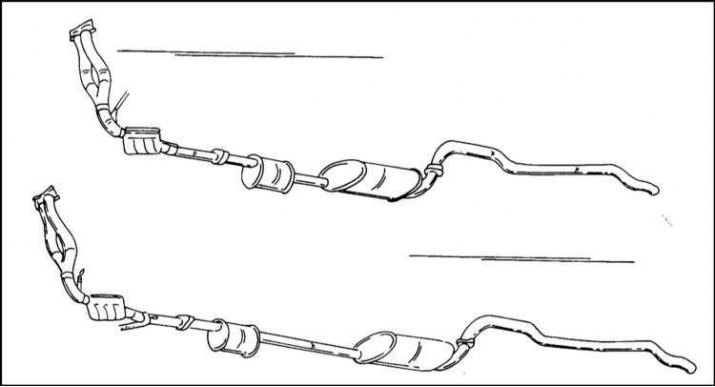
Exhaust system of a 2.0L engine from mid-1995 (top) and a 2.2L engine (bottom)

Exhaust system of a 2.0L engine from mid-1995 (top) and a 2.2L engine (bottom)


On the latest models, some design changes have been made to the exhaust system.

The purpose of the exhaust system is to direct exhaust gases to the rear of the vehicle and reduce aerodynamic noise levels. The catalytic converter present in the system reduces the content of harmful substances in the exhaust gases. The production system of cars produced since mid-1995 is shown in the illustration. The system has an oxygen sensor that provides information to the control unit about the composition of the exhaust gases. There are some design differences in the systems of cars of different production versions. When ordering spare parts, please indicate the chassis number, model and year of manufacture of the vehicle.

The exhaust system must create the back pressure necessary for normal engine operation.

Use only original spare parts to repair the exhaust system. The tightness of the exhaust system is of particular importance. To check for leaks, the system outlet pipe is covered with a rag and the engine is started at idle speed. This increases the pressure of the exhaust gases and makes it easier to determine the location of the leak.


The exhaust system consists of four parts, which can be replaced individually.

Oxygen sensor (if it exists), is located in the intake pipe. The catalytic converter is located where the secondary muffler would be in conventional exhaust systems.

The connections of the system elements are sealed with a special sealant. The muffler and pipes that are corroded must be replaced. During installation, it is necessary to exclude deformation of the system elements and thermal impact on it.

All rubber elements are replaced during assembly.


This article is available at russian, bulgarian, belarusian, ukrainian, serbian, croatian, romanian, polish, slovak, hungarian
Checking the article: Meshcheryakov Damir

Share information:

Previous articles
Opel Frontera A: Power and exhaust system
Next articles

Safety precautions when working with the power supply system
Bosch Motronic M1.5 system for 2.0 and 2.4 l engines
Fuel injection system Bosch M1.5.4 for DOHC engine
Fuel injection system Bosch M1.5.4 for OHC engine
Injection system — general information
Power supply system malfunctions
Gas pedal and gas control drive
Air filter and air supply system
Exhaust gas recirculation system
Exhaust air mixing system


See similar ones from other Opel car manuals:
▶ Emission Control Systems — General Information Opel Astra F (1991-1998, petrol)
▶ Emission control systems Opel Corsa C (2000-2006)
▶ Testing of emission control systems Opel Omega B (1993-1999)
▶ Emission Control Systems — General Description Opel Vectra A (1988-1995, petrol)
▶ Control indicators on the instrument panel Opel Insignia A (2008-2017)
Link to this page in different formats

Visitor comments


No comments yet


How much will 12 + 17 =


Vivaro A (2001-2014) 
  • General information
  • User manual
  • Power unit
  • Petrol engine F4R
  • Diesel engine F9Q
  • Diesel engine G9U
  • Transmission
  • Clutch and drive shafts
  • Manual gearbox
  • Chassis
  • Front suspension
  • Rear suspension
  • Brake system
  • Body
  • Exterior
  • Interior
  • Electrical equipment
  • Heating and ventilation
  • Air conditioner
  • Equipment and devices
  • Electrical diagrams
Ascona C (1981-1988) 
  • General information
  • Maintenance
  • Power unit
  • Gasoline engines
  • Diesel engines
  • Cooling system
  • Fuel and exhaust system
  • Contact ignition system
  • Contactless ignition system
  • Transmission
  • Clutch
  • Mechanical gearbox
  • Automatic gearbox
  • Drive shafts
  • Chassis
  • Steering
  • Brake system
  • Car suspension
  • Body
  • Exterior
  • Interior
  • Doors and windows
  • Electrical equipment
  • Equipment and devices
  • Power devices
  • Electrical circuits
Frontera B (1998-2004) 
  • General information
  • User manual
  • Maintenance
  • Power unit
  • Petrol engines 2.2 l
  • Petrol engines 3.2 l
  • Diesel engines 2.2 l
  • Cooling system
  • Fuel system (petrol)
  • Fuel system (diesel)
  • Ignition system
  • Transmission
  • Clutch
  • Manual gearbox MUA5C
  • Automatic gearbox 4L30E
  • Chassis
  • Suspension and axles
  • Steering
  • Brake system
  • Body
  • Exterior
  • Interior
  • Doors, locks and windows
  • Heating and air conditioning
  • Electrical equipment
  • Power devices
  • Equipment and devices
  • Lighting and signaling
  • Electrical diagrams
Frontera A (1991-1998, petrol) 
  • General information
  • Introduction to guide
  • User manual
  • Maintenance
  • Power unit
  • Engine repair
  • Lubrication system
  • Cooling system
  • Power and exhaust system
  • Engine electrics
  • Transmission
  • Clutch
  • Mechanical gearbox
  • Cardan shafts
  • Chassis
  • Brake system
  • Front suspension
  • Rear suspension
  • Steering
  • Body
  • Repair and care
  • Electrical equipment
  • Equipment and devices
  • Electrical circuits
OpelBook.ru © 2017–2026 · Mobile version · · Sitemap: EN BG BY UA RS HR RO PL SK HU · Feedback · Site search
Astra F, petrol · Astra G, petrol · Astra G · Astra H · Astra J, petrol · Corsa B · Corsa C, petrol · Corsa C · Insignia A · Kadett D · Kadett E · Omega A · Omega B · Omega B2 · Vectra A, petrol · Vectra A · Vectra B, petrol · Vectra B · Vectra C · Zafira A, petrol · Frontera A, petrol · Frontera B · Ascona C · Vivaro A ·
We want your visit to be comfortable 🤝! We use cookies 🍪 to make that happen.