


Contents: Removal and installation the…⬇ Removal and installation an…⬇ Removal and installation the…⬇ Replacing the throttle potentiometer ⬇ Replacing the air flow meter ⬇ Replacing the pressure regulator ⬇ Replacing the coolant temperature…⬇ Replacing the idle speed control…⬇
The following instructions apply to the 2.0L engine before 1995 and the 2.4L engine.
Removal and installation the ignition distributor
Contact the Head Engine electrical equipment.
Removal and installation an inductive pulse sensor
Contact the Head Engine electrical equipment.
Removal and installation the injection valve
It presents certain difficulties and is described here briefly.
Engine 2.0 l
1. Disconnect the ground cable from the battery.
2. Remove the following parts in the order shown: brake booster vacuum hose, throttle damper, and idle air control valve. Instructions for removing the listed parts are given in the relevant subsections.
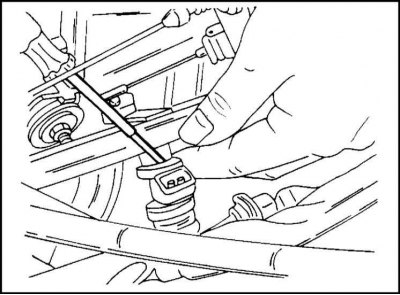
3. Remove the four injection valve clamps with a screwdriver as shown in the illustration.
4. Remove the fuel rail and its bracket.
5. Remove the injection valves from the fuel rail.
When installing:
1. Install injection valves with new seals.
2. Install the mount and fuel rail.
3. Other parts are installed in the reverse order of their removal.
Engine 2.4 l
In this engine, the injection valves are removed in pairs.
1. Disconnect the plug connection and disconnect the fuel lines from the fuel distribution line.
2. Remove the fuel rail and injection valves. The valves are removed from the main line. They are fastened with staples.
Installation is carried out in reverse order.
Replacing the throttle potentiometer
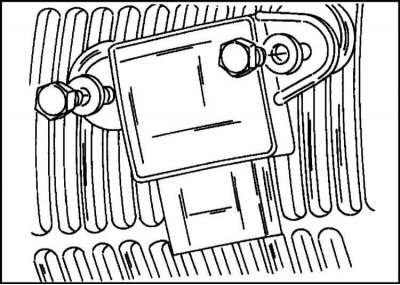
1. For the 2.0L engine, the potentiometer is located in the location shown in the illustration. After disconnecting the plug connection, the potentiometer can be unscrewed. For the 2.4L engine it is secured with two screws.
Replacing the air flow meter
In the injection device under consideration, an air volume meter is used instead of an air quantity meter. The metering flap moves in accordance with the volume of air sucked in. The movement of the damper is converted into a corresponding electrical signal. The location of the air volume meter for the 2.0L engine is shown in the illustration. below. The 2.4L engine has a slightly different gauge position.
Replacing the air volume meter is performed as follows:
1. Disconnect the plug connection and remove the intake air hose. Remove the top part of the air filter. If necessary, release the four clamps to do this.
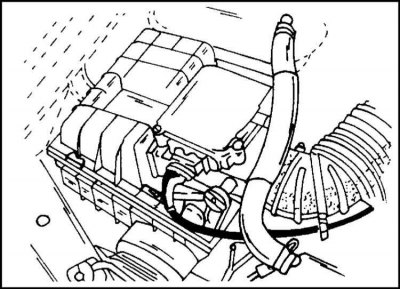
2. For a 2.0L engine, remove the gauge cover and remove the gauge itself (4 mounting screws), for a 2.4L engine, remove the gauge from the top of the air filter.
3. Remove the intake manifold (2.0L engine) and remove the meter.
4. Place the new gauge in the correct position, lubricate the four screws with thread locking compound and secure the gauge.
5. Install the meter cover, intake elbow, upper part of the air cleaner, air intake hose and connect the plug connection.
Replacing the pressure regulator
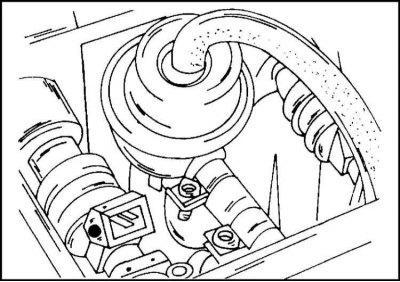
1. The appearance of the pressure regulator for the 2.0 l engine is shown in the illustration. The 2.4L engine has a similar appearance. The pressure regulator is easily replaced after disconnecting the vacuum and fuel hoses.
Replacing the coolant temperature sensor
1. The sensor is located in the intake manifold and can be unscrewed after disconnecting the plug connection. At the same time, the coolant leaks out. The sensor is secured with a torque of 10 Nm.
For the 2.4L engine, disconnect the coolant hose from the intake manifold. The coolant must be drained into a container. The sensor is disconnected after the plug connection is disconnected. Secure the sensor with a torque of 10 Nm, connect the plug connection and fill the system with fluid.
Replacing the idle speed control valve
The idle air control valve is a round piece located just next to the "OHC" marking on the top of the engine. To replace it, disconnect the plug connection, loosen the clamps, remove the hoses and unscrew the mounting screws.
The sensor is installed in the reverse order of removal.
Visitor comments