


If any relay is suspected of being faulty, it should be removed and subjected to diagnostic testing at a dealership or specialist auto repair shop. The replacement of a failed relay is carried out as an assembly.
A relay is a switch that, depending on its purpose, performs the following functions:
- 1 Switches on the starting current when the power circuit is in another location and thus makes it possible to use low-current cables and switching contacts.
- 2 Controls the switching on of several current circuits.
- 3 Turns on the circuit after a set time, which is used, in particular, when controlling the operation of the windshield wiper.
Most relays are located in a separate block, which has a different design for cars manufactured before 1997 and after 1997. The relays have a specific designation and differ from each other depending on the year of the car's production only with the help of the illustrations provided.
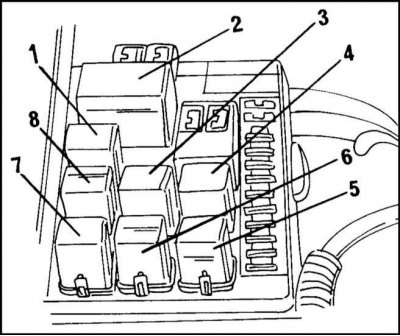
The relay panel for a vehicle produced before the end of 1996 is shown in the illustration.
It is worth keeping in mind some design changes that have occurred on the cars since mid-1995. These changes are marked with the year of manufacture 1995:
- 1 = K18, sound signal
- 2 = K8, windshield wiper
- 3 = K5, fog light
- 4 = air conditioner manufactured before 1995
- 5 = high beam headlights
- 6 = K69, parking and rear lights up to 1995
- 6 = K148, parking and rear lights since 1995
- 7 = K73, headlight produced before 1995
- 7 = K157, headlight since 1995
- 8 = K7, fan (with air conditioning before 1995) and a fan from 1995
- 8 = K92, fan without air conditioning, manufactured before 1995
Contents of the relay panel since 1997 clear from the description below. As you can see from the illustration, the relay location is the same, but the relay performs different functions:
- 1 = K18, sound signal
- 2 = K8, windshield wiper
- 3 = K5, fog light
- 4 = K140, light signal
- 5 = K4, low beam
- 6 = K148, parking and rear light
- 7 = K157, headlight
- 8 = K7, heater
Some vehicles have additional relays installed in the engine compartment that are not discussed here.
[Text copied from an online resource: www.OpelBook.ru]
If a circuit or device controlled by a relay has a fault, the corresponding current consumer can be connected for testing. If the relay is working properly, you will hear a click. From this we can assume that the fault is in the current consumer or the supply wires. If the relay has no power, this means that there is damage in the supply wires. In this case, the fault is detected by replacing the relay with a working one.
When replacing a relay, keep in mind that the relay may look the same externally, but is intended for different purposes.
1. To replace the relay, turn off the ignition.
2. Remove the relay and insert a new one.
Visitor comments