
OpelBook.ru
Cars AvtoVAZ Cars Mitsubishi Cars BMW Cars Mercedes Cars Nissan Cars Toyota Cars Chevrolet
English Русский
Български
Беларускі
Український
Српски
Hrvatski
Română
Polski
Slovenský
Magyar
 |  Sitemap  |  Contacts  |    


Main Astra Corsa Insignia Kadett Omega Vectra Zafira Others Articles
Frontera A (1991-1998, petrol) Frontera B (1998-2004) Ascona C (1981-1988) Vivaro A (2001-2014)
  • Main
  • Opel
  • Ascona C
  • Transmission
  • Mechanical gearbox
  • Driven shaft (type F10 and F 10.4 boxes) — overhaul

Driven shaft (type F10 and F 10.4 boxes) — overhaul (Opel Ascona C)

            0

To perform the following operations, you may need a hydraulic press or a heavy-duty puller.

Note: Before pressing the shaft out of the gears, synchronizers, etc., the parts to be released should be securely supported. Similarly, if a puller is used, it should be checked that its jaws are on the body of the part being removed and under no circumstances on the teeth, for example, of a gear. In extreme cases, if the part does not go well, it can be carefully heated, but not more than 100°C.


1. Remove the retaining ring from the bearing at the end of the shaft (see photo).
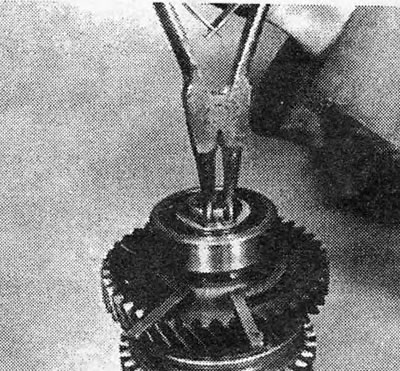
Photo 12.1. Removing the driven shaft bearing retaining ring.

Photo 12.1. Removing the driven shaft bearing retaining ring.


2. Support the 1st gear pinion and drive the shaft out of the bearing and out of the pinion. Note the spacer washer between the bearing and the gears (see photos). Some recent models have a radial needle bearing installed instead of a spacer washer. In this case, it is necessary to remove both this bearing and the gear bearing.
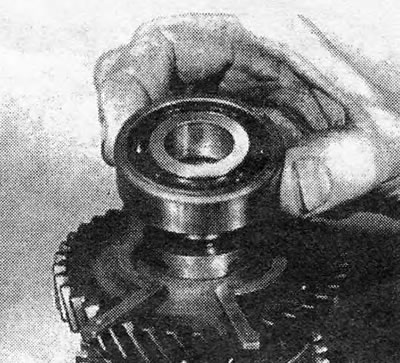
Photo 12.2A. Removing the driven shaft bearing.
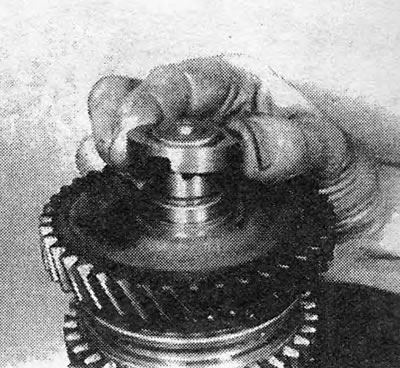
Photo 12.2A. Removing the driven shaft bearing.


Photo 12.2B. Removing the spacer washer from the 1st gear.

Photo 12.2B. Removing the spacer washer from the 1st gear.


Note: Some models may have a needle bearing instead of a spacer washer.
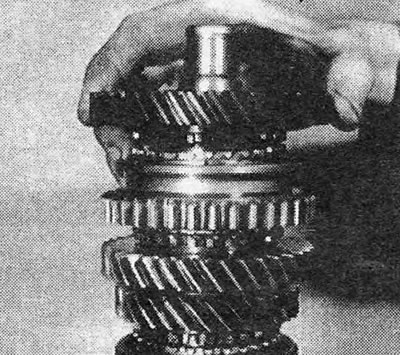

Photo 12.2C. Removing the 1st gear.

Photo 12.2C. Removing the 1st gear.


3. Support the 2nd gear and remove the retaining ring securing the 1/2 gear synchronizer (see photo).
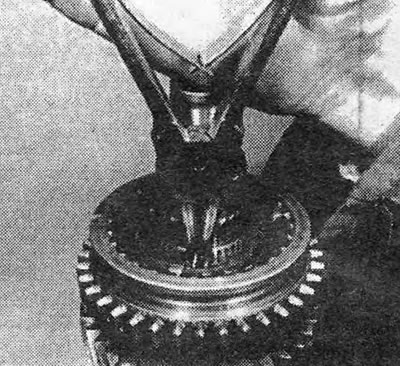
Photo 12.3. Removing the retaining ring from the 1/2 gear synchronizer.

Photo 12.3. Removing the retaining ring from the 1/2 gear synchronizer.


4. Remove the conical ring from the shaft (see photo).
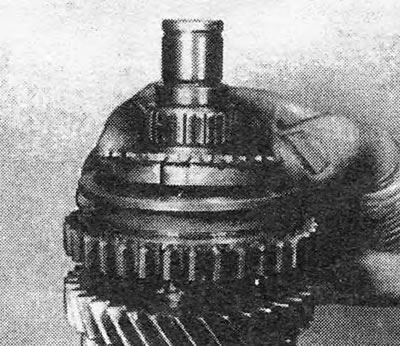
Photo 12.4. Removing the conical ring of the 1/2 gear synchronizer.

Photo 12.4. Removing the conical ring of the 1/2 gear synchronizer.


5. Secure the puller or press plate under the 2nd gear.

6. Press out or remove the 2nd gear and the 1/2 gear synchronizer from the shaft.

7. Disconnect the 2nd gear from the synchronizer and remove the 2nd gear cone ring.

8. Go to the other end of the shaft and remove the retaining ring securing the main drive pinion to the shaft (see photo).
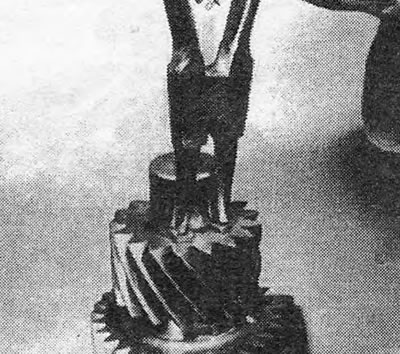
Photo 12.8. Removing the retaining ring from the main drive pinion.

Photo 12.8. Removing the retaining ring from the main drive pinion.


9. Remove the drive gear (see photo).
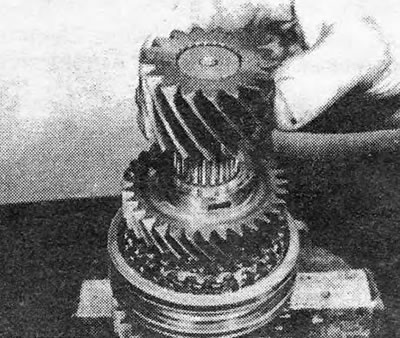
Photo 12.9. Removing the main gear pinion.

Photo 12.9. Removing the main gear pinion.


10. Remove the spacer washer (see photo).
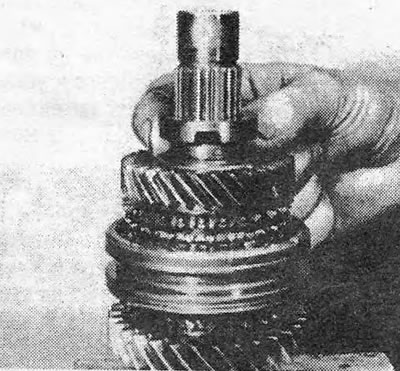
Photo 12.10. Removing the spacer washer from the 4th gear.

Photo 12.10. Removing the spacer washer from the 4th gear.


11. Remove the 4th gear (see photo).
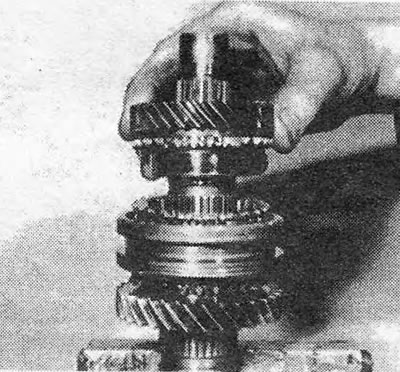
Photo 12.11. Removing the 4th gear.

Photo 12.11. Removing the 4th gear.


12. Remove the cone ring (see photo).
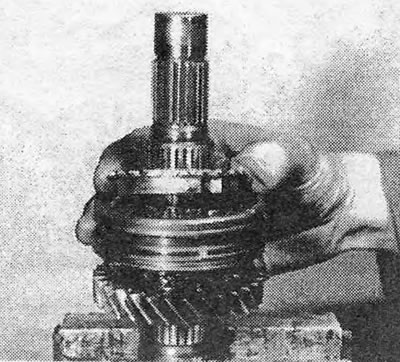
Photo 12.12. Removing the cone ring from the 4th gear.

Photo 12.12. Removing the cone ring from the 4th gear.


13. Remove the retaining ring securing the 3/4 gear synchronizer to the shaft (see photo).
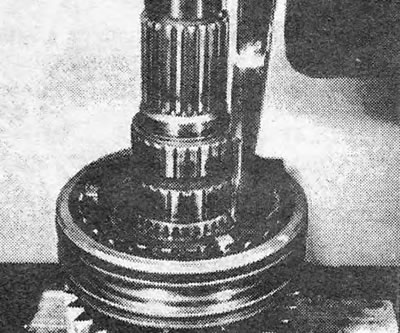


Photo 12.13. Removing the retaining ring from the 3/4 gear synchronizer.

Photo 12.13. Removing the retaining ring from the 3/4 gear synchronizer.


14. Remove the 3/4 gear synchronizer (see photo).
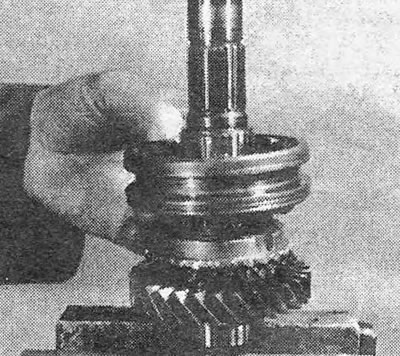
Photo 12.14. Removing the 3/4 gear synchronizer.

Photo 12.14. Removing the 3/4 gear synchronizer.


15. Remove the next cone ring (see photo).
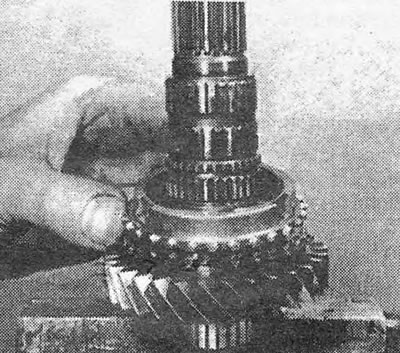
Photo 12.15. Removing the cone ring from the 3rd gear.

Photo 12.15. Removing the cone ring from the 3rd gear.


16. Remove the 3rd gear pinion (see photo).
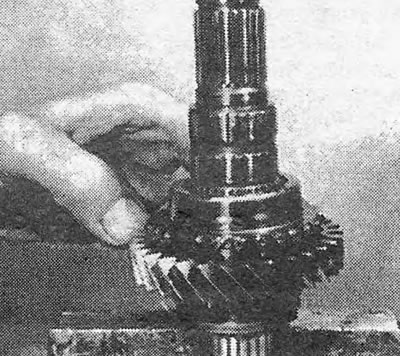


Photo 12.16. Removing the 3rd gear.

Photo 12.16. Removing the 3rd gear.


17. Inspect all gears for damaged or worn teeth, and the shaft for worn splines.

18. Replace all retaining rings. Compare new parts with old ones to ensure they are identical. This is especially important when replacing the following parts, which were modified in April 1986:
  • a. The 1st gear cones have been increased in diameter to 58 mm from the previous 51 mm. The 1st gear fork, which is not interchangeable with the fork on earlier models, has been similarly modified.
  • b. Ball bearings with mounting grooves became closed (previously open type bearings were used).
  • c. On the F10.4 gearbox, 2 modifications have been made to the 1st gear pinion. The pinion now rests on a needle bearing with a split separator, and in addition, a radial needle bearing has been installed instead of a spacer washer (see insets in Figure 6.19).

19. If gear shifting was accompanied by noise or the synchronizers did not work well, the synchronizers should be replaced as a whole or overhauled (see next section).

20. Clean and oil all parts, then assemble them in the sequence shown below. If necessary, parts should be pressed onto the shaft using a tube of suitable size, which would rest on the body of the part and not on its teeth.


21. Install the 3rd gear pinion on the end of the shaft where the main gear pinion is located.

22. Install the cone ring on the cone of the 3rd gear.

23. Install the 3/4 gear synchronizer (pressure must be applied to its hub) (see photo). It is recommended to preheat the synchronizer to 100°C.
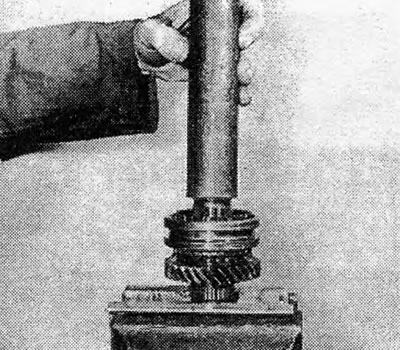
Photo 12.23. Using a tube, press the 3/4 gear synchronizer into place.

Photo 12.23. Using a tube, press the 3/4 gear synchronizer into place.


24. Secure the synchronizer with a new retaining ring.

25. Install the cone ring and 4th gear.

26. Install the spacer washer and the final drive pinion. It is recommended to preheat both of these parts to 100°C.

27. Secure the main gear pinion with a new retaining ring.

28. Go to the other end of the shaft and install the 2nd gear gear (see photo).
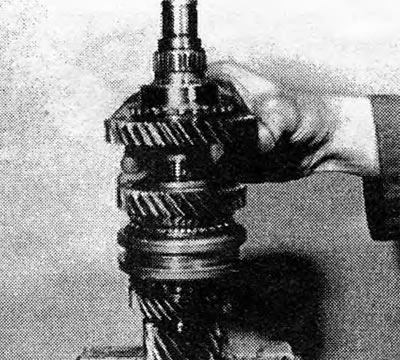
Photo 12.28. Installing the 2nd gear.

Photo 12.28. Installing the 2nd gear.


29. Install the cone ring on the cone of the 2nd gear.
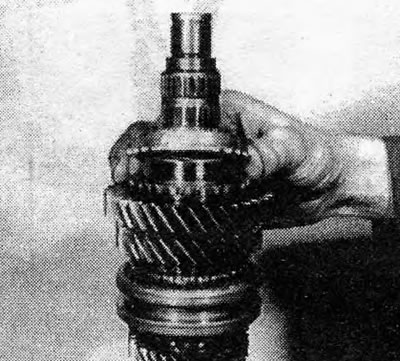
Photo 12.29. Installing the conical ring of the 2nd gear.

Photo 12.29. Installing the conical ring of the 2nd gear.


30. Heat the 1/2 gear synchronizer to 100°C and press it onto the shaft with the reverse gear teeth facing the 2nd gear gear (see photo).
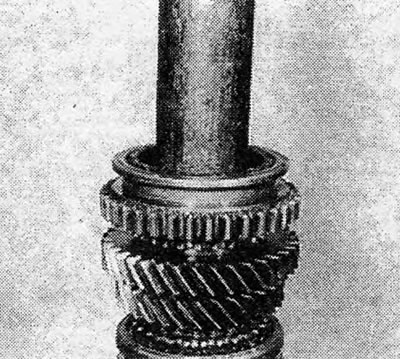
Photo 12.30. Installing the 1/2 gear synchronizer - note the position of the reverse gear teeth.

Photo 12.30. Installing the 1/2 gear synchronizer - note the position of the reverse gear teeth.


31. Secure the synchronizer with a new retaining ring.

32. Install the 1st gear cone ring and the 1st gear itself.

33. Heat the spacer washer to 100°C and press it onto the shaft with the grooves towards the 1st gear (see photo).
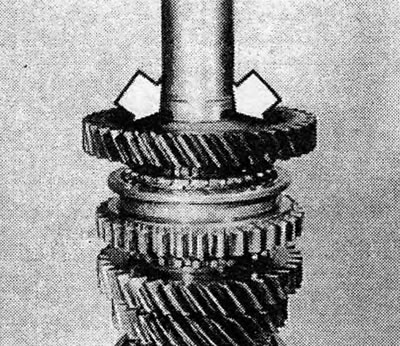
Photo 12.33. Grooves on the spacer washer (shown by arrows) must be on the 1st gear side.

Photo 12.33. Grooves on the spacer washer (shown by arrows) must be on the 1st gear side.


34. Place a new retaining ring on the shaft so that it is ready to be installed in its groove on the gearbox housing.

35. Install the bearing and secure it with a new retaining ring.

(Original source is on the website: opelbook)


This article is available at russian, bulgarian, belarusian, ukrainian, serbian, croatian, romanian, polish, slovak, hungarian
Checking the article: Kornev Georgy

Share information:

Previous articles
Opel Ascona C: Mechanical gearbox
Next articles

Drive shaft (type F10 and F 10.4 boxes) — overhaul
Gearbox housing (type F10 and F 10.4) — overhaul
Gearshift mechanism cover (type F10 and F 10.4 boxes) — overhaul
Gearbox type F10 and F10.4 — disassembly into main components
Gearbox — removal and installation
Gear shift lever mechanism — adjustment
Synchronizers — overhaul
Gearbox type F10 and F10.4 — assembly
Gearbox type F10.5 — description
Gearbox type F10.5 — disassembly and assembly
Gearbox type F16 and F16.4 — disassembly and assembly
Gearbox type F16.5 — disassembly


See similar ones from other Opel car manuals:
▶ Intermediate shaft — removal, overhaul and installation Opel Vectra A (1988-1995, petrol)
▶ Drive shaft repair — general information Opel Astra F (1991-1998, petrol)
▶ General information about engine overhaul Opel Corsa B (1993-2000)
▶ Storage boxes Opel Insignia A (2008-2017)
▶ The device of the 4-speed gearbox type «F16» Opel Kadett E (1984-1995)
Link to this page in different formats

Visitor comments


No comments yet


How much will 40 + 16 =


Vivaro A (2001-2014) 
  • General information
  • User manual
  • Power unit
  • Petrol engine F4R
  • Diesel engine F9Q
  • Diesel engine G9U
  • Transmission
  • Clutch and drive shafts
  • Manual gearbox
  • Chassis
  • Front suspension
  • Rear suspension
  • Brake system
  • Body
  • Exterior
  • Interior
  • Electrical equipment
  • Heating and ventilation
  • Air conditioner
  • Equipment and devices
  • Electrical diagrams
Ascona C (1981-1988) 
  • General information
  • Maintenance
  • Power unit
  • Gasoline engines
  • Diesel engines
  • Cooling system
  • Fuel and exhaust system
  • Contact ignition system
  • Contactless ignition system
  • Transmission
  • Clutch
  • Mechanical gearbox
  • Automatic gearbox
  • Drive shafts
  • Chassis
  • Steering
  • Brake system
  • Car suspension
  • Body
  • Exterior
  • Interior
  • Doors and windows
  • Electrical equipment
  • Equipment and devices
  • Power devices
  • Electrical circuits
Frontera B (1998-2004) 
  • General information
  • User manual
  • Maintenance
  • Power unit
  • Petrol engines 2.2 l
  • Petrol engines 3.2 l
  • Diesel engines 2.2 l
  • Cooling system
  • Fuel system (petrol)
  • Fuel system (diesel)
  • Ignition system
  • Transmission
  • Clutch
  • Manual gearbox MUA5C
  • Automatic gearbox 4L30E
  • Chassis
  • Suspension and axles
  • Steering
  • Brake system
  • Body
  • Exterior
  • Interior
  • Doors, locks and windows
  • Heating and air conditioning
  • Electrical equipment
  • Power devices
  • Equipment and devices
  • Lighting and signaling
  • Electrical diagrams
Frontera A (1991-1998, petrol) 
  • General information
  • Introduction to guide
  • User manual
  • Maintenance
  • Power unit
  • Engine repair
  • Lubrication system
  • Cooling system
  • Power and exhaust system
  • Engine electrics
  • Transmission
  • Clutch
  • Mechanical gearbox
  • Cardan shafts
  • Chassis
  • Brake system
  • Front suspension
  • Rear suspension
  • Steering
  • Body
  • Repair and care
  • Electrical equipment
  • Equipment and devices
  • Electrical circuits
OpelBook.ru © 2017–2026 · Mobile version · · Sitemap: EN BG BY UA RS HR RO PL SK HU · Feedback · Site search
Astra F, petrol · Astra G, petrol · Astra G · Astra H · Astra J, petrol · Corsa B · Corsa C, petrol · Corsa C · Insignia A · Kadett D · Kadett E · Omega A · Omega B · Omega B2 · Vectra A, petrol · Vectra A · Vectra B, petrol · Vectra B · Vectra C · Zafira A, petrol · Frontera A, petrol · Frontera B · Ascona C · Vivaro A ·
We want your visit to be comfortable 🤝! We use cookies 🍪 to make that happen.