


Contents: Removal ⬇ Installation ⬇
Removal
Automatic rear wheel brake adjustment (from 8.83)
Remove the brake drum.
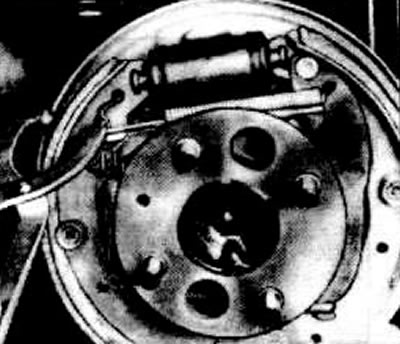
Disconnect the brake shoe return spring from the spring holder using special pliers (e.g. HAZET No.797). It can also be removed using pliers. Watch the installation system parts.
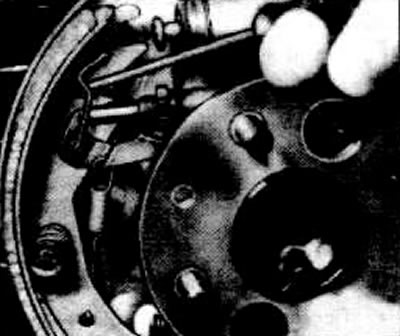
Use a screwdriver to remove the return spring retainer from the hole in the shoe.
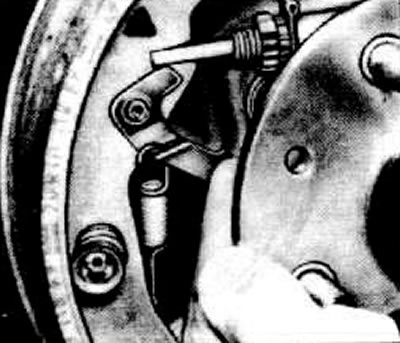
Remove the adjusting lever from the shoe and disconnect the return spring.
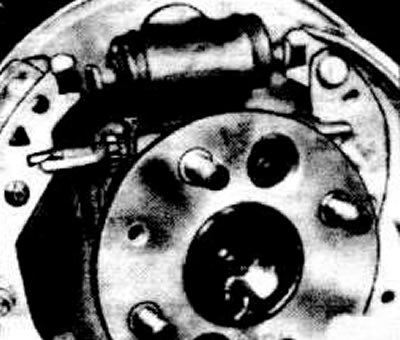
Press the shoe slightly outward and disconnect the installation system with the spacer bar from the handbrake lever and brake shoes.
Note: The installation position of the thermocouple must be recorded first.
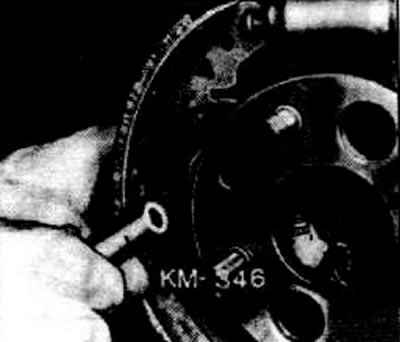
Remove the front brake shoe mount. To do this, press the spring cup with a collet and turn it 90°, while holding the pin at the back. Remove the spring cup, remove the pin. Workshops use the OPEL KM 346 device for this, you can also do this with a combination collet.
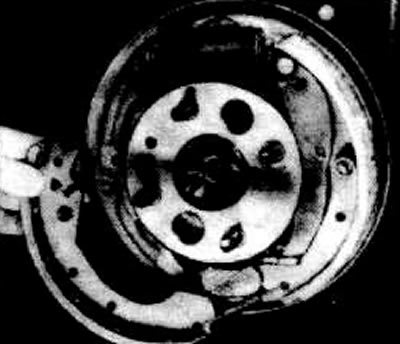
Disconnect the lower spring.
Disconnect the cable from the handbrake lever.
Installation
Use brake pads of the same quality. It is recommended to use only original OPEL brake pads. Wash the brake drum and brake shield with a rag soaked in gasoline. While the brake pads are removed, do not press the brake pedal, because the piston will fall out of the wheel brake cylinder. If the brake cylinder is leaking, repair it. Send the brake drum with grooves for turning.
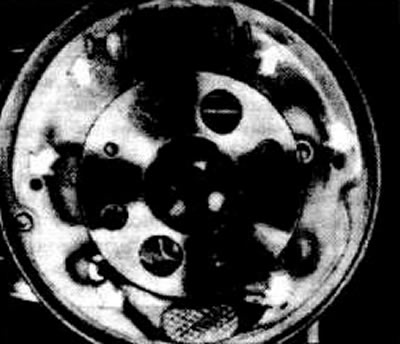
Before installing the pads, cover the brake shield in the areas where the pads are in contact with a thin layer of Plostilube (OPEL ET No.1942586/90166282).
Check the ease of movement of the gear and the installation lever. Otherwise, disassemble the installation system and clean it.
Coat the threaded rod of the installation system with silicone grease 1970206 (OPEL ET No.90167353). Screw in the installation gear until it stops.
Note: The left and right threaded rods have left and right threads respectively and are marked L and R to avoid confusion during installation. In addition, the installation gear -4- (drawing B8358), the adjusting lever -3- and the return spring holder are marked in different colours to prevent incorrect installation. The named parts for the left side are black, for the right side - silver.
Attach the cable to the handbrake lever. Attach the lower spring to the shoe.
Install the brake pads on the brake shield.
To do this, insert the pin from behind and put on the spring with the cup and crush it with a collet, then turn the springs 90° while holding the pin from behind.
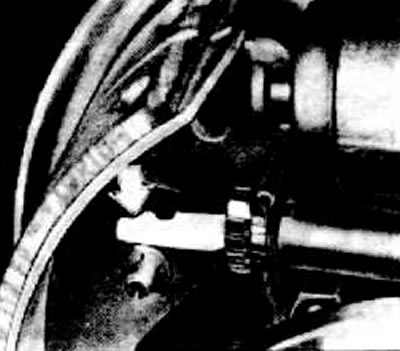
Install the adjustment system between the pads. In doing so, observe the installation position -arrow-.
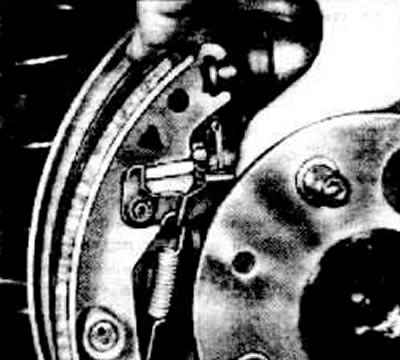
Connect the return spring for the adjusting block to the adjusting lever and brake shoe.
Install the adjusting lever onto the brake shoe retaining pin.
Note: Do not forget the spring washer for the locking pin.
Install the return spring retainer by connecting it to the retaining pin and brake shoe.
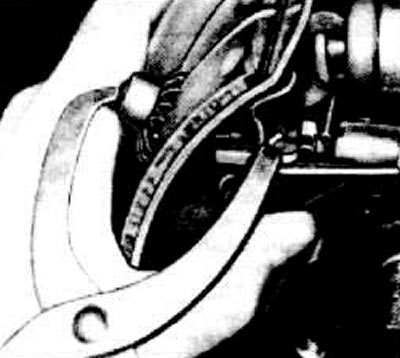
Using a spring collet, secure the brake shoe return spring into the holder. Press the adjusting lever upwards against the adjusting gear.
Attention: Ensure that the thermocouple is seated correctly. The figures show the elements for MANTA-B and REKORD-E. The thermocouple in KADETT D has a different mounting position.
Article posted on an online resource www.OpelBook.ru
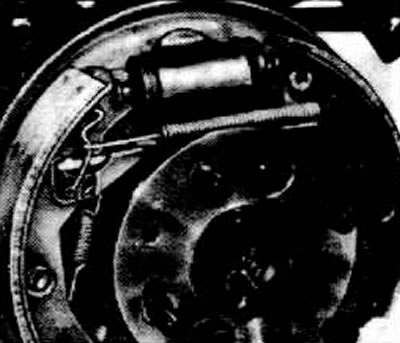
Check that the brake pads fit correctly against the wheel brake cylinder.
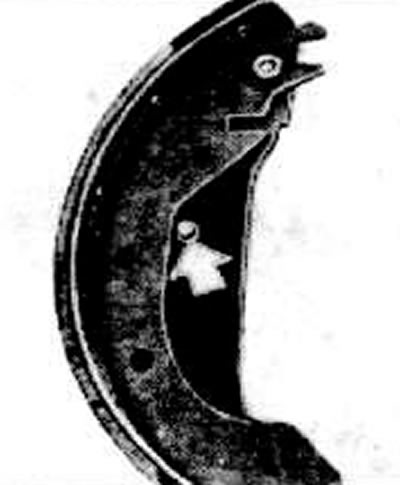
The cam -arrow- of the handbrake lever must not be in contact with the brake shoe.
Caution: If the cam is in contact with the brake shoe, the result is that when the handbrake is first applied, the lever will assume its intended position. The brake in this case has no air gap and may heat up or lock up.
Install the brake drum.
Adjust the rear wheel brakes.
Screw on the rear wheels.
Lower the vehicle and tighten the rear wheel bolts to 90 Nm.
Visitor comments