


Contents: Removal ⬇ Installation ⬇
Removal
Loosen the wheel mounting bolts and lift the car.
Unscrew the rear wheel.
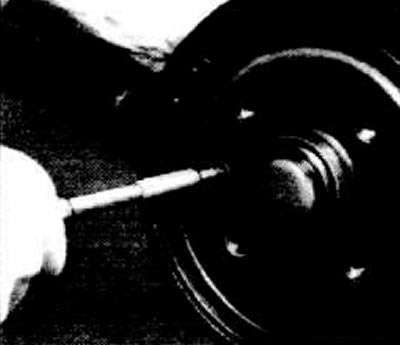
Remove the brake drum lock screw.
If necessary, set the brake pads to a comfortable position using the adjusting eccentric.
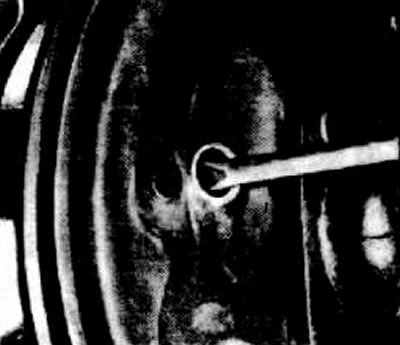
Caution: On vehicles with automatic rear brakes (since 8/1983): Unscrew the plug on the back of the brake shield. The plug is located on the left side of the left brake on the right side at about half the height of the center. Press the handbrake lever through the hole with a screwdriver. This will allow the shoe return spring to be pulled out and the brake drum to be removed.
The article was published on the website (OPELBOOK.ru)
If the drum is firmly seated on the centering flange of the hub, it should be knocked off with light blows of a polymer hammer.
Installation
Before installation, check the drum by hand, grooves up to 0.4 mm are acceptable, otherwise give the drum a groove. Then install thicker pads (5.6 mm).
Install the drum on the hub so that the hole for the locking screw and the hole in the hub match.
Note: In case of automatic brake adjustment, rotate the drum and measure the gap between the lining and the brake drum with a feeler gauge. The specified value is 0.2 mm on each side, 0.4 mm in total. If necessary, move the adjusting gear accordingly. Do not forget about the right and left threads on the gear.
A brake drum that has been in operation for a long time has a flange on the outside, as a result of which it is impossible to measure the gap between the friction lining and the drum perfectly. In this case, the brake drum must be treated first. The inner diameter of the drum (new) is 200 mm.
After turning, the diameter can be a maximum of 201 mm.
Screw in the locking screw.
Coat the edge of the hub with plastic grease.
Install the wheel.
Set the rear brake.
Lower the car, tighten the wheel bolts to 90 Nm.
Visitor comments