


When handling brake fluid, please take into account:.
Brake fluid is toxic and chemically active. Therefore, it should not be allowed to come into contact with painted parts.
Brake fluid is hygroscopic, which means it absorbs moisture from the air, so it should be stored in a closed container.
Used brake fluid cannot be used a second time. Also, when bleeding the brake system, only fresh brake fluid should be used.
The brake fluid in the system must be changed every year.
Pumping
If it is necessary to bleed the entire system, all wheel cylinders should be bled separately. This is the case when air has penetrated into all cylinders. If only one wheel cylinder was changed or repaired, then it is enough to bleed only it. Bleeding sequence.
- 1) Rear right wheel cylinder
- 2) Rear left wheel cylinder
- 3) Front right brake caliper
- 4) Front left brake caliper
Caution: On vehicles with a load-dependent brake regulator (Caravan), the spring retainer must be loosened and disconnected before bleeding.
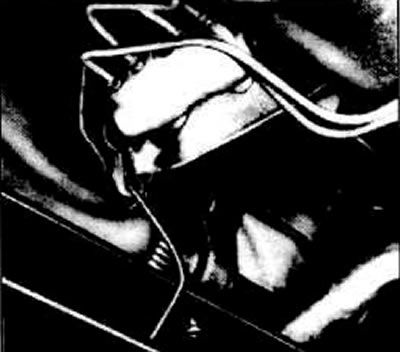
Catch the brake regulator lever all the way forward in the direction of travel. Tie the lever in this position to the rear suspension with wire.
Remove the boot of the bleeder valve of the working cylinder, put on a clean hose and lower the other end into a bottle half filled with brake fluid.
Ask an assistant to press the brake pedal ("pump") until pressure appears in the brake system. This is felt by the increased resistance of the pedal when you press it.
When sufficient pressure is reached, press the brake pedal all the way down. Hold the pedal in this position.
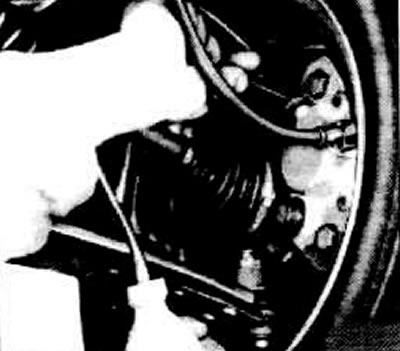
Loosen the bleed valve on the working cylinder with a key by about half a turn. Collect the leaking liquid in a bottle. Make sure that the end of the hose is always below the liquid level.
As soon as the liquid pressure drops, immediately close the valve.
Repeat the process of pumping the cylinder until the air bubbles disappear from the liquid flowing into the bottle.
After bleeding, remove the hose from the valve and put on the boot.
Bleed the other cylinders in the same way.
Caution: While bleeding, always monitor the fluid level in the tank. Do not allow the level to drop too much, otherwise air will enter the system through the tank. Always add only fresh brake fluid.
In vehicles with independent brake regulator, untie the wire. Attach the spring to the holder lever.
Slide the holder onto the rear suspension until the spring is slack but not tight.
Screw the holder to the suspension housing and tighten to 20 Nm.
After bleeding, the expansion tank should be filled to the "max" mark.
Visitor comments