


Contents: Removal ⬇ Installation ⬇
Removal
Caution: When pulling the CV joint journal of the drive shaft out of the corresponding splined connection, the shaft must be pulled by the joint assembly - never by the shaft itself!
1. Engage neutral gear (manual transmission)/move the selector lever to the "N" position (AT).
2. Loosen the hub nut of the corresponding front wheel (see Section 2).
3. If the wheels were installed in place when the hub nuts were loosened, remove the wheels again and place the front of the vehicle on stands. If equipped, remove the crankcase guard (see Chapter 2).
(Source is on the website: «www.OpelBook.ru»)
4. Disconnect the right vertical stabilizer bar from the shock absorber strut (see Chapter 10).
5. Loosen the nut (see accompanying illustration) and remove the clamp bolt securing the ball joint to the steering knuckle. Press the wishbone down and disconnect it from the steering knuckle. If necessary, use a suitable tool to loosen the clamp.
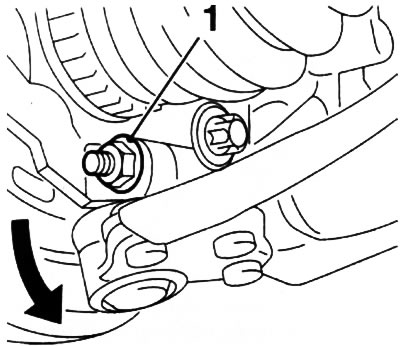
3.5. Nut (1) of the clamp bolt for fastening the ball joint to the steering knuckle
6. Secure the drive shaft with wire or a support so that when removing it from the hub, it does not hang down on the inner CV joint.
7. Pull the drive shaft end out of the hub assembly by pulling the suspension strut outward. If the shaft cannot be pulled out by hand, install a puller on the appropriate wheel hub (see accompanying illustration) and secure it with the wheel bolts. Using a puller, separate the drive shaft from the hub.
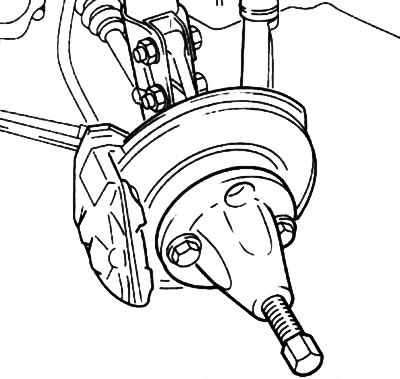
3.7. Installing the Hazet 781-5 puller to remove the drive shaft from the wheel hub
Caution: After removing the drive shaft, the wheel hub must not be loaded (use as a support), and the vehicle must not be moved - otherwise the wheel bearing may be damaged! If for any reason the vehicle needs to be moved, be sure to insert the drive shaft element into the hub and tighten the hub nut!
8. To remove the left drive shaft from the gearbox assembly, service stations use the Opel-KM-6003 and KM-313 devices (see accompanying illustration).
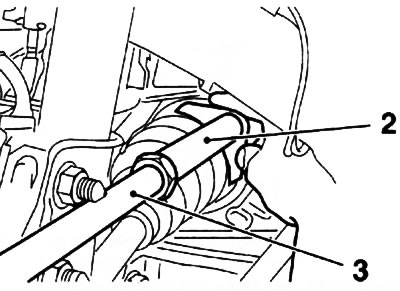
3.8. Removing the drive shaft using the Opel-KM-6003 (2) and KM-313 (3) tools
9. The KM-6003 device must be installed in a special groove on the CV joint housing (see accompanying illustration). When removing the drive shaft, be careful not to accidentally damage the lock of the mounting clamp or damage the CV joint boot.
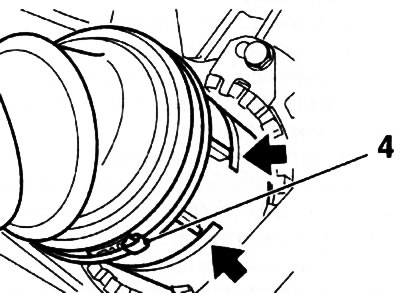
3.9. Groove (indicated by arrows) on the CV joint housing for installing the KM-6003 device (the illustration shows a tripod type CV joint): 4. Clamp lock
Attention: When removing the drive shaft from the gearbox housing, transmission oil will leak out - place a previously prepared container underneath and quickly close the hole with a suitable plug!
10. Untie the drive shaft from the bottom of the car and carefully remove it from under the engine compartment.
11. On models without an intermediate shaft, the right drive shaft is removed in the same way as the left one. The procedure for removing the right drive shaft together with the intermediate shaft for models equipped with diesel engines with a working volume of 1.7 l is described in Section 4.
Installation
Note: A new hub nut and new inner snap ring will be required.
12. Thoroughly clean the shaft splines and the hole in the hub. Lubricate the sealing lips of the oil seal and the shaft splines with clean transmission oil/ATF. Check the reliability of the CV joint boot fixation with your clamps.
13. Remove the retaining ring from the inner CV joint journal of the drive shaft and install a new one in its place (see accompanying illustration).
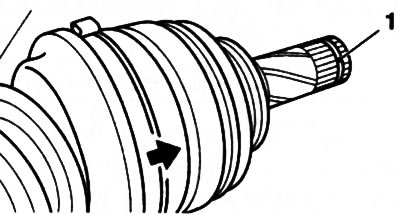
3.13. Groove (1) for installing a retaining ring - the arrow indicates the groove on the double compensation CV joint housing
14. Remove the appropriate plug from the gearbox assembly. Carefully, being careful not to damage the seal, engage the inner journal of the drive shaft with the splines of the differential side gear - if necessary, use a mandrel sleeve to protect the seal (for example, Opel KM-6332). Push the shaft into the differential until the retaining ring snaps into place. If the retaining ring does not snap into place when installed by hand, a plastic hammer and brass drift can be used to push the CV joint journal in (see accompanying illustration) - the mandrel must be installed in the groove on the body of the hinge being installed.
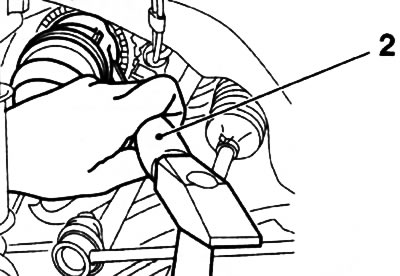
3.14. Installing the drive shaft using a hammer and brass mandrel (2)
15. Engage the splined pin of the outer joint with the splines of the hub.
Caution: Be careful not to allow the drive shafts to hang on the dust boots for long periods of time!
16. Tighten the hub nut (see Section 2).
17. Further installation is carried out in the reverse order of removal. Upon completion of the operation, check the transmission oil level and make the appropriate adjustments if necessary.
Visitor comments