
OpelBook.ru
Cars AvtoVAZ Cars Mitsubishi Cars BMW Cars Mercedes Cars Nissan Cars Toyota Cars Chevrolet
English Русский
Български
Беларускі
Український
Српски
Hrvatski
Română
Polski
Slovenský
Magyar
 |  Sitemap  |  Contacts  |    


Main Astra Corsa Insignia Kadett Omega Vectra Zafira Others Articles
Astra F (1991-1998, petrol) Astra G (1998-2004, petrol) Astra G (1998-2004) Astra H (2004-2009) Astra J (2009-2015, petrol)
  • Main
  • Astra
  • Astra H
  • Transmission
  • Drive shafts
  • Removal and installation drive shafts

Removal and installation drive shafts (Opel Astra H)

            0

Contents: Removal ⬇ Installation ⬇

Removal


Caution: When pulling the drive shaft journal out of the corresponding splined joint, the shaft must be pulled by the joint assembly - never by the shaft itself!


1. Engage neutral gear (manual transmission)/move the selector lever to the "N" position (automatic).

Note: On models equipped with the Easytronic robotic gearbox, even if a gear is engaged, the gearbox will automatically shift to neutral before starting the engine.


2. Loosen the hub nut of the corresponding front wheel (see Chapter 10).

3. Loosen the nuts of the corresponding front wheel, jack up the front of the car and place it on supports. Remove the wheel (see Chapter "Introduction").

Note: If your vehicle is equipped with directional tires, note the direction of rotation of the wheels.


If necessary, remove the crankcase guard (see Chapter 2).

4. Loosen the tie rod end mounting nut and use a special puller to release the latter from the steering knuckle (see Chapter 10).

5. Unscrew the bolt securing the flexible brake hose support bracket to the suspension strut and release the hose from the bracket (see Chapter 9).

6. Holding the pivot pin with an open-end wrench by the flats, loosen the mounting nut and separate the anti-roll bar strut from the suspension strut (see accompanying illustration).
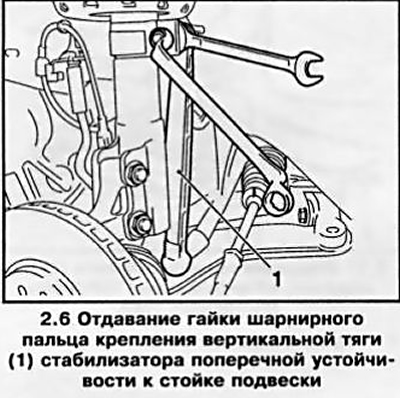
6. Holding the pivot pin with an open-end wrench by the flats, loosen the mounting nut and separate…


7. Unscrew the bolt of the clamp securing the ball joint to the steering knuckle (see accompanying illustration) - note that the bolt is turned with its head forward towards the car.
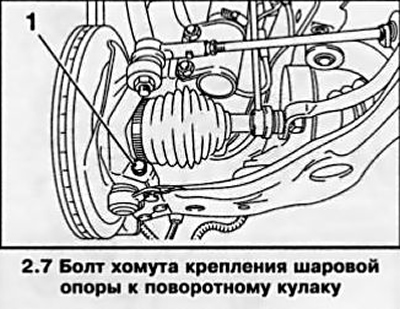


7. Unscrew the bolt of the clamp securing the ball joint to the steering knuckle (see accompanying…


8. Using a large screwdriver or chisel, wedge the ball joint clamp (see accompanying illustration).
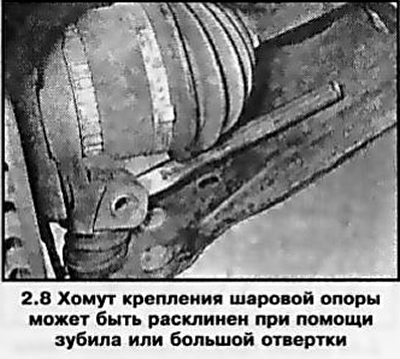
8. Using a large screwdriver or chisel, wedge the ball joint clamp (see accompanying illustration).


9. By moving the suspension arm down, release the ball joint pin tail from the mounting clamp (see accompanying illustration). Move the rack to the side and release the lever - try not to damage the rubber boot of the ball joint.
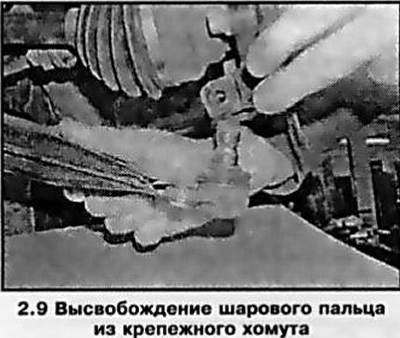
9. By moving the suspension arm down, release the ball joint pin tail from the mounting clamp (see…


10. Secure the drive shaft with wire or a support so that when removing it from the hub, it does not hang down on the inner CV joint.


11. Pull the hub outward to remove it from the drive shaft journal. If this is not possible, you can use a special puller (for example, HAZET 781-5), bolted to the hub with wheel bolts (see accompanying illustration). Move the stand to the side.
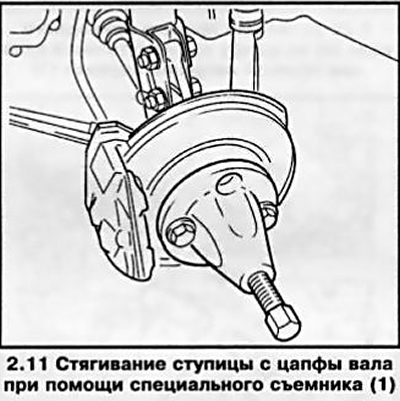
11. Pull the hub outward to remove it from the drive shaft journal. If this is not possible, you…


12. Removing the drive shaft from the gearbox/intermediate shaft can be done in different ways - depending on the degree of access to the connection points and the type of inner joint (tripod/dual compensation).

Caution: When removing the drive shaft, transmission oil will leak from the gearbox housing - place a container prepared in advance and quickly close the hole with a suitable plug. If there is time and opportunity, the transmission oil/ATF can be drained before performing the drive shaft removal procedure (see Chapter 1).


13. To remove the left drive shaft on all models covered by this Manual, and to remove the right drive shaft on models equipped with a 1.3-liter diesel engine, service stations use the Opel-KM-6003 and KM-313 tools (see accompanying illustration). The KM-6003 device must be installed between the differential assembly housing/intermediate shaft flange and the CV joint.
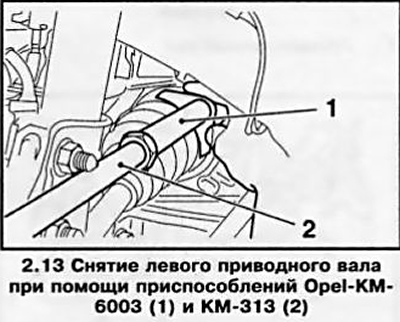


13. To remove the left drive shaft on all models covered by this Manual, and to remove the right…


14. On petrol models with 1.4 l, 1.6 l, 1.8 l engines and on models with a Z17DTL diesel engine, the Opel-KM-460-2-B fork-type tool is used to remove the right drive shaft (see accompanying illustration). If you don't have the necessary tool, you can use a crowbar - be careful not to damage the connecting elements.
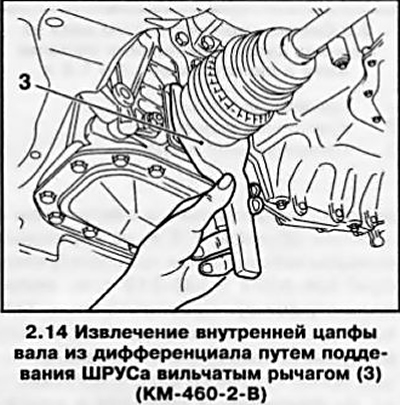
14. On petrol models with 1.4 l, 1.6 l, 1.8 l engines and on models with a Z17DTL diesel engine,…


15. On models equipped with a Z17DTH diesel engine or a 1.9L engine, and on petrol models with 2.0L and 2.2L engines, the right drive shaft is removed from the intermediate shaft using a plastic/wooden hammer and a brass drift (see accompanying illustration).
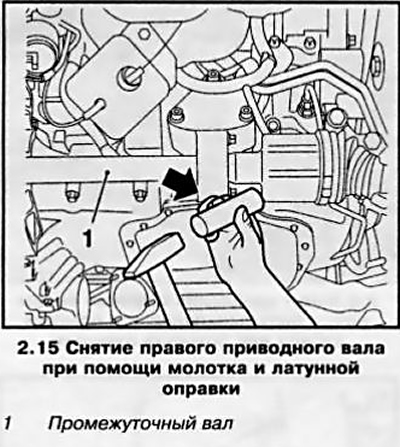
15. On models equipped with a Z17DTH diesel engine or a 1.9L engine, and on petrol models with 2.0L…


16. Carefully remove the drive shaft from the engine compartment.


Caution: Lowering the vehicle to the ground with even one drive shaft removed may damage the wheel bearings!


Installation


Note: A new hub nut and new inner snap ring will be required.


17. Remove the retaining ring from the drive/intermediate shaft journal and install a new one in its place.

19. Thoroughly clean the shaft splines and the hole in the hub. Lubricate the sealing lips of the oil seal and the shaft splines with clean transmission oil/ATF. Check the reliability of the CV joint boot fixation with your clamps.

20. On models equipped with internal double compensation CV joints, first carefully, being careful not to damage the seal, insert the internal journal of the drive shaft into engagement with the splines of the differential/intermediate shaft side gear - if necessary, use a reference sleeve to protect the seal. Push the shaft into the differential until the retaining ring snaps into place, using a hammer and a brass drift - the drift should be installed on the thickening of the end face of the joint being installed (see accompanying illustration). Engage the splined pin of the outer joint with the splines of the hub.
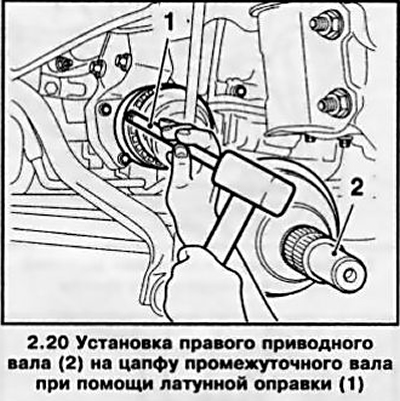
20. On models equipped with internal double compensation CV joints, first carefully, being careful…


21. On models equipped with internal tripod joints, first engage the drive shaft with the splines of the hub, and then carefully engage the journal of the internal CV joint. Then, pressing on the brake disc (see accompanying illustration), push the drive shaft until the retaining ring snaps into place, being careful not to damage the lower ball joint.
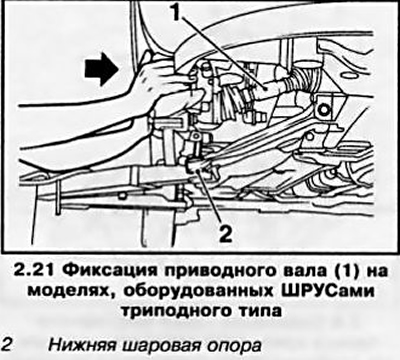


21. On models equipped with internal tripod joints, first engage the drive shaft with the splines…


22. Further installation is carried out in the reverse order of removal.


This article is available at russian, bulgarian, belarusian, ukrainian, serbian, croatian, romanian, polish, slovak, hungarian
Checking the article: Simonov Timofey

Share information:

Previous articles
Opel Astra H: Drive shafts
Next articles

General information
Specifications
Removal and installation the intermediate shaft
Checking the condition and replacing constant velocity joints (CV joints)
Replacing CV joint boots


See similar ones from other Opel car manuals:
▶ General information about clutches and drive shafts Opel Corsa B (1993-2000)
▶ Replacing the secondary drive chain (drive chain of the… Opel Insignia A (2008-2017)
▶ Removal and installation front wheel drive shafts Opel Kadett E (1984-1995)
▶ Main gear and drive shafts Opel Omega A (1986-1993)
▶ General description of drive shafts Opel Vectra A (1988-1995, petrol)
Link to this page in different formats

Visitor comments


No comments yet


How much will 49 + 19 =


Astra J (2009-2015, petrol) 
  • General information
  • Vehicle device
  • User manual
  • Faults en route
  • Maintenance
  • Power unit
  • Engine repair
  • Cooling and lubrication system
  • Engine power system
  • Exhaust system
  • Transmission
  • Clutch
  • Car gearbox
  • Drive shafts
  • Chassis
  • Front suspension
  • Rear suspension
  • Steering
  • Brake system
  • Wheels and tires
  • Body
  • Exterior
  • Interior
  • Doors and windows
  • Body Care
  • Heating and air conditioning
  • Security systems
  • Electrical equipment
  • Equipment and devices
  • Lighting and signaling
  • Power devices
  • Electrical circuits
Astra H (2004-2009) 
  • General information
  • Introduction to the guide
  • Troubleshooting
  • User manual
  • Maintenance
  • Power unit
  • Engine repair
  • Cooling and heating
  • Power and exhaust system
  • Ignition system
  • Launch and charge system
  • Transmission
  • Mechanical gearbox
  • Automatic gearbox
  • Drive shafts
  • Chassis
  • Brake system
  • Car suspension
  • Steering
  • Body
  • Interior
  • Exterior
  • Electrical equipment
  • Equipment and devices
  • Electrical circuits
Astra G (1998-2004) 
  • General information
  • Introduction to manual
  • User manual
  • Maintenance
  • Power unit
  • SOHC gasoline engines
  • DOHC gasoline engines
  • Diesel engines 1.7 and 2.0
  • Engine repair
  • Cooling system
  • Supply system
  • Injection system (gasoline)
  • Injection system (diesel)
  • Exhaust system
  • Charge and launch system
  • Ignition system (gasoline)
  • Preheat system (diesel)
  • Transmission
  • Manual gearbox
  • Automatic gearbox
  • Clutch
  • Drive shafts
  • Chassis
  • Brake system
  • Wheel suspension
  • Steering
  • Body
  • Exterior
  • Interior
  • Doors and windows
  • Ventilation and heating
  • Electrical equipment
  • Equipment and devices
  • Electrical circuits
Astra G (1998-2004, petrol) 
  • General information
  • User manual
  • Car care
  • Maintenance
  • Power unit
  • Single shaft engines
  • Twin shaft engines
  • Engine repair
  • Cooling and heating
  • Fuel and exhaust systems
  • Starting and charging system
  • Ignition system
  • Transmission
  • Clutch
  • Mechanical gearbox
  • Automatic gearbox
  • Drive shafts
  • Chassis
  • Brake system
  • Car suspension
  • Steering
  • Body
  • Interior
  • Exterior
  • Electrical equipment
  • Equipment and devices
  • Wiring diagrams Opel Astra
  • Wiring diagrams Opel Zafira
Astra F (1991-1998, petrol) 
  • General information
  • Maintenance
  • Power unit
  • Engine in car
  • Engine removed
  • Cooling system
  • Heating and ventilation
  • Fuel supply (carburetor)
  • Fuel supply (injector)
  • Emission control
  • Ignition system
  • Transmission
  • Clutch
  • Mechanical gearbox
  • Automatic gearbox
  • Drive shafts
  • Chassis
  • Brake system
  • Car suspension
  • Steering
  • Body
  • Exterior
  • Interior
  • Electrical equipment
  • Equipment and devices
  • Electrical circuits
OpelBook.ru © 2017–2026 · Mobile version · · Sitemap: EN BG BY UA RS HR RO PL SK HU · Feedback · Site search
Astra F, petrol · Astra G, petrol · Astra G · Astra H · Astra J, petrol · Corsa B · Corsa C, petrol · Corsa C · Insignia A · Kadett D · Kadett E · Omega A · Omega B · Omega B2 · Vectra A, petrol · Vectra A · Vectra B, petrol · Vectra B · Vectra C · Zafira A, petrol · Frontera A, petrol · Frontera B · Ascona C · Vivaro A ·
We want your visit to be comfortable 🤝! We use cookies 🍪 to make that happen.