


Contents: Removal ⬇ Installation ⬇
Removal
1. Set the parking brake.
2. Remove the wheel disc cover. Remove the locking pin of the crown hub nut and loosen the nut.
In this case, the car must be standing on the ground.
3. Mark the position of the front wheel in relation to its hub so that the balanced wheel can be installed in its original position. Remove the wheel mounting bolts with the car on the ground. Jack up the front of the car, place it on stands and remove the front wheels.
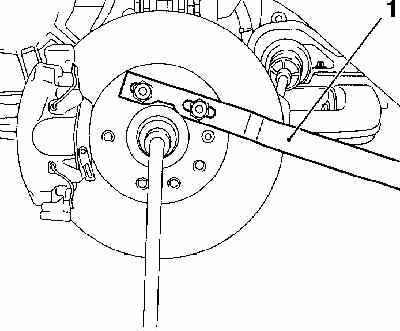
4. Remove the hub nut completely. If the car is on a lift, you can use a special tool (lever) to hold it, which you can make yourself. The tool is attached with two wheel mounting bolts.
Loosen the hub nut with the wheel removed - the hub is blocked from turning with a metal bar (1)
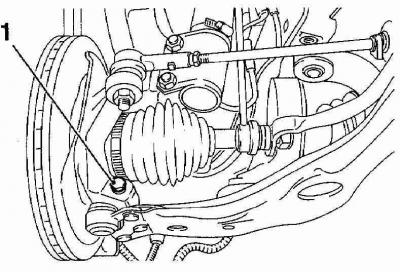
5. Loosen the clamp bolt (arrow) of the ball joint. Pull the wishbone down by hand, causing the ball joint to slide out of the steering knuckle.
Bolt of the clamp fastening the ball joint to the steering knuckle
6. Tie the drive shaft to the body with wire so that the hinges do not bend to the stop when removing one side.
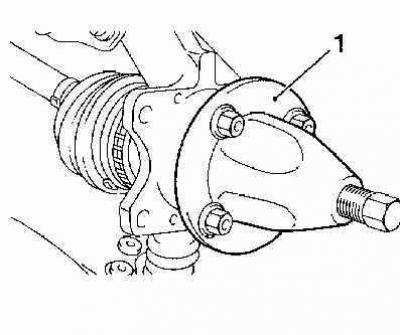
7. Remove the drive shaft from the front wheel hub by hand, pulling the shock absorber outward. If this is not possible, press out the drive using a standard puller.
Pulling the hub off the shaft journal using a special puller
8. Knock out the drive shaft from the manual transmission housing. Service stations use a special tool for this KM-460-2-A (for left drive shaft) or KM-460-1.
Removal the inner shaft journal from the differential by prying the CV joint with a fork lever
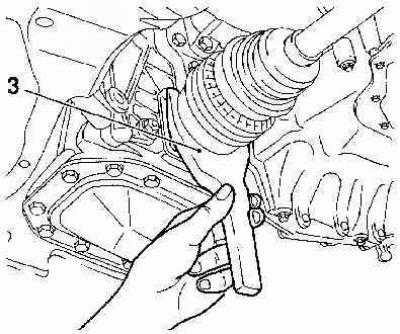
The chamfered side of the tool must face the manual transmission. Oil will leak out when the drive shafts are removed. Close the hole in the manual transmission housing with a suitable plug, for example, OPEL (ET No.9092869).
9. If the specified tool is not available or if the drive shaft is stuck during removal, knock it out with a flat chisel. To do this, first remove the CV joint cover.
10. Place a chisel between the end of the shaft and the bevel gear axle and then knock out the drive shaft.
After removing the drive shaft from the wheel hub, try not to load the CV joint and not to move the car, so as not to damage the wheel bearings. If it is necessary to move the car, insert the drive shaft into the hub and secure it with a lock nut, or tighten the bearings with a long bolt with a nut and a pair of washers. When performing all work related to the need to dismantle the drive shaft from the manual transmission housing, keep in mind that the drive shaft should be pulled out only by the joint, and not by the shaft itself. When removing and installing the drive shaft from the hub, remember that there is an internal CV joint.
Installation
The new drive shaft should be handled with care and should not be left resting on the covers for long periods of time.
1. The adjacent flange of the outer CV joint, as well as its adjacent surface to the hub bearing, should be thoroughly cleaned.
Surfaces to be cleaned
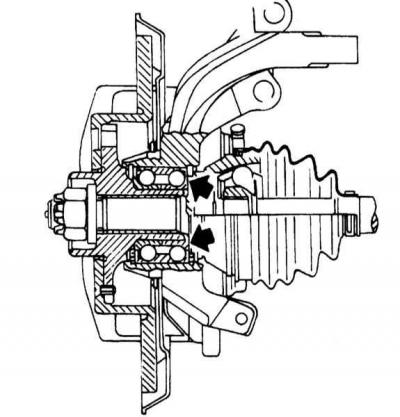
2. Lubricate the splined connection and bearing installation areas with engine oil.
3. Install a new retaining ring into the groove of the shaft on the gearbox side.
Retaining ring
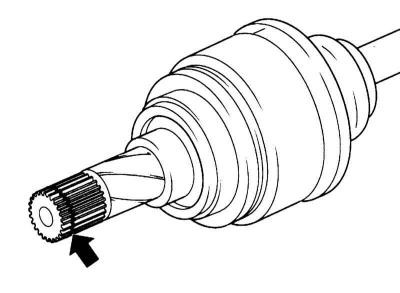
4. Insert the drive shaft into the gearbox housing hole by hand. Then push the drive shaft with a screwdriver until the locking ring is fixed. Place the screwdriver on the weld flange, not on the lining.
Article posted on a web portal (Opelbook.ru)
Position of the screwdriver when installing the drive shaft
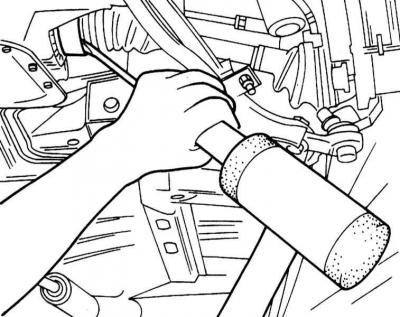
5. After fixing the retaining ring, check the reliability of the CV joint fit by pulling the outer joint with your hand.
6. If the CV joint cover was removed, replace its seal and apply grease to the cover. Tighten the steel cover fasteners with force 30 Nm, and aluminum - with effort 18 Nm.
7. Insert the splined end of the drive shaft into the hub.
8. Install a new washer and screw on a new castle nut by hand, but do not tighten it.
9. Insert the ball joint into the steering knuckle. Insert the bolt from the rear. Tighten the new self-locking nut with force 30 Nm (refer to illustration).
10. Install the front wheels so that the previously applied marks coincide. Lower the car to the ground and tighten the wheel mounting bolts crosswise with force 110 Nm.
11. Tighten the hub nut with force 130 Nm. Have an assistant depress the brake pedal, release the hub nut and retighten it firmly 20 Nm. In this position, turn the nut by an angle 90 degrees.
12. Insert a new cotter pin and bend it back. If the cotter pin does not fit, slightly loosen the nut to the nearest cotter pin hole and insert the cotter pin.
13. Check the oil level in the manual transmission and, if necessary, add oil (see Chapter Vehicle settings and routine maintenance).
Visitor comments