


Contents: Examination ⬇ Replacement ⬇
Examination
During a test drive on a limited-size area, try to determine the condition of the outer CV joints by ear. A worn joint makes a characteristic clicking sound during sharp turns - the sharper the turn, the greater the load on the joint, and the more distinctly the clicks are heard. A faulty joint must be replaced.
To assess the condition of the inner joints, set the parking brake, jack up the front of the car and place it on supports. If equipped, remove the crankcase guard. Twist the inner joint up and down, then grab it with one hand and try to rotate the shaft in both directions with the other. If any noticeable play is detected, the joint must be replaced.
Replacement
The latest models use internal tripod type hinges. Such hinges are not supplied individually to the spare parts market and in case of failure are replaced together with the shaft.
1. Remove the drive shaft (see section Removal and installation drive shafts).
2. Release the bandage straps and slide the protective cover off the damaged hinge.
3. Using a screwdriver or snap ring pliers, loosen the hinge retaining snap ring.
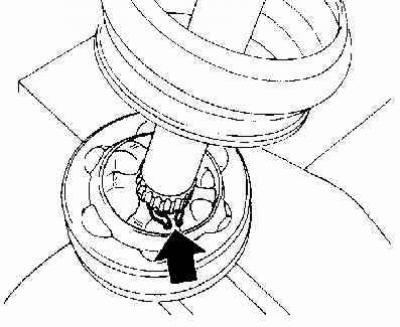
CV joint retaining ring
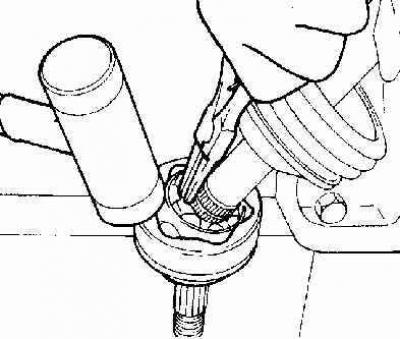
Removing the retaining ring using special pliers
4. Using a heavy, soft-faced hammer, knock the joint off the shaft.
5. Install a new retaining ring into the groove of the new joint. Place the joint on the shaft until the retaining ring snaps into the receiving groove.
Text copied from an online resource: OpelBook
6. Lubricate the joint with the required type of grease.
7. Squeeze the remaining grease into the cover, pull it over the hinge and secure it with bandage tapes (see section Replacement of protective covers of CV joints).
8. Install the shaft on the vehicle (see section Removal and installation drive shafts).
Visitor comments