


Design of the clutch and its drive components
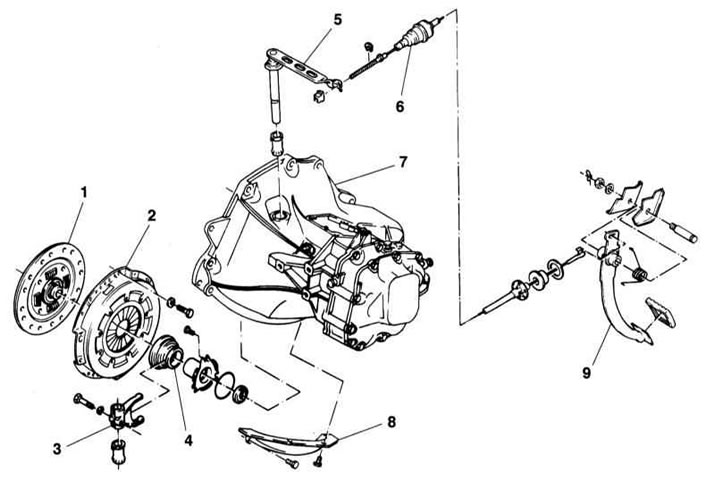
1 - Slave (friction) clutch disc
2 — Assembling the clutch basket with the pressure plate
3 — Clutch release fork
4 — Clutch release bearing
5 — Clutch release lever
6 — Clutch drive
7 — Manual transmission
8 — Clutch basket cover
9 — Clutch pedal
When the clutch pedal is pressed, the clutch release bearing is pressed against the diaphragm spring of the pressure plate, experiencing pressure through the clutch drive cable and lever. Thus, the clutch pressure plate is unloaded and the driven disk is no longer pressed against the flywheel. Contact between the engine and the manual transmission is interrupted.
If the clutch pedal is released, the pressure plate presses the driven disk against the flywheel and the transmission of torque is restored again, since the pressed disk is connected to the primary shaft of the manual transmission via a splined connection.
Every time the clutch is engaged and disengaged, the friction linings of the driven disk wear out due to slight sliding. The service life of the driven disk, however, is at least 100,000 km of vehicle mileage. Wear mainly depends on the load on the power unit (for example, towing a trailer) and driving style. As part of the maintenance, only the clutch pedal needs to be adjusted. As the friction linings wear out, the clutch pedal moves upward.
When servicing a clutch, in addition to replacing components that are obviously damaged, it is necessary to perform some initial checks (it is assumed that the gearbox is in good condition):
- To estimate the clutch shift time, start the engine at normal idle speed. Make sure the transmission is in neutral and release the clutch pedal. Now depress the clutch pedal and wait a few seconds before engaging reverse gear. The shift should not produce any grinding or other abnormal noises, which would most likely indicate a faulty clutch disc or basket assembly;
- To check that the clutch is fully disengaged, apply the parking brake and start the engine. Keeping the clutch pedal about 13 mm above the floor, shift the gearbox between first and reverse gears. The presence of interference when shifting the lever indicates a malfunction of the release mechanism components;
- Perform a visual inspection of the condition of the axle bushings at the top of the clutch pedal. Make sure there are no signs of jamming or excessive axle play.
Visitor comments