


The inspection is carried out every year.
Examination
The drive belt, or as it is sometimes called, the V-belt, is located at the front of the power unit and is used to drive such auxiliary units as the generator, steering pump and compressor of the C/V. Over time, the belt wears out and should be regularly inspected in accordance with the schedule of current maintenance of the car in order to avoid serious engine failures, the correction of the consequences of which can cost the owner a pretty penny. On models equipped with C/V or power steering, a reinforced (ribbed) belt is installed.
1. Turn off the engine, open the hood and find the drive belt at the front of the power unit. Using a flashlight, feel the belt along its entire length with your fingers, checking for cracks and delamination. The belt should also not have any abrasions, polished areas or other obvious defects. Inspect the belt on both sides, twisting them. A worn or damaged belt must be replaced.
Typical examples of V-belt wear
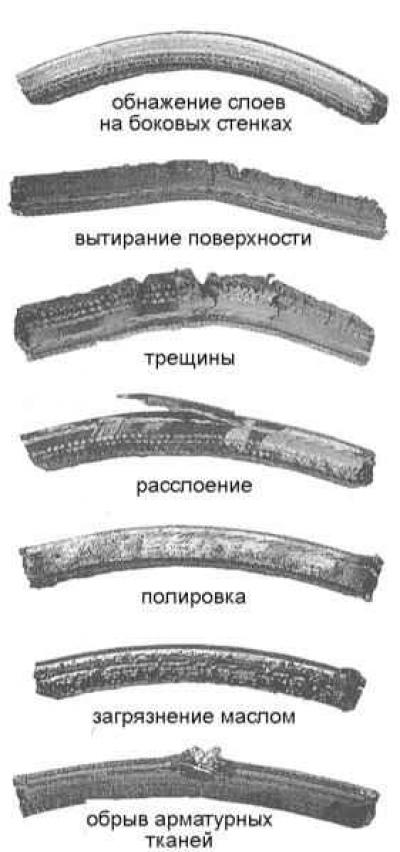
2. Check the belt tension.
Typical examples of wear on ribbed drive belts
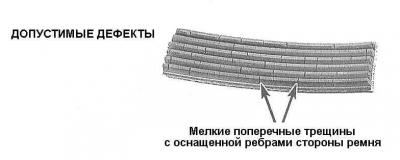
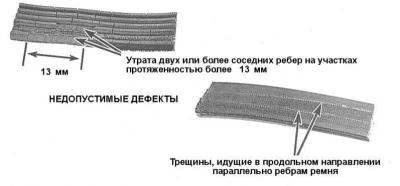
The tension of the reinforced belt should only be adjusted after it has been removed. The tension is not checked as part of maintenance.
Replacement
V-belt for models with 1.2 and 1.4 L OHC engines without power steering or crankcase ventilation and diesel engines
1. On petrol models remove the air cleaner with the intake ducts.
2. Car with diesel engine jack it up and place it on supports.
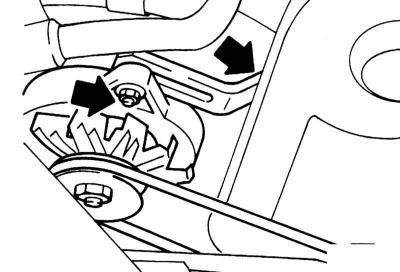
3. On gasoline engines produced before 08.1994. loosen the tension bar mounting bolt and tilt the generator toward the engine. This will loosen the drive belt tension. If necessary, loosen the lower generator bracket bolt.
Tension bar mounting bolt
4. On petrol engines produced since 09.1994. remove the generator/intake manifold bracket bolt (1). Remove the generator tension bar mounting bolts (2). Remove the generator lower support mounting bolt (3). Remove the drive belt tension bolt (4).
Belt Tensioner Components
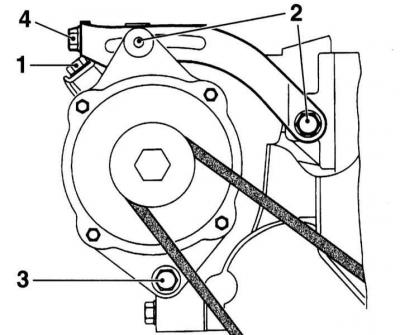
1 — Generator bracket bolt
2 — Tension bar mounting bolt
3 — Generator lower support bolt
4 — Drive belt tension bolt
5. Remove the drive belt.
6. Install the new drive belt.
7. On gasoline engines produced before 08.1994. press the generator away from the engine with a crowbar. Secure the tension bar engines produced since 09.1994. tighten the tension bolt to achieve the correct belt tension. Tighten the generator bracket mounting bolts.
(Material taken from an internet portal OpelBook.ru)
8. On a diesel engine, use a square wrench to pry the generator away from the engine and secure the tension bar.
9. Check the belt tension with your thumb. The belt should have a deflection at the point where the tension is checked with a special device 5 mm. However, when performing the next maintenance, it is necessary to check the belt tension at a service station, since if the belt is adjusted incorrectly, it may slip.
Correct tension of the V-belt has a significant impact on its service life. To check the belt tension, it is recommended to use a special tool KM-128-A. Without this tool, it is impossible to properly adjust and check the belt tension, since a new drive belt has a large pre-tension.
10. The test surface should be the middle between two pulleys if possible. On a diesel engine, the belt tension should be checked from below.
11. Place the tester on the drive belt so that the belt passes through the guides.
12. Press the lever so that the microswitch pin (at the bottom of the device) touched the drive belt. When touched, a sound signal is emitted.
Checking the belt tension using a special device
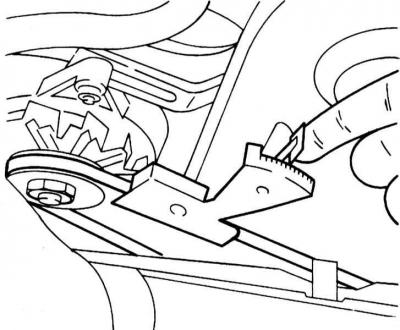
13. Read the value on the scale of the device and multiply it by 100. The resulting value corresponds to the belt tension force in Newtons.
14. The belt tension should be 250÷300 N and in no case should it be less than 250 N.
The new drive belt must be tensioned to 450 N during installation. If the belt tension is outside the specified limits, the belt must be tensioned.
14. On gasoline engines tighten the tension bar and generator mounting bolts with force 25 Nm. Install the air cleaner with intake ducts.
15. On diesel engine tighten the tension bar mounting bolts with force 25 Nm and the generator bracket with force 50 Nm. Lower the car to the ground.
OHC 1.2 and 1.4 l engines with power steering and DOHC 1.4 and 1.6 l
1. Remove the air cleaner with the air intake ducts (see Chapter Fuel, exhaust and emission control systems).
2. If the drive belt is deemed fit for further use, mark its original direction of rotation with paint or a marker. Try to remember the order in which the belt is laid around the pulleys.
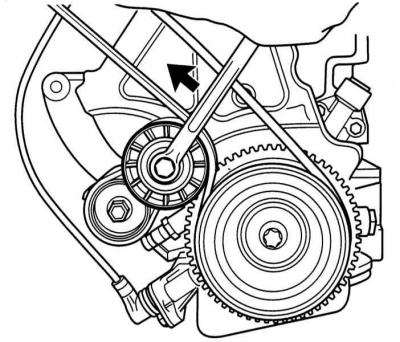
3. On dOHC engine without power steering loosen the belt tension by turning the tensioner counterclockwise by the central bolt.
Belt tension loosening on DOHC engine without power steering
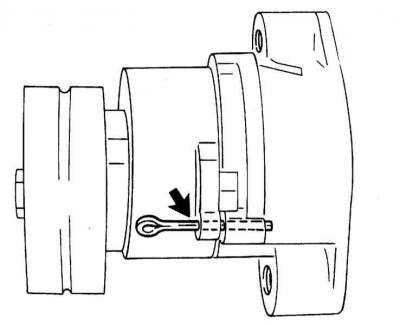
4. On OHC engine with power steering turn the tension roller clockwise with a spanner so that the holes in the holder and the tension roller align, fix the tension roller in this position with the appropriate rod or pin and remove the belt.
Fixing the tension roller
5. Place the belt on the pulleys. If you are installing a previously used belt, pay attention to the direction of its movement.
6. On dOHC engines tighten the roller with a wrench.
7. On OHC engines turn the tension roller slightly to the right, remove the pin from the locking holes and slowly unload the belt.
8. Release the tension roller, the required tension will be set automatically.
9. Check that the belt is correctly routed on the pulleys. The belt should not protrude from the side of the pulleys.
10. Install the air cleaner with the air intake ducts (see Chapter Fuel, exhaust and emission control systems).
Engines 1.2, 1.4 and 1.6 l with power steering and crankcase
1. Disconnect the negative cable from the battery.
2. Remove the air cleaner with air ducts and MAF sensor (1.6L engine) (see Chapter Fuel, exhaust and emission control systems).
3. Raise the engine using the OPEL KM-263-B tool.
If you do not have the above mentioned device, place the appropriate pipe on the wooden spacers on the wings, pass the chain through the engine eyes, connect it to the pipe and tighten the chain.
4. Turn the tension roller clockwise with a spanner so that the holes in the holder and the tension roller (A) align. In this position, secure the tension roller with the appropriate hook (C).
Fixing the tension roller
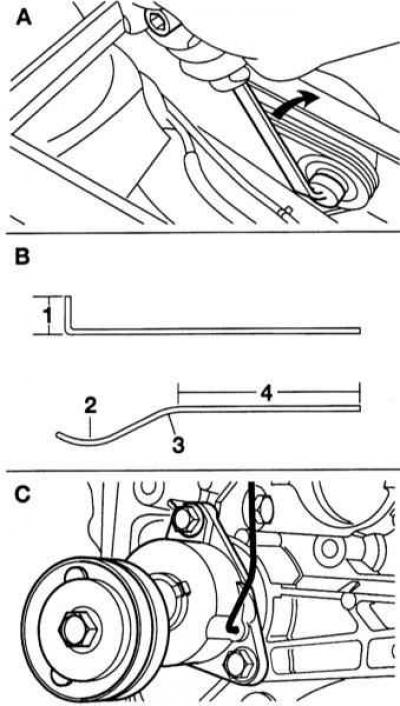
1 - 30 mm
2 - Radius 30 mm
3 - Radius 35 mm
4 - 150 mm
The hook can be made independently (B) from wire with a diameter of 4 mm. The total length of the wire is approximately 280 mm.
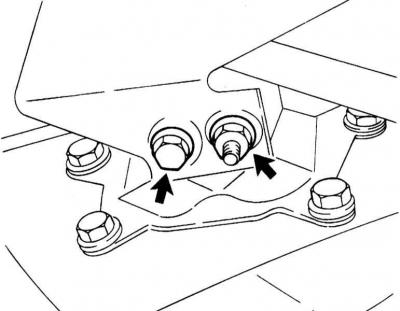
5. Loosen the mounting bolts and disconnect the power unit holder from the engine damping support.
Fastening the power unit holder to the damper support
6. Unscrew three flanged mounting bolts on the front right and left and remove the rods with the holder from the front suspension crossmember.
7. Lower the engine by approximately 5 cm, unscrew the mounting bolts and disconnect the power unit holder from the power steering pump and A/C compressor holder and remove it downwards.
8. Remove the drive belt.
9. Install the new drive belt.
10. Install the power unit holder on the power steering pump and A/C compressor holder and tighten the fasteners with force 60 Nm.
11. Raise the power unit and tighten the fasteners of its holder to the damper support with force 60 Nm.
12. Secure the rod holder at the front left and right of the crossmember with new bolts. Tighten the bolts with force 50 Nm and then turn the corner 90÷105 degrees.
13. If the KM-263-V device was installed, remove it.
14. On the engine 1.6 l connect the MAF sensor connector.
Engines 1.0 and 1.2 l DOHC
1. If the drive belt is deemed fit for further use, mark its original direction of rotation with paint or a marker. Try to remember the order in which the belt is laid around the pulleys.
2. Remove the air cleaner with the air intake ducts (see Chapter Fuel, exhaust and emission control systems).
3. Slightly raise the engine with a lift and remove the crankcase guard.
4. Disconnect the engine mount at the front right from the damper support (refer to illustration).
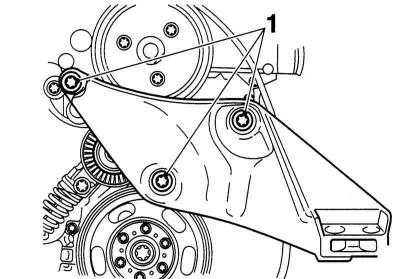
5. Disconnect the engine mount from the front right of the engine (1).
Engine mount fastener
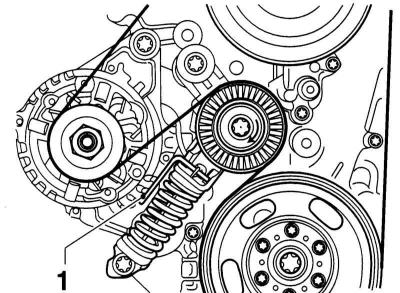
6. Turn the tension roller clockwise by the central bolt. Secure the tensioner with a suitable rod.
Tensioner fixing point
7. Remove the drive belt and replace it.
8. Slightly tighten the tensioner, remove the locking pin and slowly loosen the tensioner, making sure that the belt is correctly positioned in the pulley grooves.
9. Tighten the engine mount bolts to the engine and damper support with force 60 Nm. Remove the engine jack.
10. Reinstall the air filter.
Visitor comments