


Contents: Examination ⬇ Replacement ⬇
Examination
Typical examples of V-belt wear
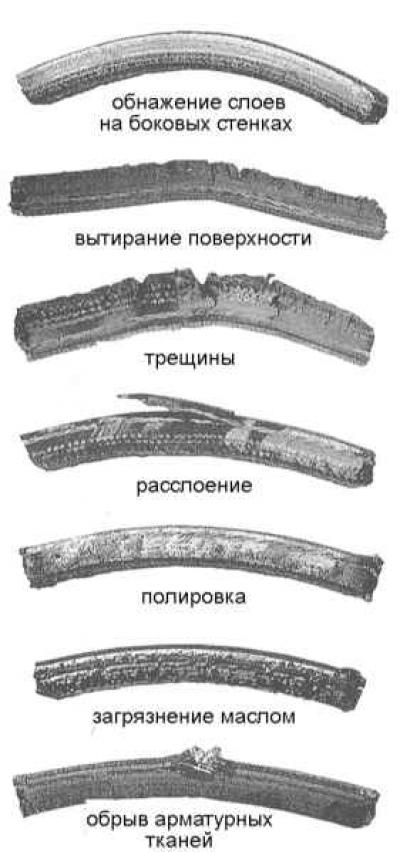
Typical examples of wear of multi-groove drive belts
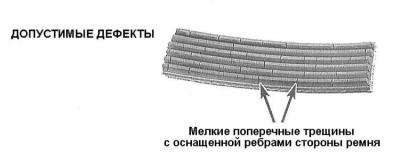
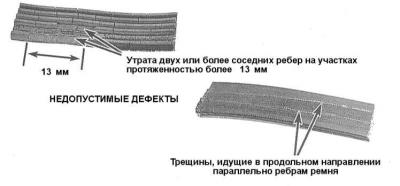
Drive belts, or V-belts as they are sometimes called, are located at the front of the powertrain and play a vital role in the operation of the engine and many other vehicle systems. Over time, belts wear out and should be inspected regularly as part of a vehicle's routine maintenance schedule to avoid serious engine failures that can be costly to repair.
The V-shaped family also includes multi-groove belts.
The number of drive belts used on an engine depends on the vehicle configuration. Belts are used to drive auxiliary units such as the generator, steering and water pumps, air conditioning compressor, etc. Depending on the pulley arrangement, more than one unit can be driven by one belt.
Turn off the engine, open the hood and locate the drive belts at the front of the power unit. Using a flashlight, feel the belts along their entire length with your fingers, checking for cracks and delamination. The presence of scuffs, polished areas and other obvious defects on the belt is also unacceptable (see illustrations Typical examples of V-belt wear and Typical examples of wear of multi-groove drive belts). Inspect the belts on both sides by twisting them. A worn or damaged belt must be replaced.
Check the position of the belt tensioner lever - it should move freely and occupy a position between the stops on the base plate. If the tensioner lever is pressed against the stop, both the belt and the tensioner should be replaced.
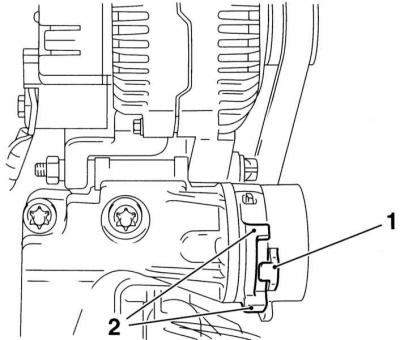
Layout of the auxiliary drive belt tensioner lever (1) and its stops (2) - models without K/V
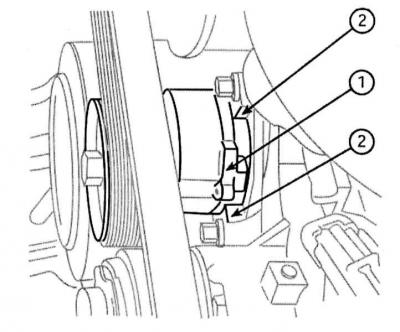
Layout of the auxiliary drive belt tensioner lever (1) and its stops (2) - models with K/V
Replacement
Petrol models
1. Remove the air cleaner with the intake ducts and air flow sensor (see Chapter Power and exhaust systems).
2. If the drive belt is deemed fit for further use, mark its original direction of rotation with paint or a marker. Try to remember the order in which the belt is laid around the pulleys.
The source is on the online website: opelbook.ru
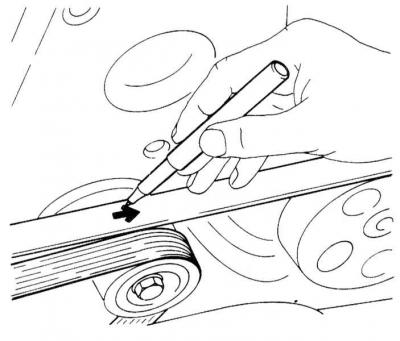
3. To loosen the belt tension, turn the tensioner counterclockwise by the central bolt. Slip the belt off the pulleys, before removing the belt from the engine, carefully release the tensioner.
4. Replace the failed components (see above Examination), - a description of the procedures for removing and installing the tensioner is given in Chapter Engine electrical equipment.
5. Install the belt on the engine (if a used belt is being installed, make sure that the original direction of rotation is maintained), - make sure that the belt ribs are correctly positioned in the pulley grooves. Release the tensioner and check again that the belt is installed and routed correctly.
6. Overcoming the resistance of the spring, press the tension roller with a suitable lever and also check the correct placement of the belt - release the tensioner smoothly.
7. Reinstall the air cleaner and associated components (see Chapter Power and exhaust systems).
Diesel models
Models with 1.7L SOHC engine
1. Remove the air cleaner with air ducts and air flow sensor (see Chapter Power and exhaust systems).
2. If the drive belt is deemed fit for further use, mark its original direction of rotation with paint or a marker. Try to remember the order in which the belt is laid around the pulleys.
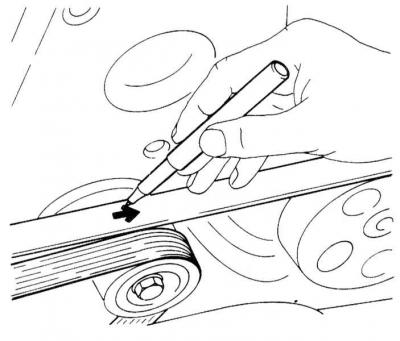
3. On models equipped with air conditioning, use a socket wrench to loosen the tensioner and slide the multi-ribbed belt off the pulleys.
4. Loosen the mounting bolts and remove the generator support bracket.
5. Loosen the locking bolt, then turn the tensioner nut to loosen the belt tension and remove the belt from the drive pulleys.
6. Install the belt on the engine (if a used belt is being installed, make sure that the original direction of rotation is maintained), - make sure that the belt ribs are correctly positioned in the pulley grooves. Apply a force of 450 N to the tensioner nut (new belt)/ 250—400 N (used belt), tighten the fixing bolt.
7. Install the generator support bracket and tighten its mounting bolts.
8. On models equipped with a/c, use a socket wrench to release the tensioner and place the belt on the pulleys - see notes above. Finally, release the tensioner.
9. Reinstall the air cleaner and associated components (see Chapter Power and exhaust systems).
Models with 1.7L DOHC engine
1. Remove the air cleaner with air ducts and air flow sensor (see Chapter Power and exhaust systems).
2. If the drive belt is deemed fit for further use, mark its original direction of rotation with paint or a marker. Try to remember the order in which the belt is laid around the pulleys.
3. Turn the tensioner counterclockwise by the central bolt, loosen the belt tension and remove it from the drive pulleys.
4. Install the new belt onto the engine. Release the tensioner, then recheck the belt routing.
5. Reinstall the air cleaner and associated components (see Chapter Power and exhaust systems).
Models with 2.0L engines
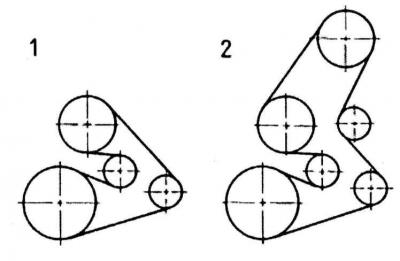
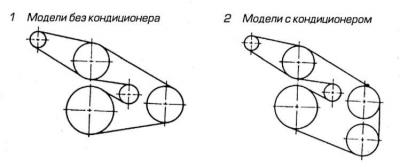
Accessory Drive Belt Routing Diagram for 2.0L Engines
1. Remove the air cleaner together with the air ducts and air flow sensor.
2. Set the parking brake, jack up the front of the vehicle and place it on supports. If equipped, remove the crankcase guard.
3. Mark the position of the balancing weight (torsional vibration damper) on the right drive shaft. Unscrew the mounting bolts and remove the weight (see Chapter Clutch and drive shafts).
4. Carefully mark the installation position of the right support of the power unit suspension relative to the subframe. Support the engine with a trolley jack (to distribute the load, place a wooden block between the jack head and the engine oil pan).
5. If the belt installed on the engine is considered fit for further use, then before removing the support, mark the original direction of its rotation. Try to remember the order of laying the belt on the pulleys (see illustration Accessory Drive Belt Routing Diagram for 2.0L Engines).
6. To loosen the belt tension, turn the tensioner counterclockwise by the bolt. Slip the belt off the pulleys, before removing the belt from the engine, carefully release the tensioner.
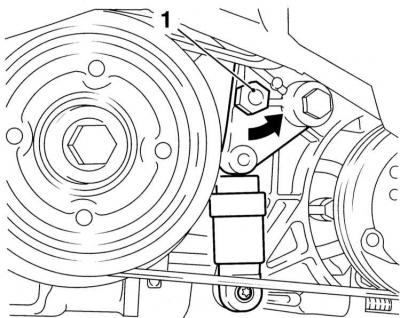
7. While holding the tensioner in the retracted position, place the replacement belt on the pulleys.
8. Install the torsional vibration damper on the right drive shaft and tighten its mounting bolts to the required torque (see Chapter Clutch and drive shafts).
9. If equipped, reinstall the crankcase guard and lower the vehicle to the ground.
10. Reinstall the air cleaner and associated components (see Chapter Power and exhaust systems).
Visitor comments