


2. Place the front wheels of the vehicle in a straight-ahead position, remove the key from the ignition and lock the steering wheel.
3. In the driver's footwell, unscrew the bolt securing the lower part of the intermediate shaft of the steering column to the input shaft of the steering gear. Separate the intermediate shaft and move it to the side.
4. Remove the battery with the tray (see Chapter 5).
5. Remove and set aside the expansion tank, having first disconnected the electrical wiring from it.
Note: You do not need to drain the coolant, but be careful not to accidentally disconnect any of the cooling system hoses.
6. On petrol models, disconnect the 2 lambda probe wiring connectors.
7. Remove the headlights (see Chapter 12).
8. Secure the radiator to the front panel by threading 2 bolts through the side mounts - the lower rubber radiator supports are mounted on the subframe.
9. Remove the cover from the fuse box on the left side of the engine compartment and disconnect the steering fuse wiring.
10. Disconnect the steering harness connector, loosen the retaining nut and disconnect the steering harness ground cable from the body panel - try to remember the harness routing pattern, then lower the harness down onto the steering gear housing.
11. If equipped, remove the engine cover (see Chapter 2) and remove the air intake duct (see Chapter 4).
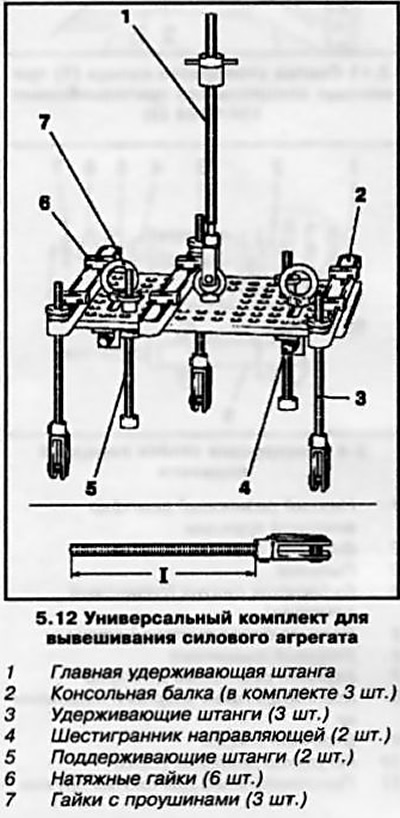
12. Hang the power unit from above. To hang the power unit at branded stations, use a special universal kit (see accompanying illustration), depending on the engine model, the rigging equipment is mounted in the appropriate order. This kit allows you to hang the unit on a special crossbar, which is installed on the front side members of the car above the engine compartment. It also allows you to raise and lower the power unit within certain limits, sufficient for repair work.
13. Raise the vehicle on a lift and place it on supports. Remove both front wheels. If equipped, remove the engine guard and the steering gear heat shield.
14. Remove the right front wheel arch protection elements.
15. Disconnect the anti-roll bar struts from the suspension struts on both sides.
16. Disconnect the steering rod ends from the steering knuckles (see Section 12).
17. Unscrew the bolts of the steering knuckle clamps and release the ball joint pins from them.
18. Remove the exhaust pipe, catalytic converter and middle section of the exhaust system (see Chapter 4).
19. Release the gearshift drive rods from the holders on the gearbox (see Chapter 6 and 7)
20. Separate the rear powertrain mount from the transmission, then disconnect the front mount from the subframe (see Chapter 2).
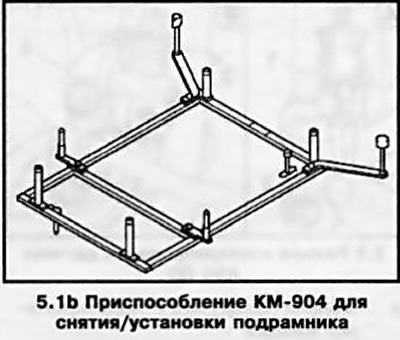
21. Support the subframe with a trolley jack; to distribute the load, place a special device on the jack head (see accompanying illustration), if it is not available, you can put suitable wooden blocks underneath.
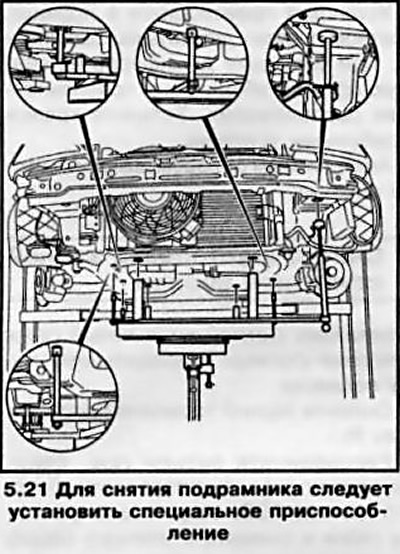
22. Clearly mark the position of the subframe and its mounting bolts relative to the car body - specialists use special guides during installation.
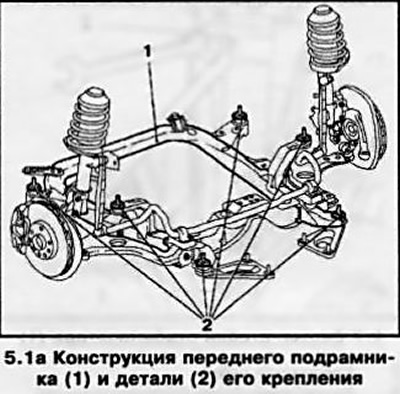
23. Remove the subframe mounting bolts. The bolts are different lengths - try to remember the location of each one. The general layout of the fasteners is as follows: 2 bolts in the front, 2 bolts above the suspension arms and 6 bolts on the triangular brackets (see accompanying illustration).
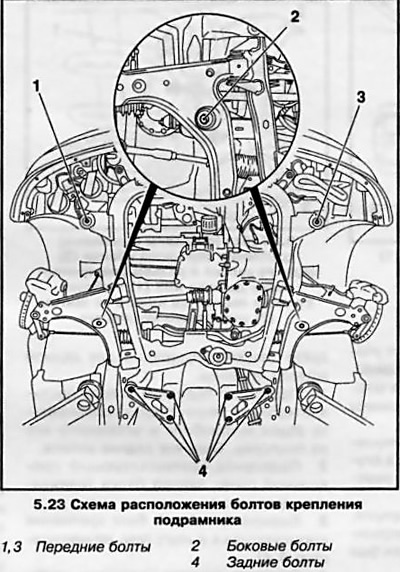
Caution: Never use impact or pulse drills to remove bolts!
24. With the help of an assistant, lower the subframe - try not to damage the steering wiring.
25. If necessary, remove and replace the elements installed on the subframe.
26. Installation is performed in the reverse order of component disassembly. Make sure that the mounting marks applied during disassembly are correctly aligned; tighten all fasteners with the required force.
Visitor comments