


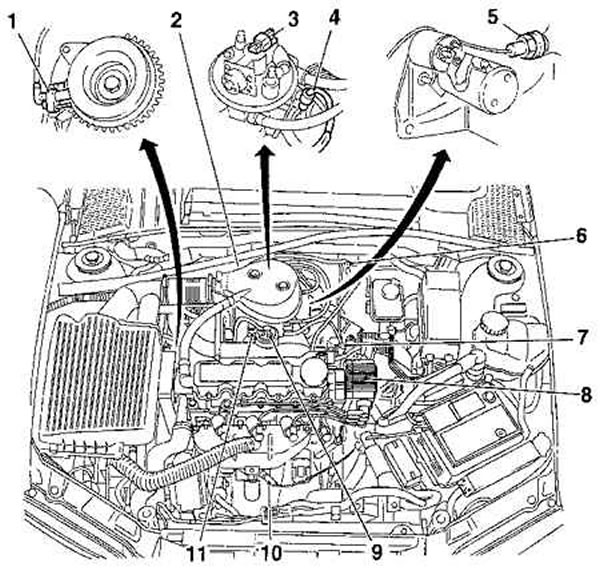
1. Crankshaft position sensor
2. Throttle body
3. Fuel injectors
4. Throttle potentiometer
5. Knock sensor
6. MAP sensor
7. Fuel vapor recovery system
8. Ignition unit
9. Exhaust gas re-burning system
10. Oxygen sensor
11. Stepper motor for idle speed control
Location of the fuel injection system diagnostic connector
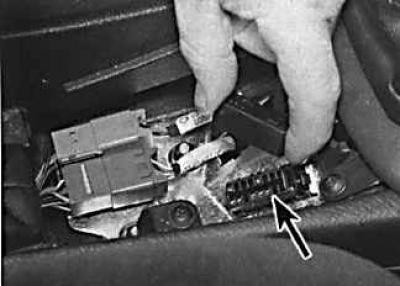
Removal the decorative trim in front of the handbrake lever
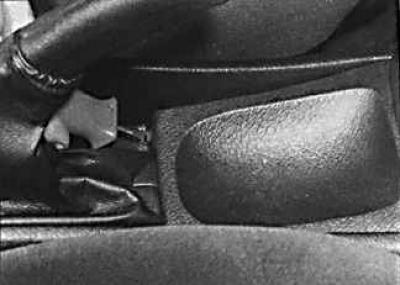
To access the diagnostic connector, you need to remove the decorative trim from the top of the center console.
The Multec system is a combined ignition and fuel injection system and includes a catalytic converter, evaporative emission control system and exhaust gas re-burning system.
The fuel pump, immersed in the fuel tank, delivers fuel from the tank to the fuel injector through a filter. The fuel pressure in the system is controlled by a pressure regulator. The regulator allows excess fuel to return to the fuel tank when the pressure in the fuel system is exceeded.
The electrical control system consists of the ECU unit together with the following sensors:
- the throttle potentiometer tells the ECU the position of the throttle valve when it is open or closed;
- the coolant temperature sensor reports engine temperature to the ECU;
- the oxygen sensor informs the ECU of the oxygen content in the exhaust gases;
- the crankshaft position sensor informs the ECU of the engine speed and the position of the crankshaft;
- a knock sensor installed in the cylinder block is used to detect the onset of detonation or early ignition;
- the manifold absolute pressure sensor informs the ECU of the vacuum in the intake manifold;
- the ABS sensor tells the ECU the relative speed of the vehicle;
- the air conditioning compressor switch informs the ECU that the air conditioning system is on.
All the information from the sensors is analyzed by the ECU, and on this basis the unit determines the appropriate ignition timing and fuel mixture composition. The unit controls the fuel injector by changing the pulse width, i.e. the length of time the injector is open, to provide a richer or leaner fuel mixture.
The ECU also controls idle speed. For this purpose, there is a stepper motor that controls the position of the throttle valve.
The ECU also controls the exhaust gas composition and the evaporative emission control system.
If there is an error in any of the data received from the sensors, the ECU enters the backup mode. In this case, the ECU ignores the incorrect sensor signal and accepts a pre-programmed value that allows the engine to continue to operate, albeit with reduced efficiency. If the ECU enters the backup mode, the hazard warning lamp on the instrument cluster will light and the fault will be recorded in the ECU memory. After this, it is necessary to carry out a complete test of the engine management system using a special electronic diagnostic test bench, which is simply plugged into the diagnostic connector of the system. The connector is located behind the central console. In order to access it, it is necessary to remove the decorative trim in front of the handbrake lever.
Visitor comments