
OpelBook.ru
Cars AvtoVAZ Cars Mitsubishi Cars BMW Cars Mercedes Cars Nissan Cars Toyota Cars Chevrolet
English Русский
Български
Беларускі
Український
Српски
Hrvatski
Română
Polski
Slovenský
Magyar
 |  Sitemap  |  Contacts  |    


Main Astra Corsa Insignia Kadett Omega Vectra Zafira Others Articles
Vectra A (1988-1995, petrol) Vectra A (1988-1995) Vectra B (1995-2002, petrol) Vectra B (1995-2002) Vectra C (2002-2008)
  • Main
  • Vectra
  • Vectra A
  • Chassis
  • Steering
  • Wheel alignment angles

Wheel alignment angles (Opel Vectra A)

            0

Optimum driving characteristics and minimal tire wear are only achieved with the correct front wheel alignment. If tire wear is abnormal, the vehicle does not maintain its direction of travel well, or if cornering is poor, you should contact a workshop to have the appropriate checks performed.

An accurate check of the wheel alignment angles can only be carried out on a suitable measuring stand. Therefore, this chapter describes only the basic concepts and the procedure for adjusting the wheel alignment.

Basic concepts


Wheel alignment


Toe-in is the difference in the distances between the side surfaces of the front wheels at the front and rear. The front wheels must have toe-in because the deflection and rolling resistance when driving forward due to play in the wheel bearings, suspension and steering rod joints cause the wheels to deviate slightly outward. Toe-in compensates for this deviation. To set the toe-in, the front wheels are adjusted so that the distance measured between the wheels at the middle of their height is less at the front than at the rear, i.e. the wheels are slightly closer together at the front.

Wheel alignment and lateral tilt


Camber and caster reduce the impact of road surface irregularities on the steering wheel and provide minimal tire friction when driving around curves.

Camber is the angle at which the plane of the wheel deviates from the vertical. Thus, the front wheels are installed at an angle and are closer to each other at the point of contact with the ground than at the top.


Caster angle is the angle between the steering knuckle axis and a vertical line drawn through the point where the tire touches the ground, looking in the direction of the longitudinal axis of the vehicle.

[Article published on the website OPELBOOK.ru]

Due to the camber angles and the inclination of the steering axis, the contact points of the wheels with the road are close to the rotation axis of the steering knuckles. Due to this, small values of the rolling shoulder are maintained. The smaller this value, the less force is required to turn the wheels. In addition, the steering is significantly less affected by impacts due to unevenness of the road.

In Opel Vectra/Calibra cars the rolling shoulder is negative. Thanks to this, maximum stability of the driving direction is maintained in case of uneven braking of the front wheels.

Longitudinal tilt of the steering knuckle axis


The longitudinal tilt of the steering knuckle axis has a significant effect on driving stability. Too little tilt causes the car to pull to one side on poor road surfaces and in crosswinds, and also makes it difficult to return the steering wheel to the straight-ahead position when exiting a turn. The tilt of the steering knuckle axis is determined by the design, by a certain angle of rotation, and is not adjustable. The value of this angle, however, should be checked after repairs to the front suspension or front axle beam (is done in the workshop).
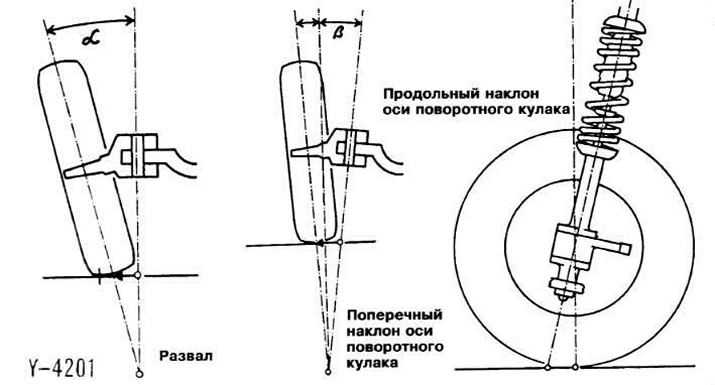
The longitudinal tilt of the steering knuckle axis has a significant effect on driving stability.…


This article is available at russian, bulgarian, belarusian, ukrainian, serbian, croatian, romanian, polish, slovak, hungarian
Checking the article: Zinoviev Kirill

Share information:

Previous articles
Opel Vectra A: Steering
Next articles

Checking, replacing and adjusting the tension of the V-belt
Checking the oil level in the power steering reservoir
Checking the steering play
Checking the condition of the steering rod end seals
Bleeding the hydraulic system (front-wheel drive vehicles)
Removal and installation the power steering pump
Measuring wheel alignment angles
Wheel alignment


See similar ones from other Opel car manuals:
▶ Wheel alignment angles — general information Opel Astra G (1998-2004, petrol)
▶ Wheel alignment angles Opel Corsa B (1993-2000)
▶ Wheel alignment angles Opel Insignia A (2008-2017)
▶ Checking and adjusting the front wheel alignment angles Opel Kadett E (1984-1995)
▶ Wheel alignment angles — checking and adjusting Opel Omega B2 (1999-2003)
Link to this page in different formats

Visitor comments


No comments yet


How much will 11 + 27 =


Vectra C (2002-2008) 
  • General information
  • User manual
  • Vehicle device
  • Maintenance
  • Troubleshooting
  • Power unit
  • Engine repair
  • Cooling system
  • Power and control system
  • Engine electrics
  • Transmission
  • Clutch
  • Car gearbox
  • Drive shafts
  • Chassis
  • Car suspension
  • Steering
  • Brake system
  • Body
  • Exterior
  • Interior
  • Doors, locks and windows
  • Heating and ventilation
  • Electrical equipment
  • Equipment and devices
  • Headlights and lighting
  • Electrical circuits
Vectra B (1995-2002) 
  • General information
  • User manual
  • Weekly checks
  • Maintenance (gasoline)
  • Maintenance (diesel)
  • Troubleshooting
  • Power unit
  • SOHC gasoline engine
  • DOHC petrol engine
  • Diesel engine 1.7 liter
  • Diesel engine 2.0 liters
  • Engine repair
  • Cooling system
  • Fuel system (gasoline)
  • Fuel system (diesel)
  • Charging system
  • Launch system
  • Ignition and preheat
  • Transmission
  • Clutch
  • Mechanical gearbox
  • Automatic gearbox
  • Drive shafts
  • Chassis
  • Brake system
  • Wheel suspension
  • Steering
  • Body
  • Exterior
  • Interior
  • Doors and windows
  • Heating and ventilation
  • Electrical equipment
  • Equipment and devices
  • Electrical circuits
Vectra B (1995-2002, petrol) 
  • General information
  • Maintenance
  • Help with malfunctions
  • Power unit
  • Engine repair
  • Exhaust system
  • Cooling system
  • Fuel system
  • Multec injection system
  • Four point injection
  • Transmission
  • Clutch
  • Gearbox and drive
  • Chassis
  • Wheel suspension
  • Steering
  • Brake system
  • Wheels and tires
  • Body
  • Exterior
  • Interior
  • Electrical equipment
  • Fuses and electronics
  • Power devices
  • Ignition system
  • Lighting and signaling
  • Equipment and devices
  • Heating and ventilation
  • Electrical circuits
Vectra A (1988-1995) 
  • Power unit
  • Engine repair
  • Ignition system
  • Lubrication system
  • Cooling system
  • Injection system
  • Fuel system (carburetor)
  • Fuel system (diesel)
  • Exhaust system
  • Transmission
  • Clutch
  • Car gearbox
  • Chassis
  • Front suspension
  • Rear suspension
  • Steering
  • Brake system
  • Wheels and tires
  • Body
  • Exterior
  • Interior
  • Electrical equipment
  • Electrical circuits
Vectra A (1988-1995, petrol) 
  • General information
  • User manual
  • Maintenance
  • Power unit
  • SOHC engine
  • DOHC engine
  • Cooling and ventilation
  • Fuel system (carburetor)
  • Fuel system (injector)
  • Exhaust converter
  • Transmission
  • Clutch
  • Mechanical gearbox
  • Automatic gearbox
  • Drive shafts
  • Chassis
  • Brake system
  • Car suspension
  • Steering
  • Body
  • Body elements
  • Electrical equipment
  • Power devices
  • Equipment and devices
  • Electrical circuits
OpelBook.ru © 2017–2026 · Mobile version · · Sitemap: EN BG BY UA RS HR RO PL SK HU · Feedback · Site search
Astra F, petrol · Astra G, petrol · Astra G · Astra H · Astra J, petrol · Corsa B · Corsa C, petrol · Corsa C · Insignia A · Kadett D · Kadett E · Omega A · Omega B · Omega B2 · Vectra A, petrol · Vectra A · Vectra B, petrol · Vectra B · Vectra C · Zafira A, petrol · Frontera A, petrol · Frontera B · Ascona C · Vivaro A ·
We want your visit to be comfortable 🤝! We use cookies 🍪 to make that happen.