


Contents: General information ⬇ Conditions for checking wheel…⬇ Adjusting the front wheel alignment ⬇
General information
The rear wheel alignment angles are set at the factory and are not included in the controlled parameters.
The front wheel alignment angles determine the geometry of the latter's position relative to the vehicle's suspension and the road surface. Violation of this geometry adjustment leads to decreased vehicle controllability and increased tire wear. The front wheel alignment angles subject to control include coasting (longitudinal tilt angle of the wheel pivot axis), camber, yaw angle and toe-in Only one parameter is subject to adjustment - toe-in. Other parameters should be checked on a regular basis to assess the degree of wear of suspension and steering components.
Wheel alignment angles of a car
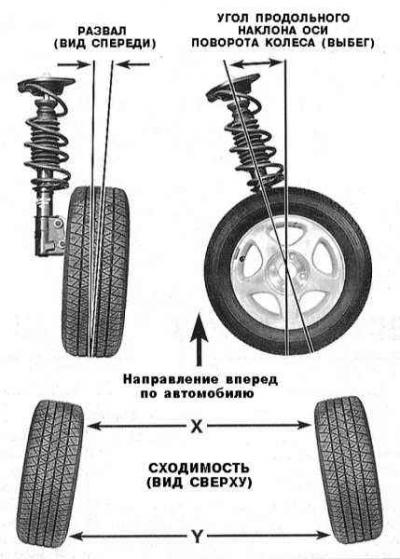
Wheel alignment is one of those procedures that require particularly precise measurements, and for high-quality performance it is necessary to have special, rather bulky and expensive equipment. It is best to entrust this work to professional mechanics at a car service center. Below, for general understanding, are definitions of each of the controlled wheel alignment angles of a car, knowledge of which will facilitate communication between the car owner and the car service personnel.
The angle of longitudinal inclination of the wheel rotation axis (coast) is called the projection of the angle between the vertical and the wheel turning axis onto the vertical longitudinal plane of the car. If the turning axis is tilted back (the lower part of the axle is pushed forward), the runout is called positive, and vice versa. The adjustment of the front wheel runout is carried out by selecting spacer washers placed under the suspension push rods.
Collapse is the angle of inclination of the plane of the wheels relative to the vertical. If the wheels are tilted with their upper edges outward, the camber is called positive, and vice versa. The camber value is measured in degrees. Correct camber adjustment determines the size and position of the contact patch of the treads with the road and allows for compensation for changes in the suspension geometry when turning and when the car is moving on uneven road surfaces. The models of cars in question do not have the ability to adjust the camber.
The angle of the transverse inclination of the wheel rotation axis is called the projection onto the vertical transverse plane of the car of the angle between the vertical and the axis of rotation of the wheel.
Due to the camber and the angle of the transverse tilt of the wheel pivot axis, the points of contact of the wheels with the road are located closer to the axis of the steering knuckle, which supports the so-called "rolling shoulder" that makes it easier to control the car and reduces the effect of the transmission of impacts of the wheels on the unevenness of the road surface to the steering.
Convergence is the amount of convergence of the front edges of the car wheels. Such a violation of the parallelism of the wheel installation allows to minimize the wear of the tread due to skidding when turning. At zero toe-in, the distance between the front edges of the wheels is equal to the distance between their rear edges. Normal toe-in usually does not exceed two centimeters. Adjustment of the toe-in of the front wheels is carried out by adjusting the length of the steering rods by changing the position of their tips. To adjust the toe-in of the rear wheels, a special adjusting cam bolt is provided, screwed into the inner end of the rear suspension control lever. Violation of the toe-in adjustment leads to accelerated wear of the tire treads due to their slippage on the road surface.
Conditions for checking wheel alignment angles
1. Checking the vehicle's installation angles requires an inspection pit or a special measuring lift. When taking measurements, the following conditions must be met:
- The air pressure in the tires complies with the requirements of the Specifications in Chapter Suspension and steering;
- The front wheels are set in a straight-ahead position;
- The car is not loaded, the fuel tank is full;
- The car's suspension is very compressed;
- The steering gear is adjusted correctly;
- The play in the articulation of the suspension components and steering gear does not exceed the permissible ranges;
- The tread depth of the tires on the same axle is the same.
2. All parameters, except for toe-in, are set during vehicle production and are not subject to adjustment. Unless the vehicle has been in a serious accident, the wheel alignment angles should be maintained throughout the vehicle's service life. If you are not sure that the parameters that are not subject to adjustment have been correctly determined, seek help from specialists.
3. At home, toe-in can be measured in two ways. The first involves measuring the distances between the front inner edges of the wheel rims with a suitable measuring device. The second method requires a special plate. By placing the plate perpendicular to the wheel and rotating it, you can determine the deviation of the wheels. The measuring device or plate can be purchased in specialized stores.
4. If the check shows that the toe-in needs to be adjusted, loosen the locknuts on the ends. Turn the steering wheel all the way to the left and accurately count the visible number of threads on the right steering rod. Then turn the steering wheel all the way to the right and count the visible number of threads on the left rod. If the two numbers match, you will need to loosen or tighten both ends by the same number of turns during subsequent adjustment. If the results obtained differ from each other, you will need to compensate for the difference during subsequent adjustment. After adjustment, both rods should have the same number of free threads.
5. Once the adjustment is complete, tighten the lock nuts - since the rods have rotated, the steering gear protective covers will most likely be deformed and you should loosen the clamps that secure them and make the appropriate corrections.
Adjusting the front wheel alignment
1. Set the wheels to the straight-ahead position.
2. The exact position is determined by reaching the control size (1).
Setting the wheels to the straight-ahead position
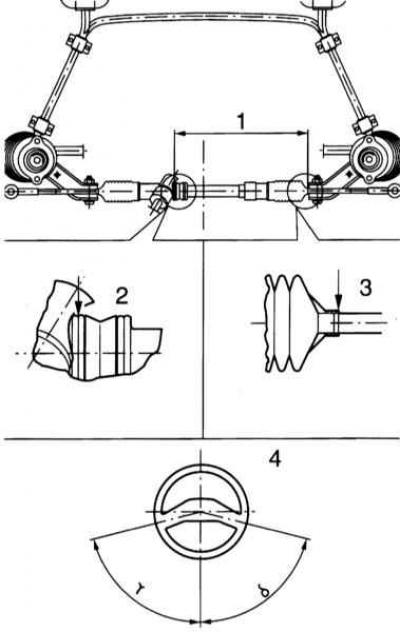
1 - Control size:
Models without power steering 420±2 mm
Models with power steering 435±2 mm
2 — Left ledge of the steering gear housing
3 - Recess for protective cover
4 - Steering wheel center position
3. Install the OPEL KM-551-2 control template between the left-hand step of the steering gear housing (2) and the right-hand step for the protective cover (3).
4. In this position, the steering wheel should be straight (4). If there is a deviation from the central position by an angle of more than ±5 degrees, remove the steering wheel and install it straight on the steering shaft.
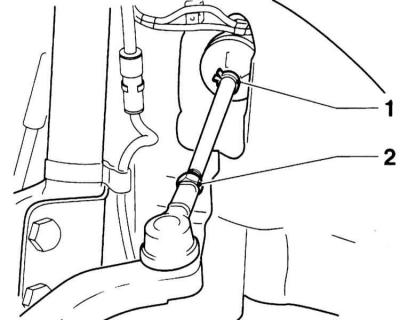
5. Remove the clamp (1) securing the protective cover and loosen the lock nut (2) of the steering rod end.
Clamp (1) of the protective cover and lock nut of the steering rod end
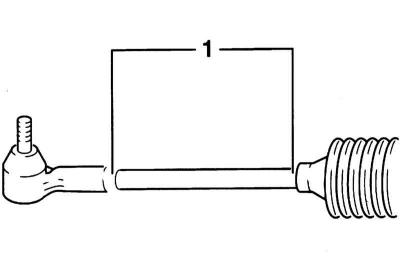
6. Adjust the toe-in by rotating both steering rods.
In this case, it is necessary to maintain the length of the steering rods.
Length (1) of tie rod end
7. Tighten the tie rod end lock nut with force 50 Nm.
8. Adjust the protective cover and secure it with a clamp.
9. Check the front wheel alignment again.
Visitor comments