


After repairing any suspension or steering components, be sure to check the wheel alignment angles. A quality check and adjustment of the wheel alignment angles can only be performed at a service facility that has a special stand for. performing adjustment work.
The following wheel alignment angles are monitored:
The front wheel camber angle is the angle of the plane of rotation of the wheel relative to the vertical. Uneven camber angles cause the car to drift to the side when driving in a straight line. Large positive camber (when the top of the wheel protrudes outward) leads to accelerated wear of the outer part of the tire tread, and large negative camber - the inner part of the tread (see "Wheels, tires and hubs - technical condition check"). The camber angle of the front wheels is set by design and is not adjustable. The camber angle can be used to diagnose the condition of the front suspension. If the camber angle is outside the permissible limits, repair of the suspension elements is required.
Front wheel toe-in is the angle between the plane of rotation of the wheel and the longitudinal plane of symmetry of the car in a straight-line position. Violation of the wheel toe-in worsens the controllability and directional stability of the car, and leads to intensive wear of the tires. Front wheel toe-in is adjusted by changing the length of the steering rods, by screwing them into the ends or unscrewing them.
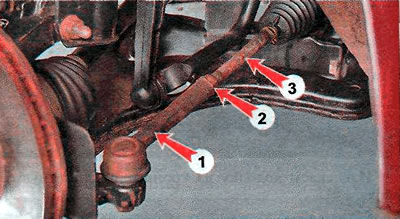
1 — steering rod end;
2 - lock nut;
3 - steering rod
Note: The front wheel alignment angles are shown at the beginning of the section (see "Reference data").
(The source is on the online website: www.opelbook.ru)
The longitudinal tilt of the front wheel pivot axis is the angle between the front wheel pivot axis and the vertical in a plane parallel to the vehicle's centerline. Violation of the correct tilt angle of the front wheel pivot axis causes deterioration in vehicle controllability. With a large longitudinal tilt angle, the resistance to steering wheel rotation increases, with a small angle, the stabilization of the front wheels in the straight-ahead direction deteriorates.
The tilt of the wheel pivot axis is set by design and is not adjustable. If the longitudinal tilt angle of the pivot axis is outside the permissible limits, repair of suspension components is required.
The rear wheel camber angle is the angle of the plane of rotation of the wheel relative to the vertical. Uneven camber angles cause the car to drift to the side when driving in a straight line. Large positive camber (when the top of the wheel protrudes outward) leads to accelerated wear of the outer part of the tire tread, and large negative camber - the inner part of the tread (see "Wheels, tires and hubs - technical condition check"). The camber angle of the rear wheels is specified by design and is not adjustable. The camber angle can be used to diagnose the condition of the rear suspension.
Rear wheel toe-in is the angle between the plane of rotation of the wheel and the longitudinal plane of symmetry of the car in a straight-line position. Violation of the wheel toe-in worsens the controllability and directional stability of the car, and leads to intensive wear of the tires. The rear wheel toe-in angle is specified by design and is not adjustable. The toe-in angle can be used to diagnose the condition of the rear suspension.
Visitor comments