


- 6 - rim width in inches;
- J — conventional designation of the rim profile;
- 15 — rim seat diameter for tire in inches;
- H2 is a conventional designation of the shape of the rim landing shelves;
- ET — conventional designation of rim offset;
- 45 — rim offset in millimeters.
Note: Rim offset (ET) is the distance between the plane that divides the wheel rim in half (plane equidistant from the sides of the rim) and the mounting (fastening) plane of the wheel.
In addition, the wheel disk has two more very important parameters that allow it to be used on a specific car model - this is the diameter of the location and the number of mounting holes, as well as the central hole of the disk. These parameters are set by the design of the car hub and must strictly correspond to it (see "Reference data"), as they ensure correct and reliable fastening of the disc to the hub.
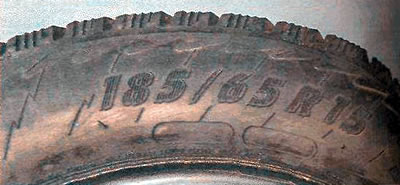
The car is equipped with tubeless tires. The tire designation, for example, 185/65R15 88Q, is deciphered as follows:
- 185 — profile width in millimeters;
- 65 — the ratio of the profile height to its width in percent;
- R — designation of radial tire;
- 15 — tire rim diameter in inches;
- 88 - load index (maximum permissible load on the tire is 560 kg);
- Q — speed index (maximum permissible speed 160 km/h).
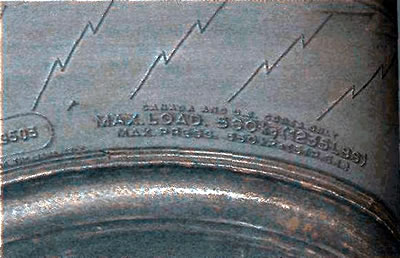
The maximum load on the tire (MAX LOAN) is duplicated in a deciphered form together with the indication of the maximum permissible pressure (MAX AT) of air in the tire.
When giving recommendations on the choice of certain ones, the manufacturer proceeds from the conditions of ensuring maximum stability, controllability, cross-country ability and safety of the car. Thus, a wheel with a large overhang can touch the parts of the mechanisms, with a smaller one - increase the load on the hub bearings and can lead to unpredictable behavior of the car during emergency braking or in case of failure of one of the brake system components. High-profile tires can touch the body parts at maximum suspension travel, and wide ones - rub against the side member of the car or its wing at large turning angles. A tire with a lower load index can burst under a maximally loaded car, a decrease in the speed index is fraught with the destruction of tires when driving at high speed.
Tires that can be installed on a car are divided into three types: summer, winter and all-season. If the car is used all year round and the winter is snowy, it is better to have two sets of wheels: with winter and summer tires. Winter tires are made of softer rubber, which allows them not to "harden" at sub-zero temperatures, and narrow wavy cuts - lamellas - are made on the tread. This allows the tire to better aim for the roughness of the surface. The inscription M + S or M.S. can be applied to the sidewalls of winter tires. The possibility of using studded tires in winter depends on the specific operating conditions of the car. It should be borne in mind that studs are designed to improve the traction properties of the tire only on slippery hard surfaces, such as ice or packed snow. In other cases, mils are useless, and on asphalt they even slightly worsen the traction of the tire with the road.
Using a winter tire in summer results in intensive wear.
All-season tires can be used all year round. They are distinguished from other tires by the inscription ALL SEASON or TOUS TERRAIN on the sidewall. According to their indicators, they behave satisfactorily in various weather conditions, but in summer they are inferior in technical indicators to summer tires, and in winter - to winter tires.
The tread pattern can be universal or directional and is not regulated by the requirements of the vehicle manufacturer. With a directional tread pattern, the inscription ROTATION and an arrow indicating the direction of rotation of the wheel when the vehicle is moving forward are written on the sidewall of the tire.
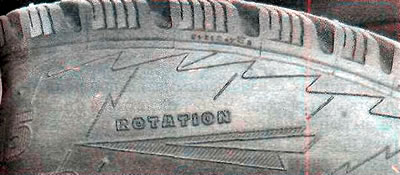
A special case of a directional pattern is asymmetrical. In this case, the inscription OUTSIDE is applied to the side, which should be on the outside during installation.
Visitor comments