
OpelBook.ru
Cars AvtoVAZ Cars Mitsubishi Cars BMW Cars Mercedes Cars Nissan Cars Toyota Cars Chevrolet
English Русский
Български
Беларускі
Український
Српски
Hrvatski
Română
Polski
Slovenský
Magyar
 |  Sitemap  |  Contacts  |    


Main Astra Corsa Insignia Kadett Omega Vectra Zafira Others Articles
Frontera A (1991-1998, petrol) Frontera B (1998-2004) Ascona C (1981-1988) Vivaro A (2001-2014)
  • Main
  • Opel
  • Frontera B
  • Power unit
  • Fuel system (petrol)
  • Exhaust gas system

Exhaust gas system (Opel Frontera B)

            0

The exhaust system consists of an exhaust pipe with a catalytic converter and mufflers. Cars with a V6 engine have two exhaust pipes. The exhaust system ensures the removal of exhaust gases into the atmosphere, reducing the concentration of pollutants, reducing engine noise to the required level with minimal loss of engine power. In order for the exhaust system to perform its functions, it must be in good working order. The condition of the exhaust system also affects engine power and fuel consumption.

Mufflers are designed to smooth out pulsations in the exhaust gas flow and reduce noise levels.

The oxygen concentration sensor is mounted in front of the catalytic converter, which ensures the combustion of harmful substances contained in the exhaust gases. Depending on the oxygen content in the exhaust gases, the oxygen concentration sensor induces a voltage of 0 to 1 V. Based on this data, the engine control unit changes the opening time of the injectors and the ratio of fuel in the air-fuel mixture. In order for the combustible mixture to burn completely and for the exhaust gases to be free of harmful substances, there must be 1 part fuel per 14.7 parts by weight of air.

When repairing, the exhaust system parts can be replaced individually. Self-locking nuts and seals must be replaced with new ones after each dismantling.

The pipe hanger retaining rings and rubber cushions should be checked for damage and cracks and, if necessary, also replaced with new ones.

When installing new exhaust pipes, it is recommended to replace all fasteners with new ones. The catalytic converter is designed to reduce the level of harmful substances in exhaust gases. It consists of a ceramic porous frame covered with a protective layer containing salts of noble metals that ensure the process of cleaning exhaust gases.


The purpose of the exhaust gas recirculation valve is to divert part of the exhaust gases back into the combustion chamber in order to reduce the ignition temperature of the fuel-air mixture and thereby reduce the content of harmful substances in the exhaust gases.

To avoid damage to the catalytic converter, follow these guidelines:
  • Use unleaded petrol only.
  • Perform forced starting of the engine by pushing or towing only once and for a distance of no more than 50 meters, but it is best to use an auxiliary battery in this case. Unburned fuel, when ignited, can cause overheating and destruction of the catalytic converter. If the engine is warm, then forced starting by pushing or towing is not allowed at all;
  • If the engine has difficulty starting, do not operate the starter for too long. When the engine is started, fuel is continuously injected. In such cases, it is necessary to find and eliminate the cause of the malfunction;
  • Monitor the amount of fuel in the tank and do not allow it to run out completely;
  • If misfires are observed, it is necessary to avoid high engine speeds and immediately eliminate the malfunction;
  • Install only the spark plug types recommended by the vehicle manufacturer;
  • Do not perform spark testing with the spark plug cap removed;
  • Do not compare cylinders by cutting off ignition in the combustion chamber of one cylinder. With such a shutdown, including with the help of a stand for checking the engine operation, unburned fuel gets into the catalytic converter;
  • Do not park your vehicle over dry leaves or grass. The exhaust system in the area of the catalytic converter is very hot and emits heat even after the engine is turned off;
  • When filling and topping up engine oil, pay special attention to not exceeding the maximum oil level mark on the dipstick: Excess oil, due to incomplete combustion, gets into the catalytic converter and can damage the precious metal or completely destroy the catalytic converter.


Exhaust leaks in the exhaust system are usually caused by damaged gaskets and leaking pipe connections or damage to the mufflers caused by impacts while driving. Exhaust gas leaks lead to increased noise and vibration from the contact of exhaust system components with the vehicle body.


Before removing or disassembling exhaust system components, soak the bolts and nuts securing the exhaust system components with a fluid that loosens the connections. Wait 5 minutes for the liquid to penetrate the threaded connection.

After working on the exhaust system, move the vehicle's exhaust system to the sides to make sure it does not touch the vehicle body. Otherwise, replace the rubber exhaust mounts.

(Article posted on an online resource OpelBook.ru)

Warning: Make sure the exhaust system is sufficiently cool before removing or inspecting components.
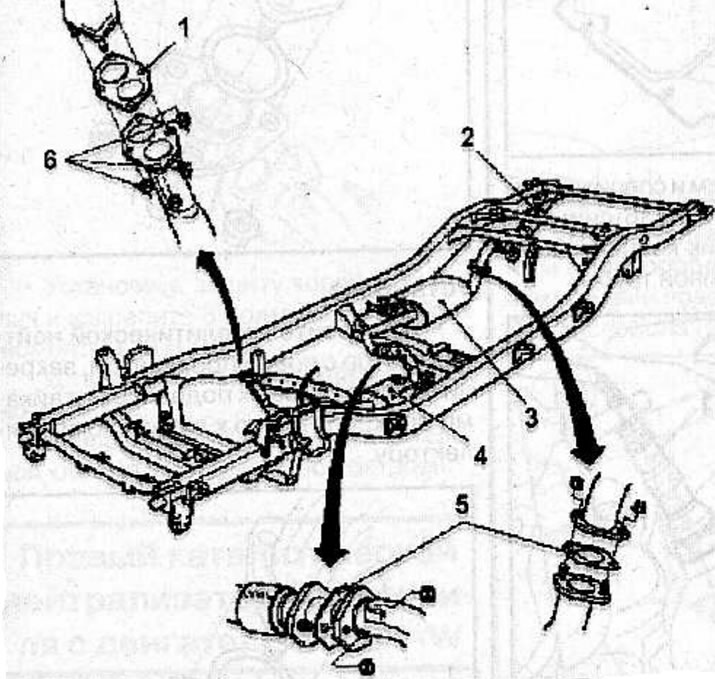

Location of exhaust system components on a vehicle with 2.2L petrol engines (X 22 SE and Y 22 SE):…

Location of exhaust system components on a vehicle with 2.2L petrol engines (X 22 SE and Y 22 SE): 1 - gasket; 2 - rear muffler; 3 - middle muffler; 4 - front exhaust pipe with catalytic converter and oxygen concentration sensor; 5 - gaskets; 6 - fastening nuts
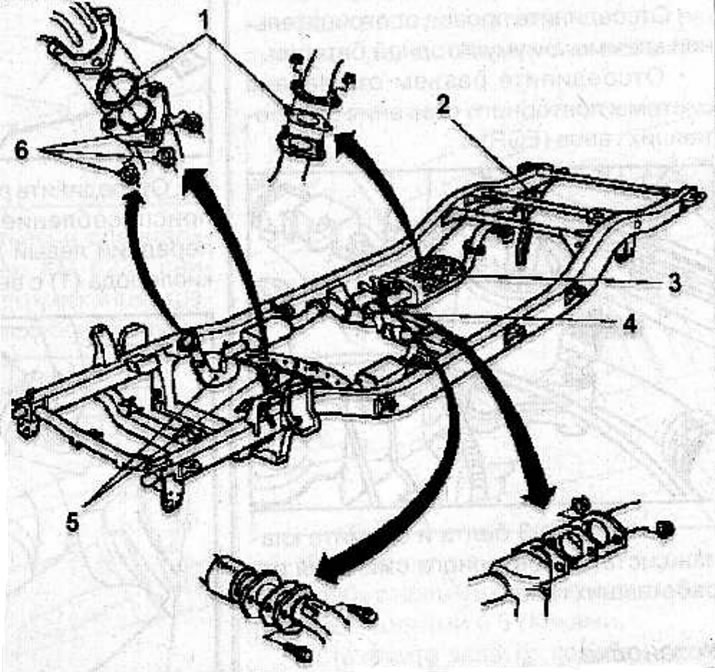

Location of exhaust system components on a vehicle with a 3.2L petrol engine (VD1 -W): 1 - gasket;…

Location of exhaust system components on a vehicle with a 3.2L petrol engine (VD1 -W): 1 - gasket; 2 - rear muffler; 3 - middle muffler; 4 - branch section; 5 - front exhaust pipes with catalytic converters and oxygen concentration sensors; 6 - fastening nuts


This article is available at russian, bulgarian, belarusian, ukrainian, serbian, croatian, romanian, polish, slovak, hungarian
Checking the article: Chernov Alexander

Share information:

Previous articles
Opel Frontera B: Fuel system (petrol)
Next articles

Adsorber — removal and installation
Replacing the fuel filter
Fuel pump and fuel level sensor unit
Fuel tank
Electromagnetic valve of ventilation of adsorber
Accelerator pedal for a car with a 3.2L engine (6VD1-W)
Exhaust Gas Recirculation System Valve
Left catalytic converter of a car with a 6VD1-W engine
Right catalytic converter for a car with a 6VD1-W engine


See similar ones from other Opel car manuals:
▶ Exhaust gas cleaning system Opel Astra F (1991-1998, petrol)
▶ Checking the exhaust system Opel Corsa B (1993-2000)
▶ Replacing the exhaust system Opel Insignia A (2008-2017)
▶ Device of the exhaust gas system Opel Kadett E (1984-1995)
▶ Exhaust system — removal and installation Opel Omega A (1986-1993)
Link to this page in different formats

Visitor comments


No comments yet


How much will 11 + 13 =


Vivaro A (2001-2014) 
  • General information
  • User manual
  • Power unit
  • Petrol engine F4R
  • Diesel engine F9Q
  • Diesel engine G9U
  • Transmission
  • Clutch and drive shafts
  • Manual gearbox
  • Chassis
  • Front suspension
  • Rear suspension
  • Brake system
  • Body
  • Exterior
  • Interior
  • Electrical equipment
  • Heating and ventilation
  • Air conditioner
  • Equipment and devices
  • Electrical diagrams
Ascona C (1981-1988) 
  • General information
  • Maintenance
  • Power unit
  • Gasoline engines
  • Diesel engines
  • Cooling system
  • Fuel and exhaust system
  • Contact ignition system
  • Contactless ignition system
  • Transmission
  • Clutch
  • Mechanical gearbox
  • Automatic gearbox
  • Drive shafts
  • Chassis
  • Steering
  • Brake system
  • Car suspension
  • Body
  • Exterior
  • Interior
  • Doors and windows
  • Electrical equipment
  • Equipment and devices
  • Power devices
  • Electrical circuits
Frontera B (1998-2004) 
  • General information
  • User manual
  • Maintenance
  • Power unit
  • Petrol engines 2.2 l
  • Petrol engines 3.2 l
  • Diesel engines 2.2 l
  • Cooling system
  • Fuel system (petrol)
  • Fuel system (diesel)
  • Ignition system
  • Transmission
  • Clutch
  • Manual gearbox MUA5C
  • Automatic gearbox 4L30E
  • Chassis
  • Suspension and axles
  • Steering
  • Brake system
  • Body
  • Exterior
  • Interior
  • Doors, locks and windows
  • Heating and air conditioning
  • Electrical equipment
  • Power devices
  • Equipment and devices
  • Lighting and signaling
  • Electrical diagrams
Frontera A (1991-1998, petrol) 
  • General information
  • Introduction to guide
  • User manual
  • Maintenance
  • Power unit
  • Engine repair
  • Lubrication system
  • Cooling system
  • Power and exhaust system
  • Engine electrics
  • Transmission
  • Clutch
  • Mechanical gearbox
  • Cardan shafts
  • Chassis
  • Brake system
  • Front suspension
  • Rear suspension
  • Steering
  • Body
  • Repair and care
  • Electrical equipment
  • Equipment and devices
  • Electrical circuits
OpelBook.ru © 2017–2026 · Mobile version · · Sitemap: EN BG BY UA RS HR RO PL SK HU · Feedback · Site search
Astra F, petrol · Astra G, petrol · Astra G · Astra H · Astra J, petrol · Corsa B · Corsa C, petrol · Corsa C · Insignia A · Kadett D · Kadett E · Omega A · Omega B · Omega B2 · Vectra A, petrol · Vectra A · Vectra B, petrol · Vectra B · Vectra C · Zafira A, petrol · Frontera A, petrol · Frontera B · Ascona C · Vivaro A ·
We want your visit to be comfortable 🤝! We use cookies 🍪 to make that happen.