


The description of the old suspension model is not given here. Below is a description of the new suspension, which has a more complex design.
The longitudinal suspension arms are made of pipes. The short lever, located in the center above the differential housing, serves to absorb the loads that arise during braking and acceleration. Lateral attachment is achieved by means of a transverse wishbone rod, the so-called transverse reaction rod, secured at one end at the rear right to the bridge, and at the other end at the left to the chassis.
The suspension has an anti-roll bar mounted on rubber bushings in front of the axle and connected to the axle by connecting rods with ball joints.
The levers and transverse reaction rod have rubber bushings with minimal friction, which ensures free movement of the suspension when the car hits various road irregularities. The bridge and suspension are shown in the illustration.
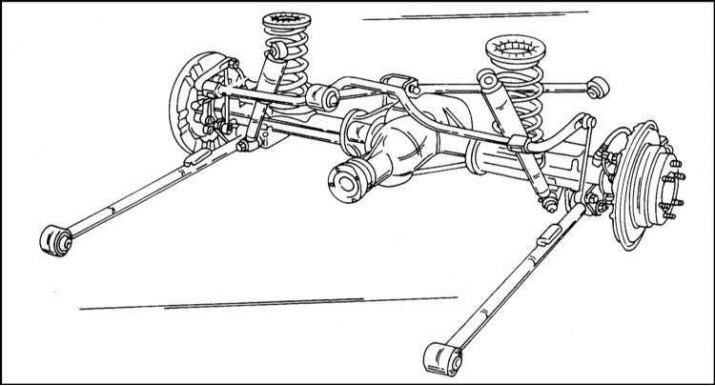
Rear axle with coil spring suspension
Two different cardan shafts are used to drive the rear axle. Three-door cars have a solid propeller shaft. For vehicles with an extended base (5 doors), a cardan shaft consisting of two parts with an intermediate support is used.
In addition, there is a difference in the design of the rear brake mechanism. Drum and disc brakes are used, which affects the performance of some works.
When performing repair work, the difference in the design of the rear suspension should be taken into account. If there are no corresponding instructions in the text, the work for both suspension versions is carried out in the same way.
When working on the rear suspension, follow the instructions given at the beginning of the section "Front Wheel Suspension". Do not forget about the need to securely fasten the car.
Visitor comments