
OpelBook.ru
Cars AvtoVAZ Cars Mitsubishi Cars BMW Cars Mercedes Cars Nissan Cars Toyota Cars Chevrolet
English Русский
Български
Беларускі
Український
Српски
Hrvatski
Română
Polski
Slovenský
Magyar
 |  Sitemap  |  Contacts  |    


Main Astra Corsa Insignia Kadett Omega Vectra Zafira Others Articles
Frontera A (1991-1998, petrol) Frontera B (1998-2004) Ascona C (1981-1988) Vivaro A (2001-2014)
  • Main
  • Opel
  • Ascona C
  • Power unit
  • Gasoline engines
  • Timing Belt — Replacement

Timing Belt — Replacement (Opel Ascona C)

            0

1. Loosen the generator adjusting bracket and the bolts securing it, move the generator toward the engine and remove the drive belt from the pulleys.

2. Loosen the bolts and remove the camshaft belt cover. On injection models, the air cleaner should also be removed to improve access (see chapter 5).

3. Place the wrench on the crankshaft pulley bolt and turn it so that piston No. 1 begins to rise to TDC on the compression stroke. (To check that this is indeed a compression cycle, you should either remove the spark plug on cylinder Nin and cover the hole with your finger to check that pressure will be created in the cylinder, or remove the distributor cap and check that the rotor is aligned with electrode N 1 (for candle N 1) on the cover). The notch on the crankshaft pulley rim should align with the pointer, which gives the ignition timing angle at the specified degrees before TDC. The mark on the camshaft sprocket should align with the mark on the rear shield (see photo).
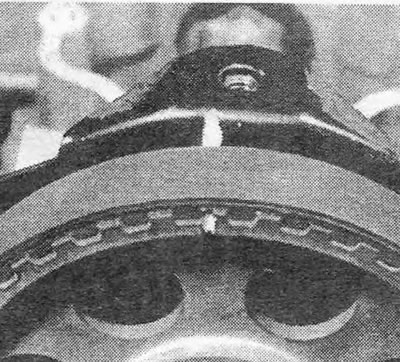
Photo 5.3. Timing marks on the camshaft sprocket.

Photo 5.3. Timing marks on the camshaft sprocket.


4. On 1.3 engines, unscrew the crankshaft pulley bolt, making sure not to change the previously set position of the crankshaft. On 1.6 and 1.8 engines, unscrew and remove the 4 cylindrical head bolts securing the pulley to the crankshaft drive sprocket. To prevent the crankshaft from turning while removing the bolts, either put the car in gear and fully engage the handbrake, or remove the lower flywheel housing cover and lock the flywheel ring gear using a suitable tool. Remove the pulley from the crankshaft or drive sprocket (depending on the design) (see photo).
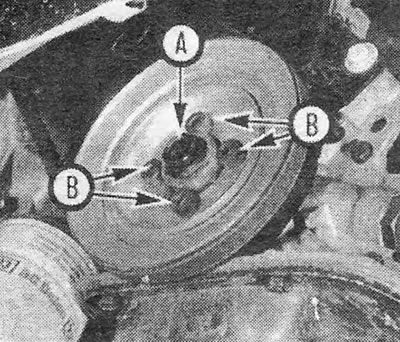


Photo 5.4. Crankshaft pulley on 1.6 engine: A. Torsional vibration damper and sprocket mounting…

Photo 5.4. Crankshaft pulley on 1.6 engine: A. Torsional vibration damper and sprocket mounting bolt; B. Crankshaft pulley mounting bolts (with cylindrical heads).


5. Drain the coolant.

6. Loosen the water pump mounting bolts enough to allow the pump to be turned and relieve tension on the timing belt. There are special chamfers on the pump body behind the sprocket, and if desired, it can be turned using a large thin screwdriver. Alternatively, the pump can be turned from under the car by carefully tapping it with a hammer through a long punch.

7. If you are not going to change the timing belt, you should pay attention to the direction of its movement before removing it.

8. Remove the old belt from the sprockets and install a new one, making sure that the position of the camshaft or crankshaft does not change.

9. Place the new belt on the sprockets and tighten it slightly by turning the water pump.

10. Reinstall the crankshaft pulley and check that the mark on the pulley is still aligned with the pointer and that the mark on the camshaft sprocket is aligned with the groove on the shield behind it. If this is not the case, loosen the belt tension and adjust the position of the sprockets as required.


11. If you do not have a special tool, the belt tension can be adjusted as follows. Slightly loosen the water pump clamp screws and, using your thumb and forefinger, twist the belt 90 degrees. If, with moderate force, the belt either twists too easily or cannot be twisted a full 90 degrees, tighten or loosen the belt slightly by moving the water pump. If the belt is too tight, it will hum when the engine is running. After completing the adjustment, tighten the water pump bolts (see photos).
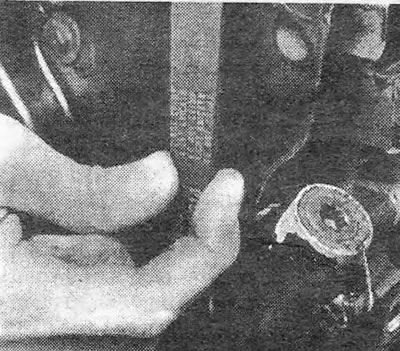
Photo 5.11A. Checking the camshaft belt tension.
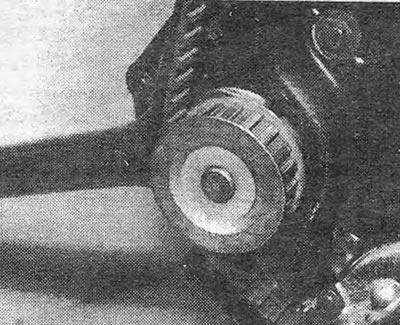
Photo 5.11A. Checking the camshaft belt tension.


Photo 5.11B. Adjusting the camshaft belt tension.

Photo 5.11B. Adjusting the camshaft belt tension.


Text copied from an online resource [www.OPELBOOK.ru]
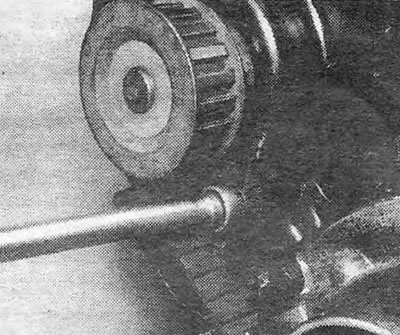
Photo 5.11C. Tightening the water pump bolt after adjusting the camshaft belt tension.

Photo 5.11C. Tightening the water pump bolt after adjusting the camshaft belt tension.


12. Remove the crankshaft pulley and install the camshaft belt cover in place.

13. Reinstall the crankshaft pulley.

14. Install the alternator drive belt in place and adjust its tension (see chapter 2).


This article is available at russian, bulgarian, belarusian, ukrainian, serbian, croatian, romanian, polish, slovak, hungarian
Checking the article: Kornev Georgy

Share information:

Previous articles
Opel Ascona C: Gasoline engines
Next articles

Oil Pressure Regulator Valve — Removal and Installation
Work possible without removing the engine
Engine — Routine Maintenance
General description
Engine — Specifications
Front camshaft oil seal — replacement (engine is still on the car)
Camshaft — removal (engine is on the car)
Cylinder head — removal and installation
Camshaft housing and camshaft — disassembly and assembly
Pallet — removal and installation
Oil pump — removal and installation


See similar ones from other Opel car manuals:
▶ Timing Belt Covers — Removal and Installation Opel Astra F (1991-1998, petrol)
▶ Removal and installation the timing belt cover Opel Corsa B (1993-2000)
▶ Checking the timing belt of the gas distribution mechanism Opel Insignia A (2008-2017)
▶ Removal and installation the timing belt Opel Kadett D (1979-1984)
▶ Timing belt of the gas distribution mechanism-check Opel Omega B2 (1999-2003)
Link to this page in different formats

Visitor comments


No comments yet


How much will 45 + 35 =


Vivaro A (2001-2014) 
  • General information
  • User manual
  • Power unit
  • Petrol engine F4R
  • Diesel engine F9Q
  • Diesel engine G9U
  • Transmission
  • Clutch and drive shafts
  • Manual gearbox
  • Chassis
  • Front suspension
  • Rear suspension
  • Brake system
  • Body
  • Exterior
  • Interior
  • Electrical equipment
  • Heating and ventilation
  • Air conditioner
  • Equipment and devices
  • Electrical diagrams
Ascona C (1981-1988) 
  • General information
  • Maintenance
  • Power unit
  • Gasoline engines
  • Diesel engines
  • Cooling system
  • Fuel and exhaust system
  • Contact ignition system
  • Contactless ignition system
  • Transmission
  • Clutch
  • Mechanical gearbox
  • Automatic gearbox
  • Drive shafts
  • Chassis
  • Steering
  • Brake system
  • Car suspension
  • Body
  • Exterior
  • Interior
  • Doors and windows
  • Electrical equipment
  • Equipment and devices
  • Power devices
  • Electrical circuits
Frontera B (1998-2004) 
  • General information
  • User manual
  • Maintenance
  • Power unit
  • Petrol engines 2.2 l
  • Petrol engines 3.2 l
  • Diesel engines 2.2 l
  • Cooling system
  • Fuel system (petrol)
  • Fuel system (diesel)
  • Ignition system
  • Transmission
  • Clutch
  • Manual gearbox MUA5C
  • Automatic gearbox 4L30E
  • Chassis
  • Suspension and axles
  • Steering
  • Brake system
  • Body
  • Exterior
  • Interior
  • Doors, locks and windows
  • Heating and air conditioning
  • Electrical equipment
  • Power devices
  • Equipment and devices
  • Lighting and signaling
  • Electrical diagrams
Frontera A (1991-1998, petrol) 
  • General information
  • Introduction to guide
  • User manual
  • Maintenance
  • Power unit
  • Engine repair
  • Lubrication system
  • Cooling system
  • Power and exhaust system
  • Engine electrics
  • Transmission
  • Clutch
  • Mechanical gearbox
  • Cardan shafts
  • Chassis
  • Brake system
  • Front suspension
  • Rear suspension
  • Steering
  • Body
  • Repair and care
  • Electrical equipment
  • Equipment and devices
  • Electrical circuits
OpelBook.ru © 2017–2026 · Mobile version · · Sitemap: EN BG BY UA RS HR RO PL SK HU · Feedback · Site search
Astra F, petrol · Astra G, petrol · Astra G · Astra H · Astra J, petrol · Corsa B · Corsa C, petrol · Corsa C · Insignia A · Kadett D · Kadett E · Omega A · Omega B · Omega B2 · Vectra A, petrol · Vectra A · Vectra B, petrol · Vectra B · Vectra C · Zafira A, petrol · Frontera A, petrol · Frontera B · Ascona C · Vivaro A ·
We want your visit to be comfortable 🤝! We use cookies 🍪 to make that happen.