


General information
1. Fuel is pumped into the system by an electric fuel pump installed together with a fuel level sensor in the housing of the assembly, which is immersed in the fuel tank. On Y17DT(L) diesel engines, only a fuel level sensor is installed in the tank. Fuel is supplied to the system by the high-pressure fuel pump.
2. The reserve sensor consists of a float and a potentiometer. When the fuel level drops, the sensor float drops, and the potentiometer connected to the float increases the electrical resistance of the sensor, and the corresponding signal is sent to the meter built into the instrument cluster (see Chapter "Controls and operating techniques").
3. When performing work, the fuel tank should not be filled more than 2/3 of its capacity. Before removing the fuel pump assembly, empty the fuel tank to the required level by using fuel while driving the car, or by pumping out the fuel using a special pump through the filler neck of the tank. Work should be carried out in a well-ventilated room, preferably equipped with a special exhaust hood.
Removal
4. Disconnect the negative cable from the battery (see Chapter 5).
5. To gain access to the hatch in the floor panel, lift and remove the rear seat (see Chapter 11). On Combo models (depending on the configuration) fold the rear seat back, or unscrew the mounting bolts and remove the luggage compartment floor cover.
6. Fold back the carpet over the service hatch cover.
Note: The carpet area above the hatch is already cut, but on newer vehicles there may still be connecting strips - carefully cut these out with a sharp knife.
7. Pry up and remove the service hatch cover (see accompanying illustration) access to the fuel pump assembly.
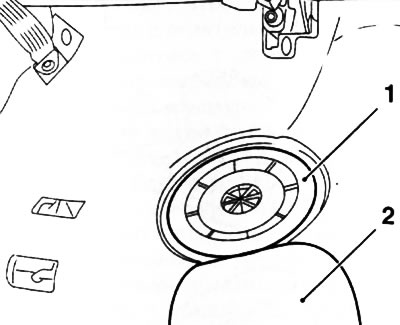
8.7. Service cover (1) of the hatch and valve (2) in the carpet for access to the fuel pump assembly
8. Disconnect the electrical wiring connector (see accompanying illustration) - secure the harness by gluing it with tape to the floor panel. Clearly mark the fuel lines of the feed and return lines so as not to mix them up during installation, disconnect them from the fittings on the cover of the pump assembly. In order to prevent fuel spillage, immediately plug the fuel lines with suitable plugs and move them to the side. Remove traces of fuel leaks.
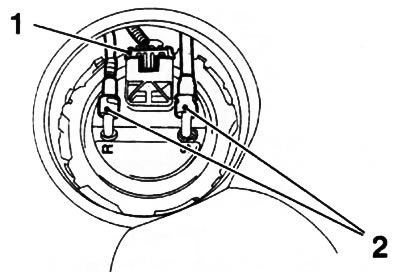
8.8. Connector (1) of electrical wiring and fuel lines (2) of the pump assembly
Note: When equipping fuel lines with quick-release couplings, a special tool, such as Hazet 4501-1, is required to disconnect them.
9. Install the special device KM-797 (see accompanying illustration) into the grooves of the retaining ring, unscrew and remove the ring. If there is no device, install a plastic wedge or a suitable wooden block into the groove of the retaining ring and unscrew the ring with light blows of a plastic or wooden hammer.
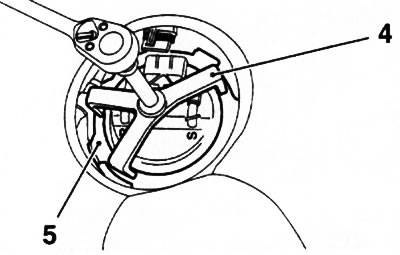
8.9. Special device KM-797 (4) for removing the retaining ring (5) of the pump assembly cover
Caution: Never use metal objects for this purpose - there is a risk of sparks when striking!
10. Carefully pull the cover upwards - it is connected to the assembly body by cable connectors and hose connections (see accompanying illustration). After removing the cover, disconnect all supply lines and the sealing ring from its inner side; if necessary, remember or write down the order in which the lines are connected.
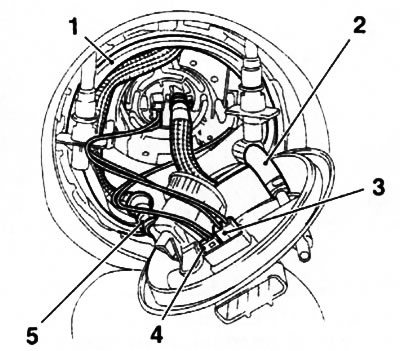
8.10. Routing electrical lines and hose connections of the electric fuel pump cover (on some models the wiring diagram may differ slightly): 1. Sealing ring; 2. Fuel supply line hose; 3. Fuel level sensor wiring connector; 4. Electrical wiring connector; 5. Fuel return line hose
Note: On petrol models, a safety valve for relieving excess pressure in the fuel tank is built into the fuel pump cap. If necessary, the valve is replaced only as a set with the cap.
11. Press the latch (see illustration 8.11a) in the direction indicated by the arrow (see illustration 8.11b) pull the sensor out of the assembly housing upwards.
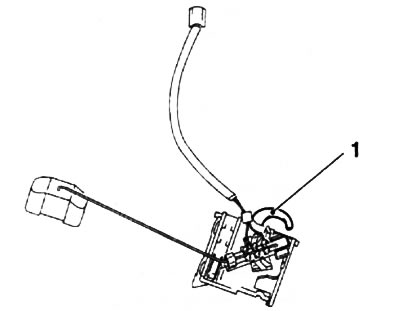
8.11a. Fuel level sensor retainer (1) (sensor in the removed position) |
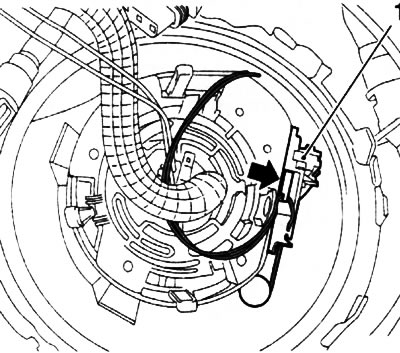
8.11b. Removing the fuel level sensor (1) |
12. Press 3 clamps simultaneously (see accompanying illustration) fuel pump assemblies and, holding them in this position, remove the pump from the fuel tank.
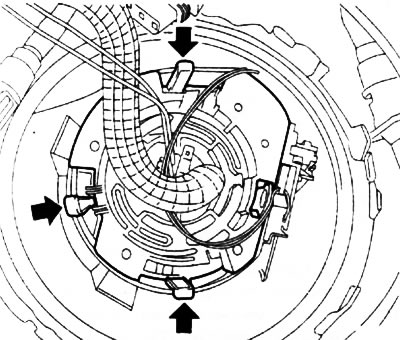
8.12. Fixators (indicated by arrows) fuel pump assemblies
13. Remove the pump from the housing and place it in a specially prepared container. Remove traces of spilled fuel.
Installation
14. Install the pump in its regular place, carefully insert the pump assembly body into the tank and securely fasten it in the clamps.
Material taken from an internet portal Opelbook.ru
Note: If replacing a pump, re-route the wiring from the old to the new one.
15. Further installation is carried out in the reverse order of removal. The sealing ring of the fuel pump assembly cover must be replaced without fail. After completing the work, check the system for leaks.
Note: The service cover and rear seat are installed after checking the system for leaks.
Visitor comments