
OpelBook.ru
Cars AvtoVAZ Cars Mitsubishi Cars BMW Cars Mercedes Cars Nissan Cars Toyota Cars Chevrolet
English Русский
Български
Беларускі
Український
Српски
Hrvatski
Română
Polski
Slovenský
Magyar
 |  Sitemap  |  Contacts  |    


Main Astra Corsa Insignia Kadett Omega Vectra Zafira Others Articles
Corsa B (1993-2000) Corsa C (2000-2006, petrol) Corsa C (2000-2006)
  • Main
  • Corsa
  • Corsa C
  • Power unit
  • Power and exhaust system
  • Turbocharger and Intercooler — General Information

Turbocharger and Intercooler — General Information (Opel Corsa C)

            0

1. The turbocharger is designed to increase engine power by increasing the mass charge of air entering the engine cylinders. Air is supplied to the cylinders under pressure, due to which the cylinder filling coefficient increases, the completeness of fuel combustion and the mixture formation process improves.

2. Turbocharger (see accompanying illustration) is a shaft, the central part of which is installed in a bearing. On both sides of the shaft there are turbines in two housings separated from each other. One of the turbines is included in the exhaust tract, the other in the intake tract. When the engine is running, the turbine included in the exhaust tract is driven by the flow of exhaust gases - while the rotation speed of the turbocharger shaft reaches 300,000 rpm, as a result of which the turbine installed at the other end of the shaft creates pressure in the intake tract. Due to the higher degree of filling of the cylinders, the increase in engine power can reach 100%.
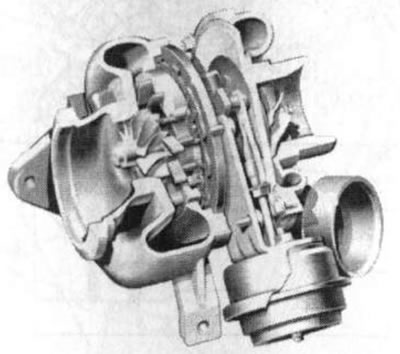
19.2. Turbocharger

19.2. Turbocharger


3. The air pressure in the intake manifold during turbocharging increases by 0.4-0.8 bar (the total pressure reaches 1.8 bar), due to which the engine power also increases. The air pressure values in the intake air duct are determined by the boost pressure sensor, which transmits the corresponding signal to the electronic module of the engine management system. At the same time, the system monitors that the maximum air pressure does not exceed a certain value.


4. Along with power, the use of a turbocharger also allows for an increase in engine torque, which has a beneficial effect on the smoothness of engine operation.

5. For optimal engine operation, a certain amount of air is required in different modes. Therefore, the Z13DTH and Z17DTH engines are equipped with a turbocharger with variable turbine geometry (VNT), i.e. the guide vanes are smoothly controlled via an electromagnetic valve and a vacuum chamber. Thus, at any engine speed, optimal boost pressure is achieved.

6. The turbocharger bearing is lubricated under pressure in the general engine lubrication system. Oil is supplied and discharged to the oil pan through separate pipelines. The bearing housing has hermetic seals.

7. The turbocharger housing is attached to the exhaust manifold. To remove it, you must disconnect all air and oil supply lines, electrical wiring connectors. Disconnect remove the exhaust manifold guard and manifold together with the turbocharger, then disconnect the turbocharger.

Note: If you need to disconnect the coolant lines when removing the exhaust manifold, be sure to drain the coolant.


8. The turbocharger is a precision-made unit. Therefore, it cannot be repaired in a regular car service workshop and is replaced as a whole.

9. For maximum turbocharging efficiency, an intercooler is located between the turbocharger and the engine intake manifold (intercooler) (see Part A, Illustration 6.1b), which cools the compressed air. Reducing the temperature of the inlet air leads to an increase in its density, an increase in the filling of the cylinders and the thermal efficiency of the working cycle.

10. The intercooler is installed on the radiator assembly of the cooling system, usually in front of it. To remove it, you need to dismantle the front bumper cover (see Chapter 11), or radiator assembly (see Chapter 3).


This article is available at russian, bulgarian, belarusian, ukrainian, serbian, croatian, romanian, polish, slovak, hungarian
Checking the article: Kornev Georgy

Share information:

Previous articles
Opel Corsa C: Power and exhaust system
Next articles

Removal and installation the fuel tank
Removal and installation the fuel filter mounting clamp (diesel)
Removal and installation the fuel pump/fuel level sensor
Removal and installation the gas pedal
Removal and installation air intake tract components
Removal dirt and water from the fuel system of a diesel engine
Exhaust system — general information
Removal and installation of the exhaust system
Removal and installation lambda probes (petrol models)
Emission control systems


See similar ones from other Opel car manuals:
▶ Turbocharger and Intercooler — General Information Opel Astra H (2004-2009)
▶ Turbocharger and Intercooler — General Information Opel Vectra C (2002-2008)
▶ Removal and installation a turbocharger Opel Insignia A (2008-2017)
▶ Turbocharger — removal and installation Opel Omega B (1993-1999)
▶ Removal and installation a turbocharger Opel Vivaro A (2001-2014)
Link to this page in different formats

Visitor comments


No comments yet


How much will 18 + 13 =


Corsa C (2000-2006) 
  • General information
  • Introduction to guide
  • Troubleshooting
  • Vehicle device
  • User manual
  • Maintenance
  • Power unit
  • Engine repair
  • Cooling system
  • Power and exhaust system
  • Control system
  • Engine electrical equipment
  • Transmission
  • Clutch
  • Mechanical gearbox
  • Automatic gearbox
  • Drive shafts
  • Chassis
  • Brake system
  • Wheel suspension
  • Steering
  • Body
  • Exterior
  • Interior
  • Doors and windows
  • Heating and air conditioning
  • Electrical equipment
  • Equipment and devices
  • Lamps and lighting
  • Electrical circuits
Corsa C (2000-2006, petrol) 
  • User manual
  • Car access
  • Governing bodies
  • Seat control
  • Heating and air conditioning
  • Driving and maintenance
  • Engines 1.0 and 1.2 l
  • Engine repair
  • Cooling and lubrication system
  • Injection system
  • Engines 1.4, 1.6 and 1.8 l
  • Engine repair
  • Cooling and lubrication system
  • Injection system
  • Transmission
  • Clutch
  • Mechanical gearbox
  • Automatic gearbox
  • Drive shafts
  • Chassis
  • Wheels and tires
  • Wheel suspension
  • Steering
  • Brake system
  • Body
  • Exterior
  • Doors and windows
  • Electrical equipment
  • Equipment and devices
  • Lighting system
  • Electrical circuits
Corsa B (1993-2000) 
  • General information
  • Introduction to guide
  • User manual
  • Maintenance
  • Power unit
  • SOHC gasoline engines
  • DOHC gasoline engines
  • Diesel engines
  • Engine repair
  • Cooling system
  • Supply system
  • Injection system (gasoline)
  • Injection system (diesel)
  • Exhaust systems
  • Control system (gasoline)
  • Preheat system (diesel)
  • Charge and launch system
  • Transmission
  • Mechanical gearbox
  • Automatic gearbox
  • Clutch and drive shafts
  • Chassis
  • Brake system
  • Front suspension
  • Rear suspension
  • Steering
  • Body
  • Ventilation and heating
  • Exterior
  • Interior
  • Doors and windows
  • Electrical equipment
  • Equipment and devices
  • Lamps and lighting
  • Electrical circuits
OpelBook.ru © 2017–2026 · Mobile version · · Sitemap: EN BG BY UA RS HR RO PL SK HU · Feedback · Site search
Astra F, petrol · Astra G, petrol · Astra G · Astra H · Astra J, petrol · Corsa B · Corsa C, petrol · Corsa C · Insignia A · Kadett D · Kadett E · Omega A · Omega B · Omega B2 · Vectra A, petrol · Vectra A · Vectra B, petrol · Vectra B · Vectra C · Zafira A, petrol · Frontera A, petrol · Frontera B · Ascona C · Vivaro A ·
We want your visit to be comfortable 🤝! We use cookies 🍪 to make that happen.