


Contents: General information ⬇ Safety precautions when working with…⬇ Engine Management System Test…⬇ Twinport System ⬇
General information
1. Electronic control system (see accompanying illustration) the engine regulates the amount of fuel supplied to the cylinders and controls the ignition process.
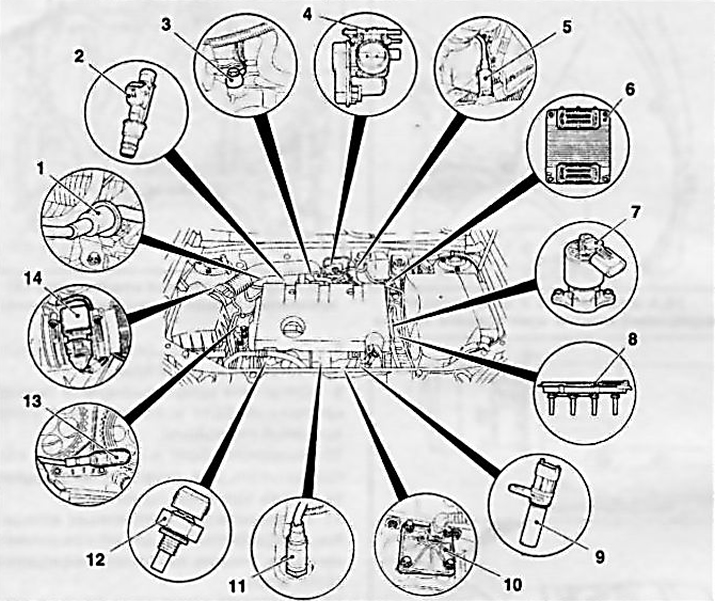
13.1 Sensors and modules of the engine management system (using the Z18XE engine as an example)
1 EVAP system valve
2 Fuel injection injector
3 Knock sensor
4 Throttle control module
5 Post-catalytic lambda probe
6 Electronic module of the engine management system
7 Exhaust gas regeneration system valve
8 Ignition module (DIS)
9 Crankshaft position sensor
10 Oil level control sensor
11 Pre-catalytic lambda probe
12 Coolant temperature sensor
13 Camshaft position sensor
14 Air mass sensor
2. The electronic engine management system provides the following capabilities:
- a) Accurate fuel dosing in any operating mode, which ensures low fuel consumption at high power;
- b) Reduction of toxic components in exhaust gases due to precise fuel metering and the use of a catalytic converter;
- c) Self-diagnosis of the engine management system provides the ability to quickly find a fault. One of the most important elements of the engine management system is the self-diagnosis subsystem. If during operation a failure of any of the system elements is detected, the corresponding fault code is entered into the ECM processor memory. Reading and identification of codes stored in memory (see Chapter 5) allows you to quickly identify and eliminate the cause of the failure.
3. The engine control unit (ECM) acts as the brain center and is equipped with a high-speed microprocessor. Based on the analysis of data continuously received from information sensors, the ECM determines the optimal injection moment and the required volume of fuel to be injected. Information processed by the transmission control modules and the engine immobilizer is also taken into account.
4. The engine management system elements maintain high performance for a long time and require virtually no maintenance. Only such system elements as the air filter and spark plugs require regular replacement during vehicle maintenance. Serious adjustment and repair work requires the use of complex diagnostic devices, which is why their implementation should be entrusted to service station specialists.
5. Adjustment of idle speed and carbon monoxide (CO) concentration is not required as part of maintenance.
Safety precautions when working with the engine management system
See also the list of safety measures provided in Section 1 this chapter.
6. Remember that the fuel inside the fuel system tract is under pressure when the engine is running and the ignition is on. Residual excess pressure continues to be retained in the system for some time after the ignition is turned off and must be released before disconnecting components/disconnecting nipple connectors!
7. Do not touch or disconnect the ignition system wiring while the engine/starter is running.
Warning: Persons with an implanted cardiac pacemaker must under no circumstances be allowed to service ignition system components!
Connecting and disconnecting measuring instruments must also be done with the ignition off.
Text was copied from the portal OPELBOOK
8. Disconnection of fuel lines must be carried out with the ignition off.
9. When performing work on checking the compression pressure in the cylinders (see Chapter 2) the ignition and fuel supply system must be switched off.
Engine Management System Test Guidelines
Attention: Malfunctions in the electronic control system can only be eliminated using special devices - any unprofessional intervention can lead to disruption of the system's functioning!
10. Before you start searching for the causes of failures using diagnostic devices, in order to exclude the influence of extraneous factors, it is necessary to check and fulfill the following conditions:
- There must be fuel in the tank;
- The engine must be mechanically sound;
- The battery is charged;
- The starter rotates at the required speed;
- The ignition system is in good working order;
- Leaks and contamination in the fuel system have been eliminated;
- The crankcase ventilation system is in good working order;
- The power unit is reliably grounded to the body ground.
Errors when starting the engine must be excluded - the correct sequence of the engine starting procedure is given in Chapter "Controls and operating techniques".
11. To determine the malfunction, it is necessary to connect to the diagnostic connector (see Chapter 5) a special device TESN-2 and output diagnostic codes from the ECM processor memory.
12. If after completing the search and elimination of the causes of failures the engine immediately stalls after starting, the cause of this phenomenon may be the blocking of the anti-theft system - query the processor memory, if necessary, adjust the corresponding control unit.
Twinport System
13. The models described in this Manual may be equipped with small-displacement engines with the Twinport system (see accompanying illustration). Air enters each engine cylinder through two air channels. One of the channels can be closed by a control valve by an ECM signal; the valve position is controlled by a drive rod from the vacuum regulator. When the channel is closed, a vortex flow of the air-fuel mixture is created, which allows lean mixtures to be used at low engine loads and when idling, thereby reducing overall fuel consumption.
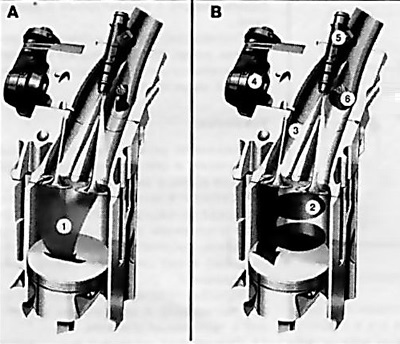
13.13 Twinport System (z14XEP engine)
A The control valve is open (at full load).
B The control valve is closed (when the engine is idling and when the vehicle is stopped).
1, 2 Direction of air-fuel mixture flow
3 Inlet ports
4 Vacuum regulator
5 Injector
6 Adjusting flap
Visitor comments