


Note: Depending on the model, the procedure for removing the tank may differ slightly from the one below, but these differences are not essential.
1. Release residual pressure in the fuel system (petrol models) (see Section 2). Disconnect the negative cable from the battery (see Chapter 5).
2. Before removing the fuel tank, it is necessary to remove all fuel from it. Since the manufacturers do not provide a drain plug, pump out the fuel with a special pump - be careful, there will still be some fuel left in the tank.
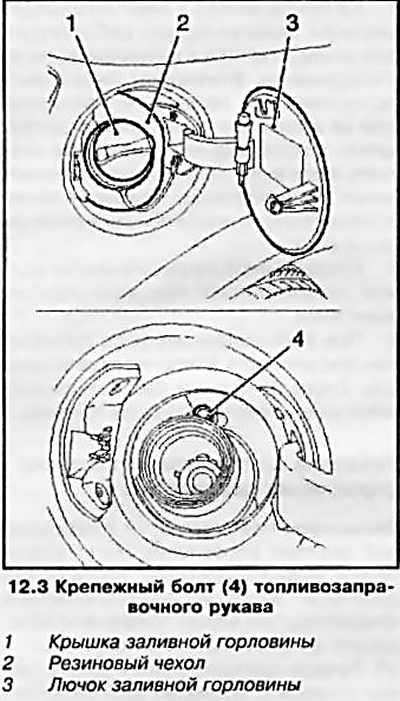
3. On petrol models, it is necessary to disconnect the filler neck from the car body, for which remove the cap and the rubber cover of the neck (see accompanying illustration), and unscrew the mounting bolt.
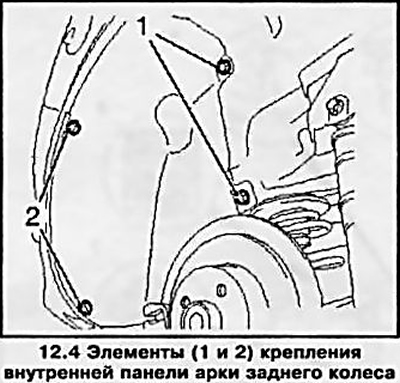
4. In addition, on petrol models it is necessary to remove the right rear wheel (see Chapter "Introduction") and, having unscrewed 2 bolts and 2 nuts, remove the inner panel of the wheel arch (see accompanying illustration).
5. Remove the exhaust system components (see Section 21).
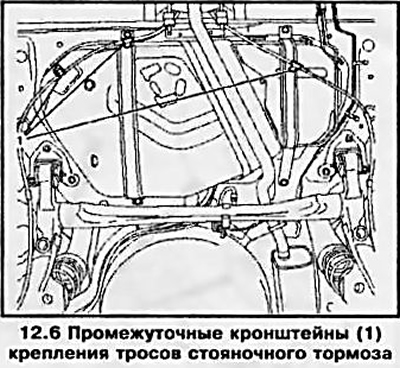
6. Release the parking brake cable from the intermediate brackets (see accompanying illustration) and clamps and move it away from the tank.
7. Disconnect the electrical wiring from the fuel pump assembly. Note: Wiring must be disconnected from underneath the vehicle.
8. Disconnect the fuel supply and return lines.
9. Loosen the clamp, unscrew the lower mounting bolt and disconnect the filler neck sleeve.
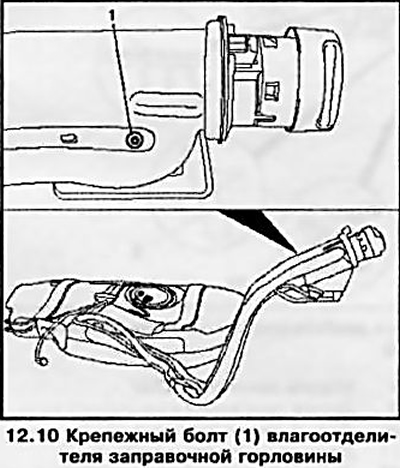
10. Remove the bolt and disconnect the moisture separator (see accompanying illustration) from the filler neck sleeve.
11. Support the tank with a trolley jack, first placing a piece of board on the head of the latter to distribute the load.
12. Unscrew the mounting bolts and remove the 2 mounting strips.
13. Gently lower and remove the fuel tank together with the filler neck sleeve, disconnect all supply lines from the tank.
14. If necessary, remove the fuel pump assembly from the tank (see Section 8) and a heat shield.
15. Installation is carried out in the reverse order of dismantling the components. Please note the following points:
- a) When installing the tank, the hoses laid above it must not be pinched;
- b) Mounting strips must be securely fastened in their places;
- c) All hoses and electrical connectors must be connected in the correct sequence and securely fastened;
16. Before your first ride, add a small amount of fuel to the tank and check for signs of developing leaks.
Visitor comments